
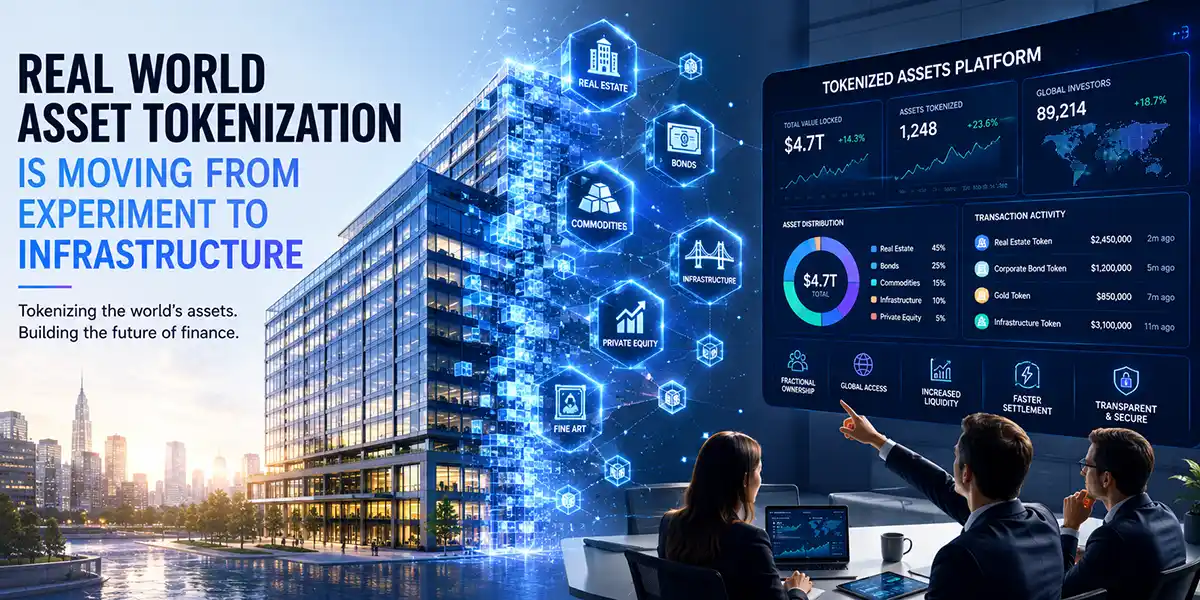
Real World Asset Tokenization Is Moving From Experiment to Infrastructure
For years, blockchain enthusiasts talked about a future where physical assets could be represented digitally on blockchain networks. While the concept sounded promising, many financial institutions viewed it as an experiment rather than a serious transformation of global finance.
That perception is changing rapidly.
Today, some of the world’s largest financial institutions are actively investing in Real World Asset Tokenization. What was once considered a blockchain innovation is increasingly becoming part of the future financial infrastructure that could reshape investing, ownership, and capital markets.
The shift signals an important milestone in the evolution of the future digital economy.
What Is Real World Asset Tokenization?
Real World Asset Tokenization is the process of converting ownership rights of physical or traditional financial assets into digital tokens recorded on a blockchain.
Each token represents a portion of ownership in an underlying asset. These tokens can then be bought, sold, transferred, or traded digitally.
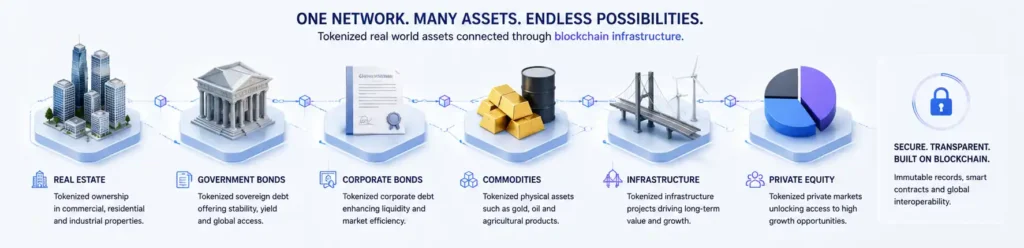
Examples of tokenized assets include:
- Real Estate
- Government Bonds
- Corporate Bonds
- Commodities
- Infrastructure Projects
- Private Equity
- Fine Art
- Collectibles
By bringing traditional assets onto blockchain networks, tokenization creates new opportunities for ownership, liquidity, and accessibility.
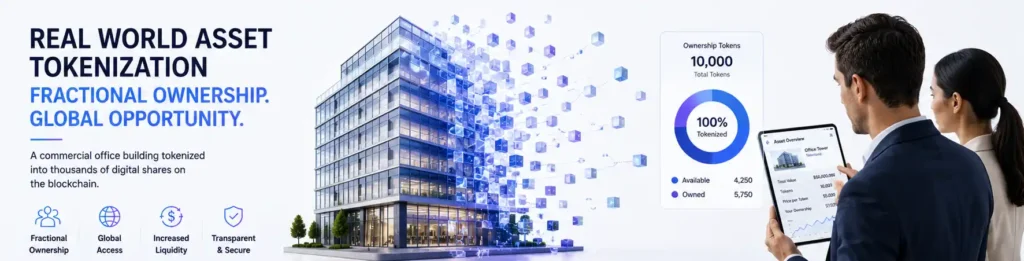
Why Real World Asset Tokenization Matters
The excitement surrounding Real World Asset Tokenization is driven by several significant advantages.
Fractional Ownership
Traditionally, investing in certain assets required substantial capital. Tokenization allows ownership to be divided into smaller units, making investments accessible to a broader audience.
Improved Liquidity
Assets that were previously difficult to trade can potentially be exchanged more efficiently through digital marketplaces.
Global Accessibility
Investors can access opportunities across geographic borders without many of the traditional barriers associated with international investing.
Faster Settlement
Blockchain networks can streamline ownership transfers and settlement processes, reducing delays that often exist in traditional markets.
Greater Transparency
Blockchain-based records provide a transparent and auditable ownership history that can improve trust and efficiency.
Why Major Financial Institutions Are Paying Attention
One of the strongest indicators that tokenization is becoming mainstream is the growing involvement of major financial institutions.
Leading asset managers, investment banks, and financial technology companies are increasingly exploring tokenized investment products and blockchain settlement systems.
These organizations are not pursuing tokenization simply because it is new technology. They see opportunities to improve efficiency, reduce costs, expand market access, and modernize financial infrastructure.
Many industry experts now view tokenization as one of the most important developments in capital markets since the transition from paper-based trading systems to digital platforms.
The Infrastructure Shift
The most significant trend is that Real World Asset Tokenization is moving beyond pilot projects and proof-of-concept demonstrations.
Financial institutions are increasingly building infrastructure designed to support tokenized assets at scale.
This includes:
- Tokenized treasury products
- Tokenized money market funds
- Blockchain settlement networks
- Digital asset custody solutions
- Institutional trading platforms
- Smart contract-based financial products
As these systems mature, tokenization could become a foundational layer of future financial markets.
Challenges Facing Real World Asset Tokenization
Despite its potential, several challenges remain.
- Regulatory uncertainty
- Custody and security requirements
- Interoperability between blockchain networks
- Market education and adoption
- Legal frameworks for digital ownership
Many of these challenges are being addressed through collaboration between regulators, financial institutions, and technology providers.
What Businesses and Investors Should Watch
Organizations should pay close attention to developments in tokenized financial products, digital asset regulations, institutional blockchain adoption, and emerging tokenization platforms.
The businesses that understand these changes early may be better positioned to participate in new forms of investment, ownership, and capital formation.
Conclusion
Real World Asset Tokenization is no longer simply a blockchain experiment. It is increasingly becoming a core part of the infrastructure being built for the future of finance.
By bringing traditional assets onto blockchain networks, tokenization has the potential to create more accessible, efficient, transparent, and global financial markets. While challenges remain, the direction is becoming increasingly clear: tokenization is moving from innovation to infrastructure.
Continue Exploring the Future Digital Economy
Discover more insights into blockchain, digital ownership, Web3, future finance, and the technologies transforming how people invest, own, and create value in a digital world.
About the Author
Curtis Randall is an award-winning creative executive and future systems thinker helping people and businesses understand the future of work, technology, digital ownership, and creativity. Through CurtisRandall.com, and Sights.com, Curtis explores the systems shaping how people work, create, own, and build value in a rapidly changing world.
Connect with Curtis: LinkedIn · YouTube · Instagram · X · TikTok · Facebook · Threads
Want the Complete AI Video Marketing System?
The AI Video Marketing Kit for Creators gives you prompts, scripts, planners, affiliate video templates, course promo workflows, and repurposing tools to turn your ideas into useful video content faster.