
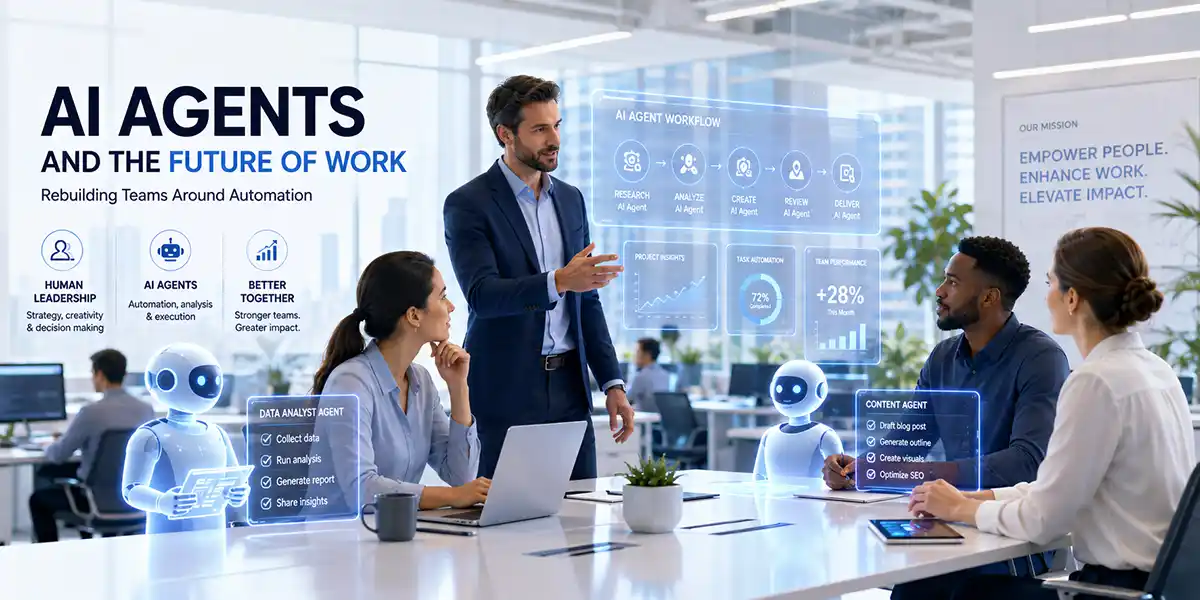
AI Agents the Future of Work: Why Companies Are Rebuilding Teams Around Automation
The future of work is changing faster than many organizations expected. While much of the public conversation around artificial intelligence has focused on job replacement, a different trend is emerging inside businesses. Companies are increasingly adopting AI Agents and the Future of Work not to replace entire teams, but to redesign how work gets done.
This shift represents one of the most significant workplace transformations of the digital economy. Instead of relying solely on human workers to perform every task, organizations are beginning to build hybrid teams where people and AI agents work together.
What Are AI Agents?
AI agents are more advanced than traditional AI tools. While a tool typically performs a single task when prompted, an AI agent can take an objective, make decisions, perform multiple actions, and coordinate workflows with minimal supervision.
Modern AI agents can conduct research, analyze data, generate reports, create content, manage workflows, monitor systems, and automate repetitive tasks.
As these capabilities improve, businesses are finding new ways to integrate AI agents into everyday operations.
Why Businesses Are Adopting AI Agents and the Future of Work
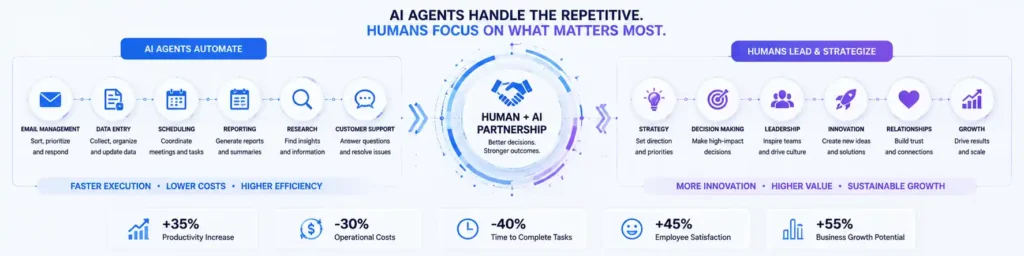
Organizations face increasing pressure to improve productivity while managing costs and growing customer expectations. AI agents help address these challenges by automating repetitive work and supporting faster decision-making.
Increasing Productivity
AI agents can complete repetitive administrative tasks faster than traditional manual processes, freeing employees to focus on strategic and creative responsibilities.
Reducing Operational Costs
Automation reduces the time spent on routine work, allowing organizations to scale output without increasing complexity at the same pace.
Improving Scalability
Businesses can expand operations more efficiently when AI agents manage repeatable processes, data analysis, reporting, and workflow coordination.
The Rise of Agentic Workflows
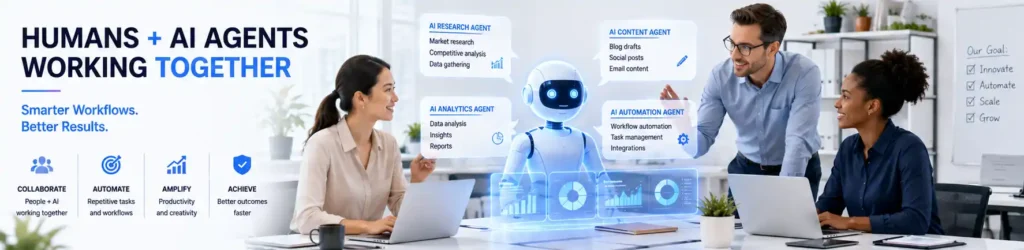
One of the most important trends in business today is the emergence of agentic workflows. These workflows combine human expertise with AI-powered execution.
A modern marketing department, for example, may include human strategists, creative leaders, AI research agents, AI content agents, and AI analytics agents. Each contributes to the overall process while focusing on different strengths.
This model is increasingly appearing across finance, operations, customer support, software development, and content creation.
Jobs Are Changing, Not Disappearing
History shows that technology often changes jobs rather than eliminating work entirely. AI agents are automating routine and repetitive activities, but they are also increasing demand for uniquely human skills.
- Critical thinking
- Leadership
- Creativity
- Emotional intelligence
- Strategic planning
- Relationship building
The most valuable employees will increasingly be those who can effectively collaborate with intelligent systems.
New Careers Emerging in the AI Economy
As AI adoption grows, entirely new career paths are beginning to emerge. These roles focus on helping organizations integrate AI into their operations while maximizing human productivity.
- AI Workflow Designer
- AI Operations Manager
- AI Strategy Consultant
- AI Systems Trainer
- Human-AI Collaboration Specialist
What Businesses Should Do Now
Companies preparing for the future of work should begin by identifying repetitive processes that can be automated. From there, they can test AI agents on low-risk workflows, build human-AI collaboration systems, invest in employee upskilling, and focus on augmentation rather than replacement.
Organizations that embrace this transition early are likely to gain significant competitive advantages.
Conclusion
The future of work is not a battle between humans and machines. It is a partnership.
AI agents are becoming valuable digital teammates that handle repetitive tasks, process information, and improve efficiency. Human workers continue to provide strategy, creativity, leadership, and judgment.
The companies that succeed in the next decade will be those that build the strongest collaboration between people and intelligent systems.
Continue Exploring the Future Digital Economy
Discover more insights into artificial intelligence, future work, digital ownership, blockchain, Web3, creator business models, and the technologies reshaping how people build value in the digital economy.

About the Author
Curtis Randall is an award-winning creative executive and future systems thinker helping people and businesses understand the future of work, technology, digital ownership, and creativity. Through CurtisRandall.com, and Sights.com, Curtis explores the systems shaping how people work, create, own, and build value in a rapidly changing world.
Connect with Curtis: LinkedIn · YouTube · Instagram · X · TikTok · Facebook · Threads
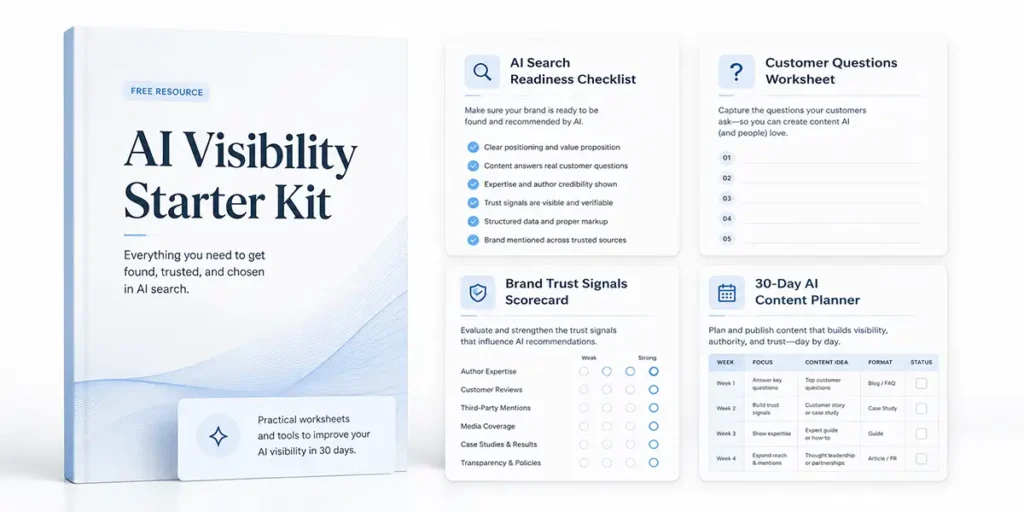
Want to Improve Your AI Visibility?
Download the free AI Visibility Starter Kit from Sights.com and start improving your content clarity, customer questions, trust signals, and AI search readiness.