
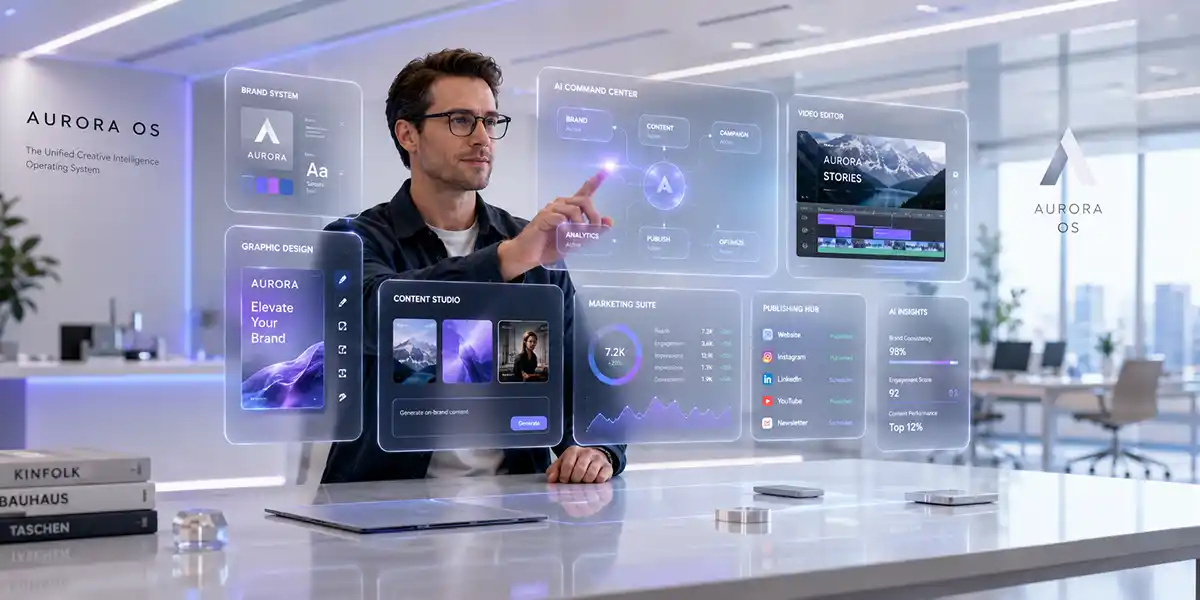
The Rise of the AI Creative Operating System: Why Individual Tools Are No Longer Enough
For decades, creative professionals have built their workflows around collections of individual software applications.
A designer might move between Photoshop, Illustrator, and After Effects. A marketer might switch from a writing tool to a presentation app, then into a social media scheduler before finally checking analytics. Video creators often bounce between editing software, audio tools, animation platforms, and publishing systems.
This fragmented approach has become the accepted way of working.
Artificial intelligence is changing that.
Rather than adding AI as another feature inside existing applications, the creative industry is beginning to build something much larger: AI Creative Operating Systems.
Instead of helping you complete a single task, these intelligent environments are designed to assist with the entire creative process—from planning and design to production, publishing, optimization, and analysis.
The future of creative work may no longer be defined by the individual tools we use, but by the intelligent systems that connect them.
The Problem with Traditional Creative Workflows
Creative work has never been limited by imagination.
It has been limited by process.
A typical content project often involves:
- Researching ideas
- Writing copy
- Designing graphics
- Editing images
- Producing video
- Creating social media assets
- Scheduling content
- Measuring performance
Each step usually requires a different application, different file formats, and constant switching between platforms.
While each tool may excel at a specific task, the overall workflow often becomes slow, repetitive, and fragmented.
This is where AI is beginning to make its biggest impact.
What Is an AI Creative Operating System?
An AI Creative Operating System is not a single application.
It is an intelligent creative environment that connects multiple creative disciplines into one continuous workflow.
Rather than asking AI to generate one image or write one paragraph, creators can increasingly work with systems capable of understanding an entire creative brief.
Imagine providing a single prompt such as:
“Launch a new sustainable travel brand aimed at young professionals.”
Instead of producing only text, the AI could help generate:
- Brand positioning
- Messaging
- Logo concepts
- Colour palettes
- Marketing copy
- Social media campaigns
- Promotional videos
- Presentation decks
- Website content
- Advertising variations
All while maintaining consistent branding and adapting content for different platforms.
The role of AI shifts from tool to collaborator.
From Applications to Intelligent Workflows
One of the biggest changes happening across the creative industry is the movement away from isolated software toward connected workflows.
Modern AI platforms are increasingly capable of sharing context across multiple creative tasks.
A brand voice established during copywriting can automatically influence social media captions.
Design styles can remain consistent across presentations, videos, and advertising.
Marketing campaigns can be adapted for different audiences without recreating every asset manually.
Instead of constantly moving files between applications, creators begin working inside one intelligent production environment.
The technology disappears into the workflow.
The Benefits for Creative Teams
AI Creative Operating Systems offer more than speed.
They change how teams collaborate.
Some of the most significant advantages include:
Faster Production
Routine production tasks can be completed in minutes rather than hours.
Greater Consistency
Brand colours, messaging, typography, tone of voice, and design systems remain consistent across every piece of content.
Improved Collaboration
Designers, marketers, writers, and video producers can work from the same creative brief rather than isolated documents.
Better Personalisation
AI makes it easier to create multiple variations of campaigns for different audiences without rebuilding every asset from scratch.
More Time for Creativity
Perhaps the greatest benefit is that creative professionals spend less time repeating production tasks and more time developing ideas.
The Human Role Becomes More Important
Whenever new technology automates production, concerns about job displacement naturally follow.
History suggests something different.
Desktop publishing changed graphic design.
Digital cameras transformed photography.
Video editing software changed filmmaking.
The internet changed publishing.
In every case, technology automated parts of the production process while increasing the importance of creativity, strategy, and communication.
Artificial intelligence follows the same pattern.
As AI becomes better at execution, human value shifts toward:
- Creative direction
- Strategic thinking
- Storytelling
- Brand leadership
- Customer understanding
- Creative judgement
The future belongs to professionals who can combine human imagination with AI efficiency.
Building the Creative Teams of Tomorrow
The creative teams of the future may look very different from those of today.
Instead of expanding production departments, organisations may build smaller teams supported by intelligent AI systems.
Creative professionals will increasingly act as directors rather than operators.
Their role will be to define the vision, guide the process, evaluate the output, and ensure every piece of content supports the broader brand strategy.
AI becomes the production engine.
Humans remain responsible for purpose, originality, and meaning.
Looking Ahead
The evolution toward AI Creative Operating Systems is still in its early stages, but the direction is becoming increasingly clear.
Rather than managing dozens of disconnected applications, future creators may work inside unified intelligent environments capable of planning, producing, publishing, and improving content continuously.
Success will depend less on mastering individual software tools and more on understanding how to orchestrate intelligent creative workflows.
Those who embrace this shift will be better positioned to create faster, collaborate more effectively, and focus on what technology cannot replace—human creativity.
Conclusion
Artificial intelligence is reshaping more than individual creative tasks.
It is redefining how creative work happens.
The rise of AI Creative Operating Systems marks a transition from disconnected software to connected intelligence, where design, marketing, video, branding, and content creation become part of a single creative ecosystem.
The future of creativity will not be built around more tools.
It will be built around better systems.
And the professionals who learn to lead those systems will help shape the next generation of the Future Digital Economy.
Continue Exploring the Future Digital Economy
Explore more insights into artificial intelligence, creative technology, branding, digital marketing, future work, and the innovations transforming how businesses create value in the digital age.

About the Author
Curtis Randall is an award-winning creative executive and future systems thinker helping people and businesses understand the future of work, technology, digital ownership, and creativity. Through CurtisRandall.com, and Sights.com, Curtis explores the systems shaping how people work, create, own, and build value in a rapidly changing world.
Connect with Curtis: LinkedIn · YouTube · Instagram · X · TikTok · Facebook · Threads