
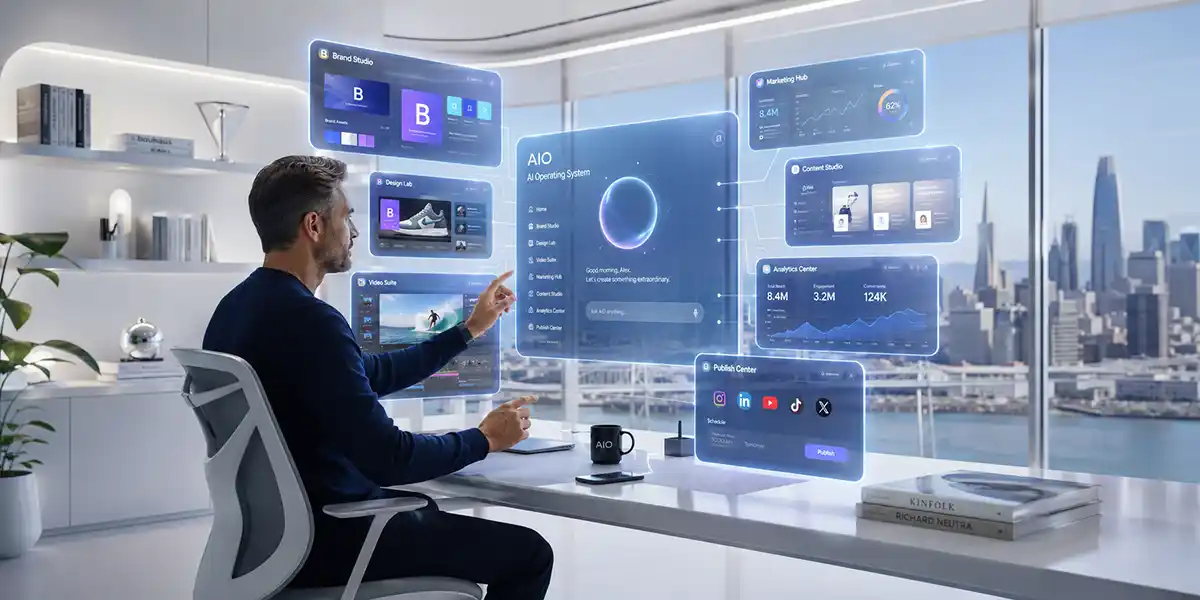
The Rise of the AI Creative Operating System: Why Individual Tools Are No Longer Enough
For decades, creative professionals have relied on a collection of individual software applications to produce their work. Designers moved between Photoshop and Illustrator. Video editors switched between editing software, audio tools, animation platforms, and publishing applications. Marketers managed separate tools for writing, email, analytics, social media, and advertising.
Each application solved a specific problem, but the creative process itself remained fragmented. Every project required constant switching between tools, file formats, and workflows.
Artificial intelligence is changing that model. Rather than adding AI as another feature inside existing applications, the industry is moving toward something much larger: the AI Creative Operating System.
Instead of helping creators complete individual tasks, these intelligent systems are beginning to connect the entire creative process—from research and strategy to design, video production, publishing, optimization, and performance analysis.
The End of Fragmented Creative Workflows
Creative work has always involved more than creativity. It also involves process.
A modern marketing campaign typically requires multiple stages:
- Research and audience analysis
- Creative strategy
- Brand messaging
- Graphic design
- Video production
- Website creation
- Social media content
- Email marketing
- Publishing and distribution
- Performance reporting
Historically, every stage required different software. The result was slower production, duplicated effort, and constant context switching between applications.
AI is beginning to eliminate many of these workflow barriers.
What Is an AI Creative Operating System?
An AI Creative Operating System is more than a creative application with AI features. It is an intelligent environment capable of understanding a project from beginning to end.
Imagine providing a single creative brief:
“Launch a new sustainable travel brand aimed at young professionals.”
Rather than generating only a logo or a paragraph of text, an AI Creative Operating System could assist with:
- Brand positioning
- Messaging and copywriting
- Visual identity concepts
- Website layouts
- Marketing campaigns
- Social media content
- Video storyboards
- Presentation decks
- Advertising variations
- Content publishing
Every asset remains connected through a single workflow while maintaining consistent branding, messaging, and creative direction.
From Creative Tools to Creative Systems
The shift happening today is not simply about AI creating faster. It is about AI connecting creative disciplines into one intelligent ecosystem.
Instead of isolated software applications, future creators will increasingly work inside connected environments where information flows naturally between design, marketing, branding, video production, and publishing.
These systems understand context, remember previous work, maintain brand consistency, and automate repetitive production tasks while allowing humans to remain in creative control.
Why This Matters for Marketing Teams
Marketing teams are under constant pressure to produce more content across more channels than ever before.
An AI Creative Operating System helps solve this challenge by enabling teams to:
- Create campaigns faster.
- Maintain brand consistency.
- Generate multiple content variations.
- Personalize messaging for different audiences.
- Reduce repetitive production work.
- Focus more time on strategy and customer experience.
The result is not simply greater efficiency—it is better marketing.
The Human Role Becomes More Important
Whenever technology automates production, there are concerns that creativity will become less valuable. History suggests the opposite.
As AI becomes better at generating assets, human value shifts toward:
- Creative direction
- Storytelling
- Brand strategy
- Customer understanding
- Creative judgment
- Quality control
The future creative professional is becoming less of a production operator and more of a creative director—guiding intelligent systems to produce exceptional work.
Looking Ahead
The rise of the AI Creative Operating System represents a fundamental shift in how creative work is organised. Rather than mastering dozens of disconnected applications, future professionals will increasingly orchestrate intelligent workflows that connect every stage of the creative process.
The tools themselves will become less important than the systems that connect them.
Businesses that embrace these integrated workflows will create content faster, collaborate more effectively, and deliver stronger customer experiences while allowing creative teams to focus on what technology cannot replace: imagination, strategy, and original thinking.
Conclusion
Artificial intelligence is no longer just another creative tool. It is becoming the operating system that connects design, branding, marketing, video production, publishing, and analytics into one intelligent workflow.
The organisations that succeed in the next decade will not necessarily own the most software. They will build the smartest creative systems—and empower people to lead them.
Continue Exploring the Future Digital Economy
Explore more articles on artificial intelligence, creative technology, future work, digital marketing, branding, and the innovations transforming the Future Digital Economy.

About the Author
Curtis Randall is an award-winning creative executive and future systems thinker helping people and businesses understand the future of work, technology, digital ownership, and creativity. Through CurtisRandall.com, and Sights.com, Curtis explores the systems shaping how people work, create, own, and build value in a rapidly changing world.
Connect with Curtis: LinkedIn · YouTube · Instagram · X · TikTok · Facebook · Threads