
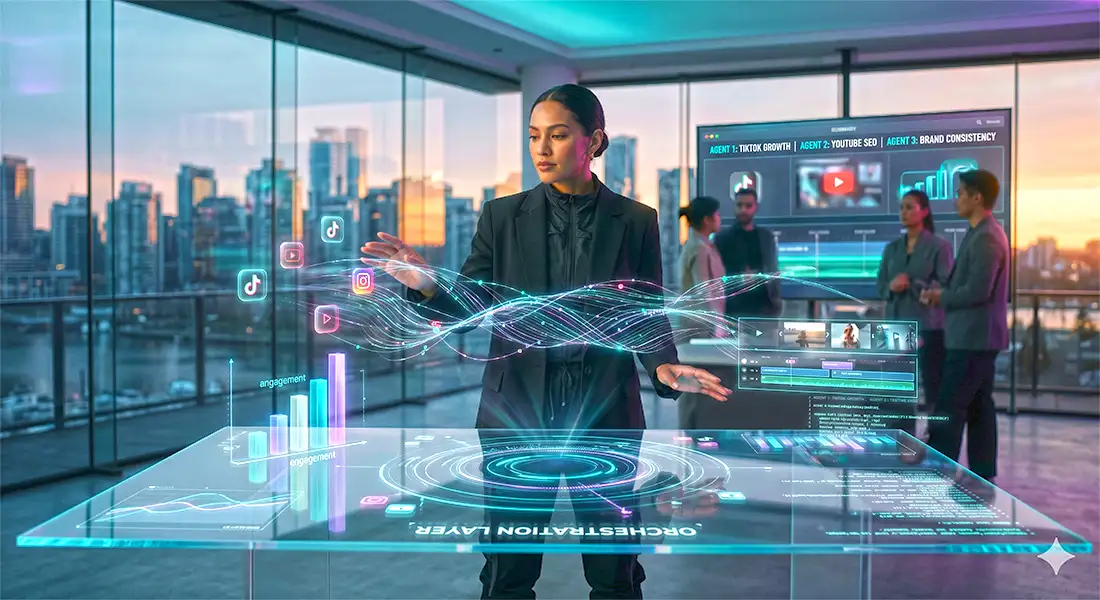
Why Digital Marketing is Moving From “Prompting” to “Orchestrating”
In the rapid evolution, of digital media, we have officially moved past the “Chatbot Era”, and entered ‘The Age of the AI Agent‘. For the last few years, creators and marketers used AI as a reactive tool—you typed a prompt, and it gave you a response. But as we navigate the landscape of 2026, the paradigm has shifted. At Sights.com, we are seeing the rise of Agentic Workflows: a world where AI doesn’t just assist; it executes autonomously.
What is an AI Agent?
Unlike standard generative AI, an AI Agent is designed to achieve a goal rather than just complete a single task. In the context of branding and digital marketing, this means moving from “Write me a caption” to “Manage my brand’s social media presence for the next 30 days.” An agent can research current trends, generate visual assets, draft copy, schedule posts, and even adjust the strategy based on real-time engagement data.
The Shift: From Creator to Orchestrator
For the modern creative professional, this evolution changes the job description fundamentally. We are no longer just making content; we are orchestrating intelligence. This is particularly relevant for those managing diverse digital assets across multiple platforms like YouTube and TikTok.
- Strategic Direction: Instead of spending hours on video editing, creators now act as directors, setting the creative vision and allowing AI agents to handle the technical assembly of 12K high-resolution footage.
- Brand Consistency: AI agents can act as “Brand Guardians,” ensuring that every piece of marketing collateral—from a luxury skincare proposal to a technical streetwear drop—adheres to a predefined visual and tonal identity.
- Scalability: One person can now manage an entire media group by deploying specific agents for client acquisition, content production, and community management.

Case Study: The “Momentum Rhythm” Strategy
Look at the rebranding of a music-focused channel to Momentum Rhythm. In the old model, a creator would manually search for music, edit visuals, and write descriptions for every video. In the 2026 agentic model, a creator defines five content pillars—Morning Energy, Motivation, Deep Focus, Creative Flow, and Rebuild.
An AI agent can then be tasked to: 1. Scan for royalty-free tracks that match the “Deep Focus” frequency. 2. Sync these tracks with AI-generated visuals that align with a minimalist brand aesthetic. 3. Generate optimized metadata in multiple languages, including Chinese, to capture a global audience.
The Impact on Digital Marketing Agencies
For agencies like Que Media, the implementation of “Client Acquisition Agents” is a game-changer. These agents can automate the intake process, generating professional pitch packages and 30-day content calendars in minutes rather than days. This allows the human leads to focus on high-level relationship building and creative “big ideas” that a machine cannot replicate.
The Future of Sights.com
As we continue to explore these technologies, the goal isn’t to replace the human element of creativity. It’s to amplify it. By offloading the “grind” of content production to autonomous agents, we free ourselves to explore more ambitious projects—whether that’s designing functional techwear for creators or planning high-end residential extensions with modern architectural aesthetics.
The “Age of the Agent” is here. It’s time to stop typing prompts and start building systems.
Stay tuned to Sights.com tomorrow as we explore “The Creative Tipping Point” and how to maintain a competitive edge when AI can produce 80% of standard creative work.
Want to Improve Your AI Visibility?
Download the free AI Visibility Starter Kit from Sights.com and start improving your content clarity, customer questions, trust signals, and AI search readiness.