

When Everyone Can Create AI Content, Brand Governance Becomes Essential
AI content creation is no longer limited to the marketing department.
Sales teams can use AI to draft outreach emails. Customer support teams can use AI to write help articles. Product teams can use AI to explain features. Executives can use AI to draft thought leadership posts. HR teams can use AI to write employer branding content. Freelancers, agencies, and internal teams can all use AI to generate social posts, landing page copy, video scripts, email campaigns, and product messaging.
That is powerful.
It also creates a new brand risk.
When everyone inside a company can create content quickly, the brand can become inconsistent just as quickly. Different voices, different claims, different visuals, different standards, and different interpretations of the brand can all appear in public-facing content.
That is why AI content governance is becoming essential.
Why This Topic Is Timely
AI tools are spreading content creation across entire organizations. Shopify’s recent AI marketing statistics report notes that by the end of 2026, generative AI and creative tools are expected to put content creation directly into the hands of employees across organizations, with two-thirds of all AI-created marketing content happening outside centralized content teams.
This is a major shift for brands. Content creation is becoming more democratized, but brand control is becoming more complicated.
The trend is also visible in small business adoption. The Associated Press reported that a U.S. Chamber of Commerce and Teneo survey found that nearly all small businesses use AI-enabled tools, and many are already using generative AI tools for tasks such as chatbots and image creation. The same report noted that human oversight remains important for maintaining quality. Associated Press
AI is no longer a side experiment. It is becoming part of everyday business work. That means brand governance needs to catch up.
The New Reality: Content Creation Is Spreading
In the past, most public-facing content came through a smaller group of people. Marketing, communications, PR, creative, or agency teams usually handled the brand’s voice and message.
AI changes that.
Now almost anyone in the company can draft content with a prompt. That can increase speed, but it also reduces the natural control that used to exist when content creation was more centralized.
A sales person might use AI to create a one-page pitch. A customer success manager might create a tutorial. A recruiter might write a LinkedIn post. A product manager might draft launch messaging. A CEO might generate a blog post. A regional team might create local campaign copy.
Each piece of content may seem small.
Together, they shape the brand.
The Problem Is Not More People Creating Content
More people creating content can be a good thing.
Employees outside marketing often have valuable knowledge. Sales teams understand objections. Customer support teams know common questions. Product teams know features deeply. Executives can explain vision. Operations teams understand the customer experience.
AI can help turn that knowledge into useful content.
The problem is not participation.
The problem is unmanaged participation.
Without guidance, AI content can quickly become inconsistent, inaccurate, exaggerated, off-brand, or confusing.
What Can Go Wrong Without AI Content Governance
When AI content is created without guardrails, several issues can appear.
1. Inconsistent brand voice
One team may sound formal. Another may sound casual. Another may sound overly promotional. Another may sound generic. Over time, the brand becomes harder to recognize.
2. Unapproved claims
AI can produce confident statements that are not accurate, approved, or legally safe. This is especially risky in industries involving finance, health, education, technology, legal services, or regulated products.
3. Mixed messaging
Different teams may describe the product, service, audience, or value proposition in different ways. That creates confusion for customers.
4. Visual inconsistency
AI image tools can generate visuals in many styles. Without a visual standard, the brand may look different across every channel.
5. Weak content quality
AI can make content sound polished even when the idea is shallow. Without review, brands may publish content that adds noise instead of value.
6. Disclosure and trust issues
Some AI-assisted content may require disclosure or extra care, especially if synthetic media, fake testimonials, AI-generated people, or manipulated visuals are involved.
These risks do not mean companies should stop using AI. They mean companies need better rules.
What Is AI Content Governance?
AI content governance is the system a brand uses to guide, review, approve, and manage AI-assisted content.
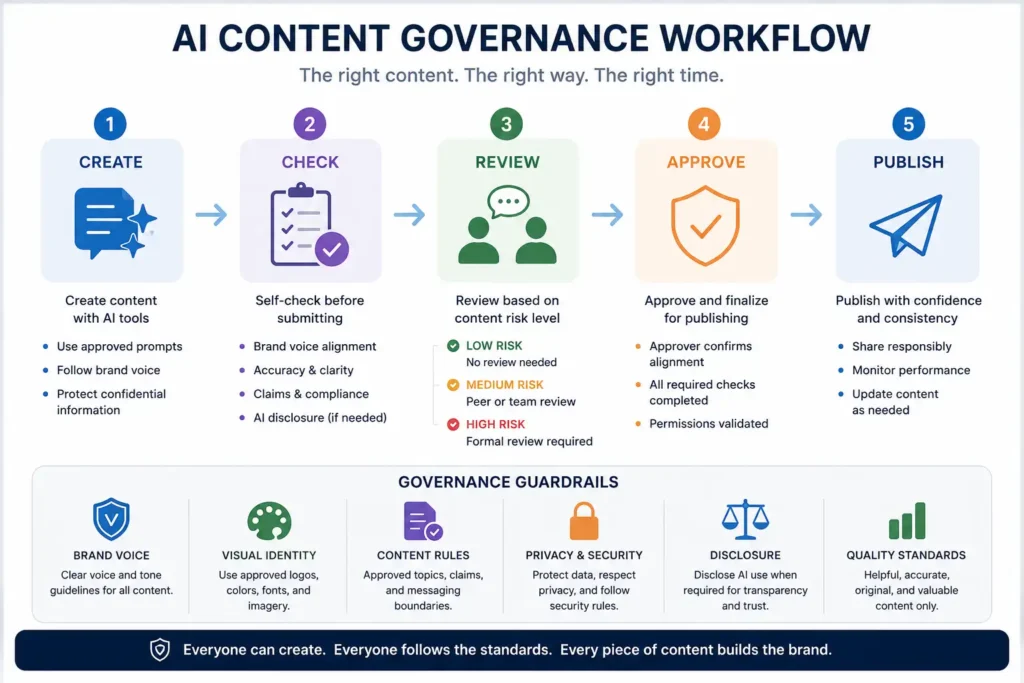
It helps answer practical questions:
- Who is allowed to create content with AI?
- What tools are approved?
- What prompts should people use?
- What brand voice should content follow?
- What claims are allowed or not allowed?
- What content requires review before publishing?
- What content can be published without approval?
- When should AI use be disclosed?
- How should content quality be checked?
The goal is not to create bureaucracy. The goal is to protect trust while still allowing teams to move faster.
Governance Should Be Lightweight, Not Heavy
Many businesses hear the word governance and think it means slow approvals, long documents, and complicated processes.
It does not have to.
For most brands, especially smaller businesses, AI content governance can be simple.
Start with a lightweight system:
- A one-page brand voice guide
- A list of approved content topics
- A list of claims that require approval
- A few reusable AI prompts
- A simple review checklist
- A rule for when content needs human approval
- A policy for synthetic images, fake people, and AI-generated testimonials
This gives people enough structure to create safely without slowing everything down.
The Three Levels of AI Content Review
One useful approach is to create review levels.
Not every piece of content needs the same approval process. A short internal draft is different from a public ad. A customer support note is different from a legal claim. A social caption is different from an AI-generated video using a person’s likeness.
Brands can use three simple levels.
Level 1: Low-risk content
This might include internal drafts, brainstorming documents, early outlines, meeting summaries, or unpublished ideas.
These can usually be created freely, as long as confidential information is protected.
Level 2: Medium-risk content
This might include social posts, blog drafts, newsletters, product explanations, and public-facing educational content.
These should be checked for brand voice, accuracy, clarity, and usefulness before publishing.
Level 3: High-risk content
This includes paid ads, legal claims, financial claims, health claims, synthetic media, testimonials, influencer content, executive statements, and anything involving likeness, privacy, or compliance.
This content should require formal review before publishing.
This simple structure helps teams move quickly while still protecting the brand where the risk is highest.

Brand Voice Guidelines Become More Important
AI can generate content in almost any tone. That makes brand voice guidelines more important, not less.
Your team should know how the brand sounds.
For example, is the brand:
- Professional or casual?
- Bold or reassuring?
- Simple or technical?
- Inspirational or practical?
- Conversational or formal?
A useful voice guide should also include examples.
Instead of only saying, “We sound helpful,” show what helpful looks like. Give sample intros, headlines, social captions, email openings, and calls to action.
Then turn those guidelines into AI instructions.
Approved Prompts Can Protect the Brand
One of the easiest ways to improve AI content governance is to create approved prompts.
Instead of letting everyone write their own prompt from scratch, give teams templates that include brand direction.
For example:
Content draft prompt:
Create a clear, helpful draft for [audience] about [topic]. Use a professional but accessible tone. Avoid exaggerated claims. Keep the message aligned with our brand pillars: [pillar 1], [pillar 2], [pillar 3]. End with a practical next step.
Social post prompt:
Write three social media post options for [platform] promoting [topic]. Use our brand voice: practical, clear, optimistic, and human. Avoid hype. Include one useful takeaway and one call to action.
Review prompt:
Review this content for brand consistency, clarity, accuracy, tone, and trust. Flag any unsupported claims, vague language, or statements that may require approval.
Approved prompts help teams create faster while staying aligned.
AI Content Governance Also Protects Employees
Governance is not only about protecting the company. It also protects employees.
Without clear rules, employees may not know what is safe to publish. They may accidentally use confidential information in an AI tool. They may publish content with unapproved claims. They may create visuals that do not meet brand or legal standards.
Clear rules reduce uncertainty.
Employees should know:
- Which AI tools they can use
- What information they should never enter into AI tools
- What content needs approval
- Who reviews high-risk content
- How to disclose AI use when required
That clarity helps people use AI with more confidence.
The Role of Marketing Changes
As AI content creation spreads across the organization, marketing’s role changes.
Marketing is no longer only the team that creates content.
Marketing becomes the team that enables the organization to create better content.
That means building systems, templates, prompts, brand guidelines, content libraries, review workflows, and training.
In this model, marketing becomes a brand governance hub.
It helps teams across the company communicate in a way that is accurate, useful, and aligned.
What This Means for Small Businesses
Small businesses may not have departments, but the same issue still applies.
A small business owner might use AI for website copy, ads, emails, social posts, customer replies, product descriptions, and sales materials. A freelancer or virtual assistant may also help create content. Without a simple brand system, the business can still become inconsistent.
Small businesses should create basic guardrails early.
That might include:
- A brand voice paragraph
- A list of approved offers
- A simple product description
- A few reusable content prompts
- A rule that all public content is reviewed before posting
- A folder of approved images, logos, and colors
This does not take long, but it can make every AI-assisted content asset stronger.
Trust Is the Point
The point of AI content governance is not control for the sake of control.
The point is trust.
Customers trust brands that communicate clearly. They trust brands that are consistent. They trust brands that do not exaggerate. They trust brands that feel recognizable across every touchpoint.
AI can help teams create faster, but speed without trust is not a strategy.
Governance makes speed safer.
How to Start This Week
If your business is already using AI content tools, start with a simple audit.
- List where AI is being used today.
- Identify who is creating content with AI.
- Review what types of content are public-facing.
- Write a one-page brand voice guide.
- Create three approved prompts.
- Define what content needs approval.
- Build a simple checklist for content review.
You do not need a perfect governance system to begin. You need a practical one.
Final Thoughts
AI is making content creation faster and more accessible across entire organizations.
That is a major opportunity. It allows more people to contribute ideas, share knowledge, and support marketing efforts.
But when everyone can create AI content, brand governance becomes essential.
Without guardrails, brands risk inconsistency, inaccurate claims, weak quality, visual confusion, and trust problems.
With the right system, AI can help more people create useful, on-brand, trustworthy content.
The future of content is not just about who can create more.
It is about who can create with clarity, consistency, and trust.
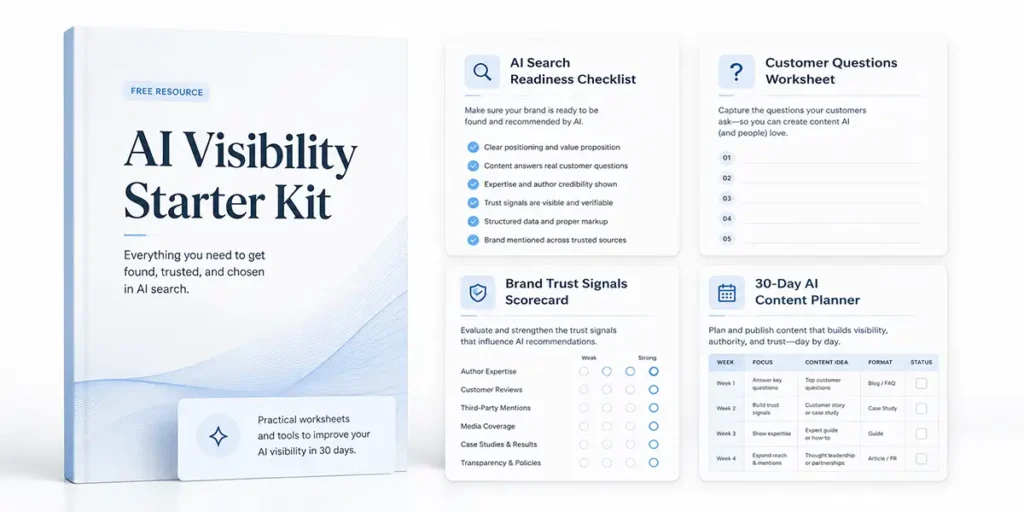
Want to Improve Your AI Visibility?
Download the free AI Visibility Starter Kit from Sights.com and start improving your content clarity, customer questions, trust signals, and AI search readiness.