
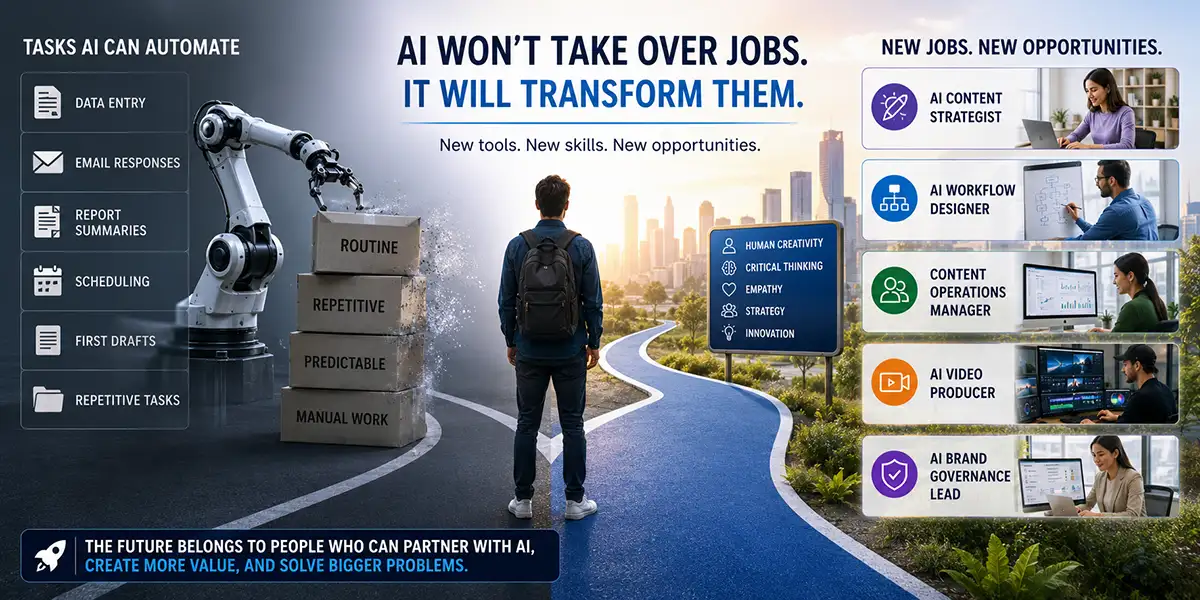
AI May Not Take Your Job — But Someone Using AI Might Create the Next One
The conversation around AI and jobs is usually framed as a threat.
Will AI take my job? Will companies replace people with software? Will entry-level roles disappear? Will creative work become automated? Will the next generation have fewer opportunities?
Those are real questions, and they should not be dismissed.
AI is already changing the workplace. It can write, summarize, design, code, edit, analyze, respond, generate visuals, create video concepts, and automate repetitive tasks. Some roles will absolutely be pressured. Some tasks will disappear. Some companies will use AI to reduce headcount.
But that is not the whole story.
Technology does not only remove work. It also redesigns work. It creates new needs, new workflows, new businesses, new roles, and new skills.
That is why the better question is not simply, “Will AI take my job?”
The better question is, “What new work becomes valuable when AI changes the old work?”
That is where AI job creation becomes an important part of the future-of-work conversation.
Why This Topic Is Timely
The AI jobs debate is active because the data points in more than one direction.
On one side, there are clear concerns about disruption. Some companies are already restructuring work around AI, and entry-level roles are under pressure in areas such as marketing, finance, law, software development, administration, and customer service. A World Economic Forum briefing on AI and entry-level jobs found that early-career workers are more curious and excited about AI than worried overall, but the report also makes clear that young workers are navigating a fast-changing and uncertain labor market. World Economic Forum
On the other side, major labor research suggests that AI may transform many jobs more than fully replace them. The International Labour Organization’s 2025 update on generative AI and jobs uses task-level analysis to measure occupational exposure, emphasizing that the effect of generative AI depends on the tasks inside a job, not just the job title itself. International Labour Organization
The International Monetary Fund has also focused on new job creation in the AI age. A 2026 IMF staff discussion note argues that demand for new skills, especially IT and AI skills, is reshaping hiring and wages, with new skills appearing in job vacancies and affecting labor markets differently across advanced and emerging economies. International Monetary Fund
In other words, the future is not as simple as “AI destroys jobs” or “AI creates unlimited opportunity.” The more realistic answer is that AI changes the shape of work.
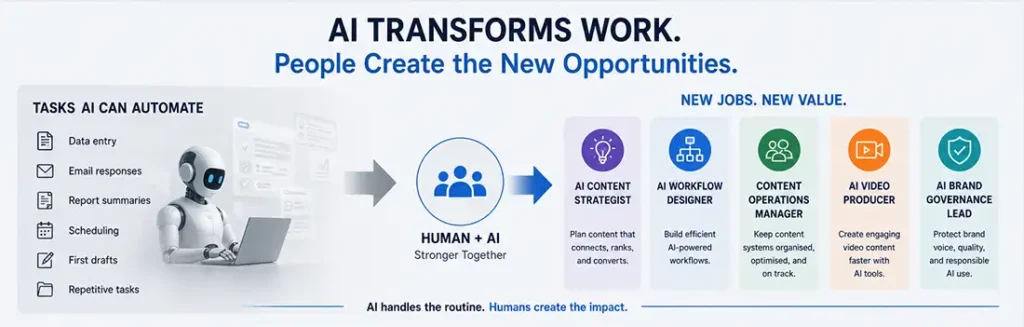
AI Changes Tasks Before It Replaces Jobs
Most jobs are not one task.
A marketer does not only write captions. A designer does not only create layouts. A customer support person does not only answer the same question. A project manager does not only schedule meetings. A creative director does not only review visuals.
Jobs are bundles of tasks.
AI may automate some of those tasks, assist with others, and create new responsibilities around the work that remains.
For example, AI may help a marketer draft ten caption options quickly. But the marketer still needs to understand the audience, choose the right message, align the post with the campaign, review the tone, protect the brand, and decide what should actually be published.
AI may help a designer create mood boards and visual concepts. But the designer still needs taste, judgment, brand understanding, composition skills, and the ability to decide which direction fits the business.
AI may help a customer support team generate draft replies. But humans still need empathy, escalation judgment, product knowledge, and the ability to handle unusual situations.
This is why the task-level view matters. AI may take over routine parts of a job, but that does not automatically mean the entire job disappears.
Some Jobs Will Be Pressured
A balanced article needs to be honest: some work will be disrupted.
Roles built mostly around repetitive, predictable, text-based, rules-based, or administrative tasks are more exposed. This can include parts of data entry, basic reporting, simple content production, scheduling, summarization, first-draft writing, repetitive customer support, and basic research.
Entry-level workers may feel this pressure strongly because many early-career jobs include foundational tasks that AI can now assist with or partially automate.
This is a serious issue. Entry-level roles are often where people learn, build judgment, and gain experience. If companies automate too much of the early work without creating new learning pathways, the talent pipeline can weaken.
So the goal should not be to pretend there is no risk.
The goal should be to identify where new opportunities can appear and how people can prepare for them.
New Work Appears Around the AI System
Every major technology creates work around itself.
When websites became essential, new jobs appeared in web design, SEO, content management, analytics, UX, e-commerce, digital advertising, and social media.
When social media became a business channel, companies needed social media managers, community managers, content creators, influencer managers, paid social specialists, and platform strategists.
AI is likely to follow a similar pattern.
The work may shift away from doing every task manually and toward designing, guiding, reviewing, improving, and managing AI-assisted systems.
This creates demand for people who understand both the technology and the human goal behind it.
New Roles AI Could Help Create
Here are several areas where AI may create new types of jobs or expand existing ones.
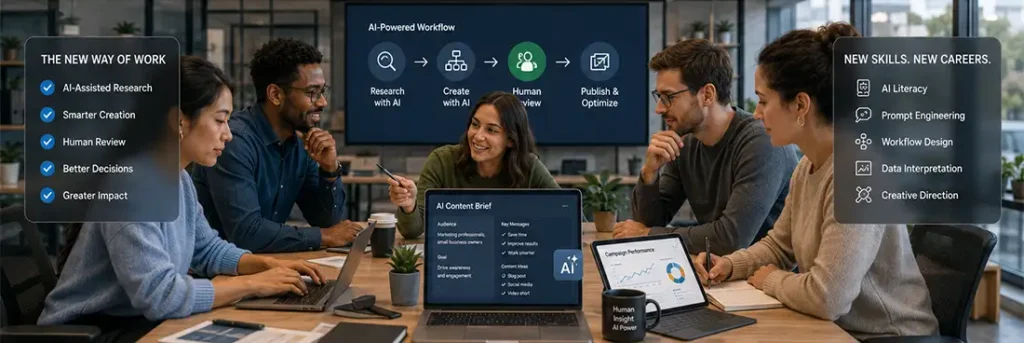
1. AI Content Strategist
As companies produce more content with AI, they will need people who can decide what content should exist in the first place.
An AI content strategist does not simply ask AI to write more articles. This person defines content themes, audience needs, search intent, AI visibility opportunities, brand voice, distribution plans, and conversion goals.
The value is not in generating words. The value is in directing the content system.
2. AI Workflow Designer
Many businesses will need someone to connect AI tools into practical workflows.
An AI workflow designer might map how a company moves from idea to draft, draft to review, review to design, design to publishing, and publishing to performance analysis.
This role is about making AI useful inside real business processes.
3. AI Brand Governance Lead
As more people use AI to create content, brands will need governance.
An AI brand governance lead helps maintain voice, visual identity, claims, approval rules, AI disclosure standards, and content quality. This role protects the brand from becoming inconsistent, inaccurate, or generic.
This is especially important as AI content creation spreads across marketing, sales, support, HR, and leadership.
4. Synthetic Media Reviewer
AI-generated video, voice, images, and digital likenesses create new risks around consent, accuracy, and brand safety.
A synthetic media reviewer may check whether AI-assisted content uses a person’s likeness properly, whether disclosure is needed, whether the context is misleading, and whether the content meets ethical and legal standards.
This role becomes more important as synthetic video and AI-generated influencers become more common.
5. AI Video Producer
Video production is being reshaped by AI tools for scripting, storyboarding, captioning, editing, localization, voiceovers, and ad variations.
An AI video producer combines traditional storytelling judgment with AI-assisted production tools. The role is not only about editing. It is about turning ideas into efficient, platform-ready video content.
6. Content Operations Manager
As brands publish across blogs, newsletters, YouTube, TikTok, LinkedIn, Facebook, Instagram, X, and paid ads, content operations becomes more important.
A content operations manager keeps the system moving. They manage calendars, workflows, assets, approvals, repurposing, analytics, and performance feedback.
AI can help with the workload, but a human still needs to run the system.
7. AI Tool Trainer
Companies will need people who can train teams to use AI responsibly and effectively.
This includes teaching employees how to write better prompts, protect confidential data, review AI output, avoid weak claims, maintain brand voice, and use approved workflows.
AI literacy will become a business skill, and trainers will help close that gap.
8. Human-AI Creative Director
Creative leadership will not disappear. It will evolve.
A human-AI creative director may guide campaigns where AI assists with ideation, visuals, scripts, storyboards, ad variations, and content repurposing. But the human still leads taste, strategy, story, emotional direction, and brand standards.
This role blends creative judgment with AI fluency.
The New Value Is Not Just Doing the Task
AI changes what is valuable.
If a task becomes easier to automate, the value shifts to the human skills around the task.
For example:
- Writing becomes more about point of view, editing, and strategy.
- Design becomes more about direction, taste, and consistency.
- Marketing becomes more about systems, audience insight, and testing.
- Video becomes more about story, pacing, and platform fit.
- Operations becomes more about workflow design and quality control.
- Leadership becomes more about judgment, training, and responsible use.
The people who thrive will be the ones who understand how to use AI as leverage while strengthening the human parts of the work.
Why Creative Professionals Still Matter
Creative professionals may feel especially anxious about AI because AI can now produce images, copy, videos, music, layouts, and design directions.
But creativity is not only output.
Creativity is judgment. It is context. It is taste. It is timing. It is knowing what the audience needs, what the brand stands for, and what idea is worth developing.
AI can generate options. Humans still decide what matters.
That distinction is important.
The future creative professional may spend less time producing every first draft manually and more time directing, refining, curating, combining, and improving creative work.
That can be a powerful shift for people who adapt.
What Workers Should Do Now
The safest move is not to compete with AI at routine tasks.
The safer move is to become the person who knows how to use AI, guide it, check it, improve it, and turn it into business value.
Here are practical steps:
1. Learn the AI tools in your field
Do not try to learn every tool. Focus on the ones that affect your work: writing, design, analytics, video, automation, coding, customer support, or operations.
2. Build prompt and review skills
Prompting is useful, but reviewing is even more important. Learn how to spot weak output, factual errors, generic language, bad design choices, and unsupported claims.
3. Strengthen human skills
Communication, judgment, empathy, leadership, creativity, strategy, and problem-solving become more valuable when routine production is automated.
4. Understand workflows
Learn how work moves through a business. People who can redesign workflows around AI will be valuable.
5. Create proof of skill
Build examples. Show how you used AI to improve a process, create a campaign, organize content, analyze data, or produce better work faster.
What Businesses Should Do Now
Businesses also have responsibility.
If companies only use AI to cut roles, they may save money in the short term but weaken long-term capability. They may lose training pathways, institutional knowledge, creative judgment, and employee trust.
Instead, businesses should ask:
- Which tasks can AI improve?
- Which roles need to be redesigned?
- What new skills do employees need?
- How do we train entry-level workers in an AI-supported environment?
- What new roles are emerging inside our company?
- How do we keep humans in control of quality and trust?
The best companies will not simply replace people with tools. They will redesign work so people can create more value with tools.
The Entry-Level Challenge
One of the biggest risks is the entry-level career path.
Many entry-level workers learn by doing basic tasks. If AI automates those tasks, companies need new ways to train people.
This may require redesigning junior roles around AI supervision, quality review, research validation, content support, customer insight, tool testing, and workflow documentation.
Instead of asking young workers to do repetitive tasks manually, companies can train them to work with AI while learning the judgment behind the task.
That could create stronger workers faster, but only if businesses invest in training.
AI Job Creation Will Not Be Automatic
It is important to be clear: new jobs will not appear automatically for everyone.
There will be disruption. There will be uneven access to training. Some workers will benefit faster than others. Some companies will handle the transition responsibly, and others will not.
That is why skills, education, leadership, and policy matter.
AI job creation depends on whether businesses, workers, schools, and governments actively build pathways into the new work.
The opportunity is real, but it requires preparation.
The Sights.com Perspective
For creators, marketers, designers, business owners, and digital professionals, the lesson is practical.
AI is not just a threat to existing work. It is also a signal of where new value is moving.
Work is moving toward:
- Creative direction
- Content systems
- Brand governance
- AI-assisted workflows
- Video production
- Audience strategy
- Trust and quality control
- Human-AI collaboration
These are areas where people can build new expertise.
Final Thoughts
AI may change jobs dramatically, but that does not mean the future is only job loss.
Some tasks will disappear. Some roles will shrink. Some entry-level paths will need to be rebuilt.
But new work will also appear.
The biggest opportunity is not in pretending AI will have no impact. It is in learning where the impact creates new demand.
AI may not take your job directly.
But someone who knows how to use AI may redesign the work, build the system, manage the workflow, create the campaign, review the output, protect the brand, and create the next opportunity.
The future belongs to people who can combine human judgment with AI capability.
That is where the next jobs will be created.
Want to Improve Your AI Visibility?
Download the free AI Visibility Starter Kit from Sights.com and start improving your content clarity, customer questions, trust signals, and AI search readiness.