

In the AI Era, Brand Consistency May Matter More Than Content Volume
AI has made it easier than ever to create content.
A small team can now produce blog posts, social media captions, ad concepts, product descriptions, email drafts, video scripts, images, campaign ideas, and landing page copy at a speed that would have seemed impossible only a few years ago.
That is powerful. But it also creates a new risk.
When content becomes easier to produce, brands may be tempted to create more of everything. More posts. More ads. More images. More videos. More campaigns. More emails. More experiments.
But more content does not automatically create a stronger brand.
In fact, too much disconnected content can weaken a brand. If every post sounds different, every visual looks different, and every campaign feels like it came from a different company, the audience may not remember who you are or what you stand for.
That is why brand consistency may become more important than content volume in the AI era.
Why This Topic Is Timely
Marketers are beginning to shift from simply producing more AI content to building stronger brand systems. Google’s Asset Studio is one example of this shift. Google describes it as a creative destination inside Google Ads that helps marketers generate, manage, and scale creative assets while maintaining brand consistency through style references and on-brand visuals.
Google’s business resources also show how its newer AI ad tools are designed for campaign workflows, not just one-off assets. A recent Google guide on using Nano Banana Pro and Veo in Asset Studio encourages marketers to generate on-brand images, animate them into videos, and apply creative best practices such as integrating the brand early and often.
Large agencies and brands are also paying more attention to consistency. According to The Australian, AustralianSuper appointed VML to lead a strategic brand overhaul focused on stronger engagement, trust, and consistent brand presentation across touchpoints as AI becomes more central to consumer decision-making.
The message is clear: AI is not only changing how fast brands create content. It is changing how carefully brands need to manage identity, trust, and recognition.
The Content Volume Trap
The content volume trap is the belief that more content automatically means more growth.
It sounds logical at first. More posts should mean more reach. More videos should mean more engagement. More articles should mean more traffic. More ads should mean more conversions.
But audiences do not experience your brand as a spreadsheet of content output. They experience your brand through repeated signals.
They notice your tone. They notice your visual style. They notice whether your message feels clear. They notice whether your content feels trustworthy. They notice whether your ideas connect or feel random.
If your content is inconsistent, more volume can actually make the problem worse.
Instead of creating familiarity, it creates confusion.
AI Can Amplify Brand Drift
Brand drift happens when a brand slowly becomes less recognizable over time.
Before AI, brand drift often happened because different teams, agencies, freelancers, or departments created content without strong guidelines. One team used one tone. Another used different visuals. Another created campaigns with a different message. Over time, the brand started to feel scattered.
AI can accelerate that problem.
If every employee, creator, or marketer uses a different AI prompt, the output may vary wildly. One blog post may sound formal. Another may sound playful. One social post may feel bold. Another may sound generic. One campaign image may look sleek and futuristic. Another may look soft and lifestyle-focused.
None of these assets may be “bad” on their own.
But together, they may not feel like one brand.
Recognition Is a Competitive Advantage
In a crowded market, people remember what they can recognize.
This is why brand consistency matters. It helps people form a clear mental picture of your business. When they see your content repeatedly, they begin to associate your brand with certain ideas, visuals, values, and experiences.
That recognition builds trust over time.
A consistent brand feels more professional. It feels more intentional. It feels easier to understand. It gives the audience confidence that the company knows who it is.
This does not mean every piece of content should look exactly the same. A brand can be flexible, creative, and platform-specific while still feeling connected.
The goal is not sameness.
The goal is coherence.
What Brand Consistency Means in the AI Era
Brand consistency used to mean using the same logo, colors, and fonts. Those things still matter, but they are no longer enough.
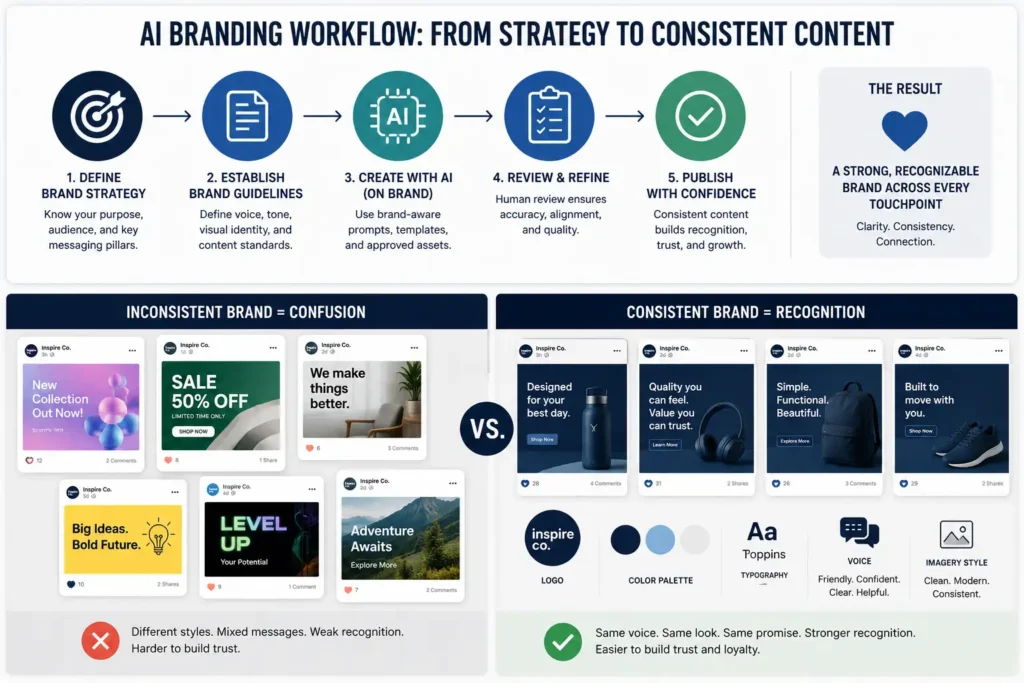
In the AI era, brand consistency also includes:
- Brand voice
- Messaging pillars
- Audience priorities
- Visual style rules
- Content quality standards
- AI prompt guidelines
- Review and approval workflows
- Ethical boundaries around AI use
- Platform-specific adaptation rules
A brand needs to define how it should sound, how it should look, what it should talk about, what it should avoid, and how AI-generated content should be reviewed before publishing.
That is how brands prevent AI from creating a scattered identity.
The Strongest Brands Will Build Creative Systems
The next step is not simply using AI tools. It is building creative systems.
A creative system gives the brand a repeatable way to create content while staying recognizable. It helps a team generate ideas, produce assets, review quality, and adapt content across channels without losing the brand’s core identity.
A strong creative system may include:
- A brand voice guide
- A visual identity guide
- A library of approved phrases and messaging pillars
- A content calendar structure
- A prompt library for AI tools
- A checklist for reviewing AI-generated content
- Templates for blog posts, social captions, ads, and videos
- A process for measuring what works
This turns AI from a random content generator into a brand-aligned assistant.
Why Small Businesses Need This Too
Brand consistency is not only for large companies.
Small businesses may need it even more because they often have fewer chances to make an impression. If a visitor sees a website, a social post, a video, and an email, those touchpoints should feel connected.
For a small business, consistency can make the brand feel more established, even if the team is small.
AI gives small businesses more power to create content, but that power needs direction.
A small company does not need a massive brand manual. It can start with a simple one-page guide:
- What we help people do
- Who we help
- What we believe
- How we sound
- What topics we cover
- What visual style we use
- What we never say or claim
This alone can make AI content much more consistent.
AI Prompt Systems Are Becoming Brand Assets
One of the most overlooked parts of AI branding is the prompt system.
If your team uses AI regularly, your prompts become part of your brand workflow. A good prompt can reinforce your tone, audience, message, structure, and style. A weak prompt can produce generic content that sounds like everyone else.
Instead of asking AI to “write a social post,” a brand should give more direction:
- Who the audience is
- What the brand voice sounds like
- What the goal of the content is
- What message should be emphasized
- What should be avoided
- What format is needed
- What call to action should be used
Over time, these prompts become a practical brand asset.
They help everyone create content that feels more aligned.
The Review Process Matters More Than Ever
AI-generated content should not go straight from prompt to publish.
Every brand needs a review process, even a simple one.
Before publishing AI-assisted content, ask:
- Does this sound like us?
- Is the message clear?
- Is the claim accurate?
- Is the visual style aligned?
- Does this support our larger brand story?
- Is this useful to the audience?
- Does this create trust?
This review step is where human judgment protects the brand.
AI can help create options. Humans still need to decide what represents the company.
More Content Can Still Be Useful
This article is not arguing against content volume.
Publishing consistently matters. Testing ideas matters. Showing up across multiple platforms matters. AI can help with all of that.
The point is that volume only works when it supports a clear brand system.
More content is useful when it reinforces the same identity, values, voice, and promise.
More content becomes harmful when it spreads the brand in too many disconnected directions.
The best brands will use AI to create more, but they will not create randomly.
How to Build Better Brand Consistency With AI
Here is a simple workflow brands can start using:
1. Define the core brand message
Write one sentence that explains what your brand helps people do. This should guide every article, ad, video, email, and product page.
2. Create three to five messaging pillars
These are the main ideas your brand returns to again and again. For Sights.com, examples might include AI visibility, human creativity, digital marketing, creative tools, and content systems.
3. Build a voice guide
Define whether your brand sounds professional, casual, educational, bold, optimistic, practical, or visionary. Add examples of phrases that fit and phrases that do not.
4. Create visual rules
Define colors, image style, typography direction, layout feel, and the emotional tone of visuals.
5. Write brand-aware AI prompts
Create reusable prompts that include your audience, tone, message, format, and CTA.
6. Review before publishing
Use a checklist to make sure the content is useful, accurate, aligned, and recognizable.
The Real Goal Is Trust
Brand consistency is not about being rigid. It is about building trust.
When people see a brand show up consistently, they begin to understand it. They know what kind of value to expect. They know what the brand stands for. They know whether it is relevant to them.
That trust becomes even more important as AI-generated content increases.
If the internet becomes louder, consistency becomes a signal.
If content becomes easier to generate, trust becomes harder to earn.
If many brands start sounding the same, recognizable brands will stand out.
Final Thoughts
AI gives brands the ability to create more content than ever before. But content volume alone is not a strategy.
The real advantage will belong to brands that can use AI without losing their identity.
That means building clear brand guidelines, consistent messaging, recognizable visuals, smart prompt systems, and human review workflows.
In the AI era, the strongest brands will not simply be the loudest.
They will be the clearest.
They will be the most recognizable.
And they will understand that brand consistency may matter more than content volume.
Want to Improve Your AI Visibility?
Download the free AI Visibility Starter Kit from Sights.com and start improving your content clarity, customer questions, trust signals, and AI search readiness.