
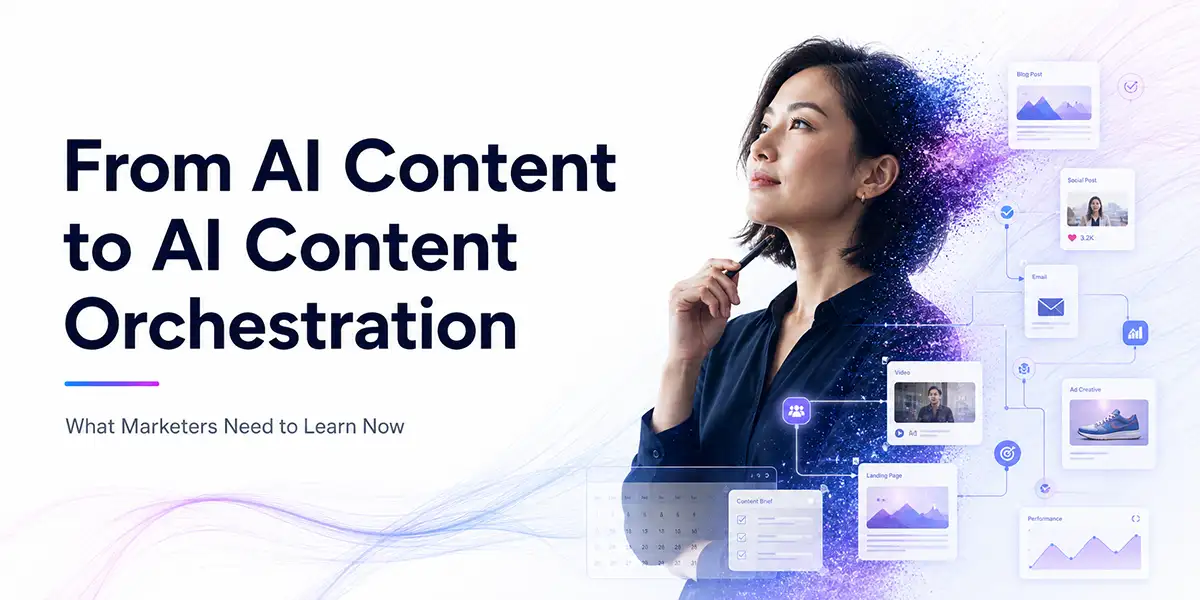
From AI Content to AI Content Orchestration:
What Marketers Need to Learn Now
For the last few years, most conversations about AI and marketing have focused on content generation. People have asked questions like: Can AI write a blog post? Can AI make a social media caption? Can AI create a product image? Can AI design an ad?
Those questions still matter, but the bigger shift is now happening one level higher.
The future of AI in marketing is not just about generating one piece of content at a time. It is about AI content orchestration: using AI to help plan, create, organize, adapt, govern, distribute, and measure content across an entire marketing workflow.
That may sound like a technical phrase, but the idea is simple. AI is moving from being a creative assistant that helps make one asset into a connected system that helps manage the full content process.
This shift is becoming especially important as brands face pressure to create more content, for more channels, in more formats, and at a faster pace than ever before. Adobe recently introduced Brand Intelligence as part of its GenStudio content supply chain solution, describing it as a way to help teams keep content on-brand while planning, creating, managing, activating, and measuring content at scale.
For marketers, creators, and businesses, this is a major change. The winning teams will not simply be the ones using AI to make more content. They will be the ones using AI to create better systems around their content.
What Is AI Content Orchestration?
AI content orchestration is the process of using artificial intelligence to coordinate the full content workflow. Instead of only asking AI to create a single output, teams use AI to support every stage of the marketing process.
That can include research, strategy, campaign planning, content creation, localization, brand review, asset management, publishing, performance analysis, and future optimization.

In a traditional workflow, a marketing team might move through these steps manually. First, they research the audience. Then they create a campaign brief. Then writers, designers, video editors, and social media managers produce separate assets. Then brand or legal teams review everything. Then the content is adapted for each platform. Finally, performance is measured after launch.
AI content orchestration helps connect those steps.
For example, a long-form report could be transformed into a blog article, LinkedIn post, email campaign, YouTube script, short video concept, infographic idea, and ad campaign. Instead of starting from scratch each time, AI can help adapt the core idea into platform-specific formats.
But the most important part is not just speed. The real value is consistency.
Why This Trend Matters Now
Marketing teams are being asked to produce more than ever. A single campaign may need blog content, social posts, email copy, landing pages, video scripts, display ads, newsletters, short-form clips, sales materials, and localized versions for different audiences.
That creates pressure on creative teams. It also increases the risk that content becomes inconsistent, rushed, or off-brand.
This is why brand intelligence and content supply chain tools are becoming more important. Adobe describes Brand Intelligence as an AI-powered system that can use brand guidelines, creative assets, campaign data, and performance results to help teams produce on-brand content at scale and validate content against brand governance rules.
OpenAI’s business guidance also points to a broader marketing workflow approach, including using AI for market research, data analysis, campaign strategy, content creation, localization, and channel optimization.
Together, these signals show where the industry is heading. AI is not just a writing tool or image tool. It is becoming part of the marketing operating system.

The Problem With One-Off AI Content
One-off AI content can be useful, but it has limits.
A marketer can ask an AI tool to write ten headlines. A designer can generate an image concept. A social media manager can create caption variations. These are helpful tasks, but they do not automatically create a strong content strategy.
The problem is that one-off AI content can become disconnected. A blog post may not match the email campaign. The ad copy may not match the landing page. The visuals may not follow the brand style. The tone may shift from platform to platform.
Even worse, the content may start to feel generic.
This is one of the biggest risks in AI marketing. If every brand uses similar tools, similar prompts, and similar templates, a lot of content can begin to sound and look the same.
That is why orchestration matters. It is not just about creating content faster. It is about creating content that is connected, consistent, purposeful, and aligned with the brand.
Brand Safety Is Becoming Part of the AI Conversation
Another reason AI content orchestration matters is brand safety.
AI can help teams move faster, but speed without control can create problems. Content may include claims that are not accurate. Visuals may not reflect the brand correctly. Ads may appear in the wrong context. AI-generated material may create trust issues with audiences.
This is becoming a larger public concern. The United Nations recently warned that unchecked AI adoption in advertising can increase risks across the digital information ecosystem, especially when it contributes to misinformation or weakens information integrity.
At the same time, cultural criticism around low-quality “AI slop” is growing. Recent commentary has described mass-generated AI material as a kind of cognitive pollution that can overwhelm platforms and weaken the value of human creative work.
For businesses, this creates a clear lesson: AI should not be used only to produce more. It should be used with better standards, better review, and better creative direction.
Human Oversight Is Still the Competitive Advantage
AI content orchestration does not mean removing people from the process. In fact, the opposite is true.
The more AI becomes part of the workflow, the more important human oversight becomes.
Humans are still needed to define the message, understand the audience, guide the tone, judge the quality, protect the brand, and decide what is worth publishing.
AI can suggest options. Humans decide what is right.
AI can generate drafts. Humans refine the voice.
AI can analyze performance. Humans interpret what it means.
AI can help scale content. Humans make sure the content still has purpose.
This is where many brands will either win or lose. A brand that uses AI without human judgment may create more content but weaken its identity. A brand that combines AI speed with human creativity can build a stronger, more consistent presence across every channel.
What Marketers Should Learn Now
Marketers should start thinking less about individual AI tools and more about AI workflows.
Instead of asking, “What AI tool can write this post?” ask, “How does this content move from idea to campaign to distribution to performance learning?”
This mindset creates a stronger marketing process.
Start with the strategy. Define the audience, message, goal, and brand voice before using AI. Then use AI to explore ideas, create drafts, adapt formats, and organize production. After that, use human review to strengthen the work before publishing.

Finally, use performance data to learn what worked. The next version of the campaign should be smarter because the system has learned from the last one.
This is the promise of AI content orchestration. It turns content from a disconnected set of tasks into a connected creative system.
How Small Businesses Can Use This Idea
AI content orchestration is not only for large companies. Small businesses and independent creators can use the same thinking on a simpler scale.
A small business could start with one strong article idea and turn it into a full content package. That package might include a blog post, social captions, newsletter copy, a YouTube script, a short video outline, image prompts, and a few ad concepts.
The key is to keep the core message consistent.
For example, if the main article is about AI tools for creative teams, every related piece of content should support the same idea. The language, visuals, tone, and call to action should feel connected.
This helps a small brand look more professional and organized, even with a limited team.
The Future of AI Marketing Is Systems, Not Shortcuts
The most important thing to understand is that AI is not just a shortcut. Used poorly, it can create weak, repetitive, forgettable content. Used well, it can become a powerful creative system.
That system should help teams move faster, stay organized, protect brand quality, and make better decisions.
Adobe and NVIDIA have also announced a partnership focused on agentic creative and marketing workflows, pointing toward a future where AI agents support campaign and production speed across more connected workflows.
This suggests the next stage of AI marketing will be less about isolated prompts and more about coordinated collaboration between humans, AI systems, creative tools, and performance data.
Final Thoughts
AI content creation was the first wave. AI content orchestration is the next one.
For marketers, this means the conversation is changing. The goal is no longer just to generate a caption, image, video, or article. The goal is to build a smarter content process that connects strategy, creativity, production, brand governance, distribution, and learning.
That is where the real value will be.
The brands that succeed will not be the ones that publish the most AI-generated content. They will be the ones that use AI to create more thoughtful, consistent, useful, and human-centered marketing.
- AI can help scale the work.
- But human strategy gives the work direction.
- And in the future of marketing, that combination will matter more than ever.
Want to Improve Your AI Visibility?
Download the free AI Visibility Starter Kit from Sights.com and start improving your content clarity, customer questions, trust signals, and AI search readiness.
Human Creativity in the Age of AI Content | Why Original Ideas Matter More Than Ever