
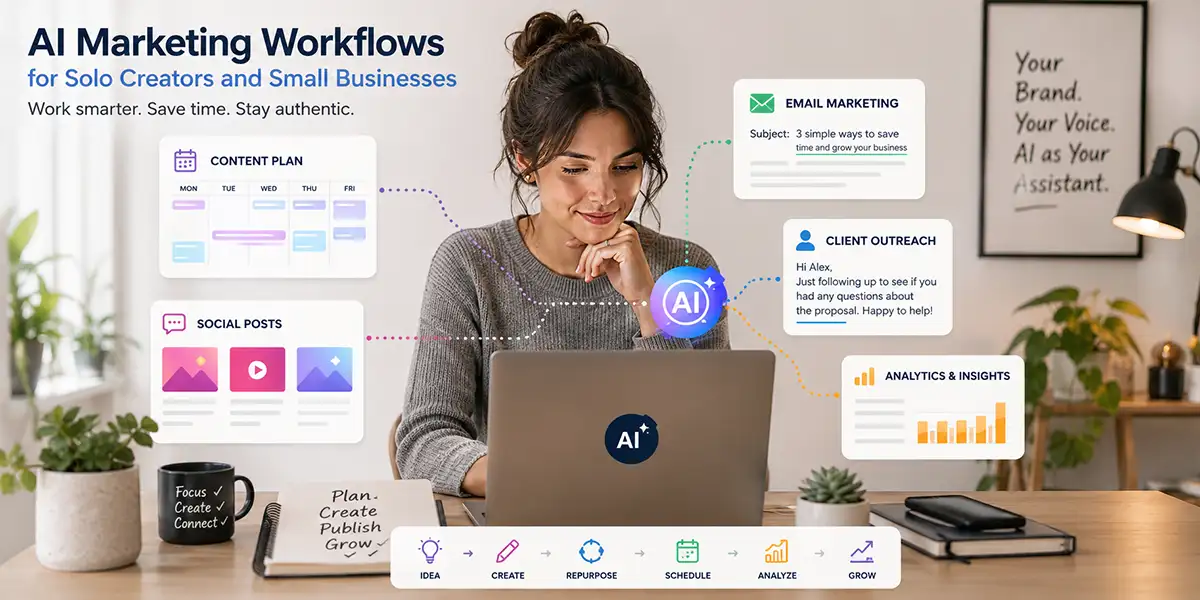
How Solo Creators Can Use AI to Build Smarter Marketing Workflows
Solo creators and small business owners have always had to wear too many hats.
One person may be responsible for content planning, social media, email marketing, customer replies, client outreach, product updates, website copy, sales pages, video ideas, blog posts, analytics, and follow-ups.
That is a lot of work.
AI can help, but only if it is used the right way.
The goal should not be to hand your entire brand voice over to a tool. The goal is to build smarter AI marketing workflows that save time, improve consistency, and help you show up more often without sounding fake or generic.
For solo creators, freelancers, consultants, and small businesses, this is where AI becomes most useful. It can become a practical assistant for the repetitive parts of marketing while you stay in control of the strategy, message, and human connection.
Why This Topic Is Timely
AI is moving from “interesting tool” to everyday marketing workflow. A recent Business Insider article highlighted solo business owners using tools like ChatGPT, Claude, and AI-enabled CRM features to improve marketing tasks such as email subject lines, social posts, client outreach, and follow-ups.
One solo entrepreneur used AI to create different versions of subject lines and social posts, allowing her to test ideas faster. Another used AI within her CRM to personalize client follow-ups and revive dormant business relationships. The important lesson is not that AI replaced their creativity. It helped them move faster while keeping their own business knowledge at the center.
That is the right model for solo creators: human-led, AI-assisted marketing.
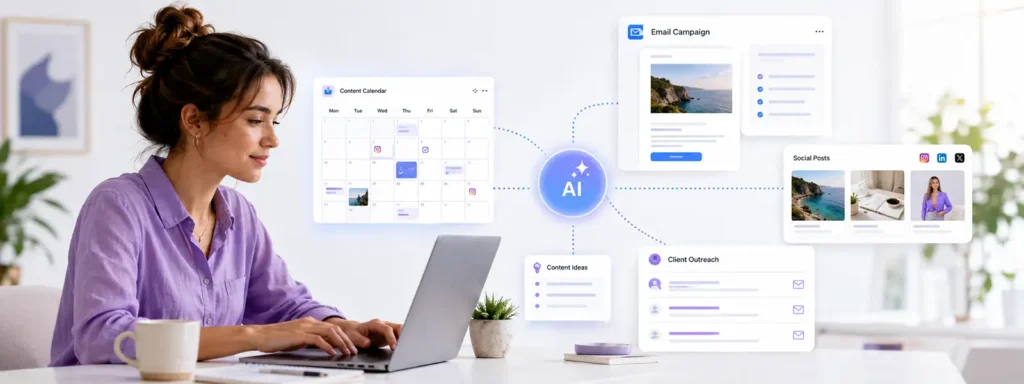
The Problem Solo Creators Face
Most solo creators do not struggle because they lack ideas.
They struggle because they lack time.
You might know what you want to say, but turning that idea into a blog post, three social captions, an email, a short video script, a product description, and a follow-up message can take hours.
That is where marketing becomes overwhelming.
Instead of creating a system, many solo creators end up posting randomly. They write when they have time. They send emails when they remember. They follow up when they are not too busy. They create content in bursts, then disappear for weeks.
AI can help solve this problem by turning marketing into a repeatable workflow.
AI Should Support the Workflow, Not Replace the Creator
The biggest mistake is treating AI like a replacement for your voice.
If you simply ask AI to “write a post about my business,” the result may sound polished but generic. It may use vague phrases, overstate claims, or sound like every other brand online.
That is not what you want.
Instead, AI should support specific parts of the workflow:
- Brainstorming content angles
- Creating headline options
- Drafting email subject lines
- Turning one idea into multiple formats
- Summarizing customer questions
- Organizing content calendars
- Writing first drafts
- Improving clarity
- Checking for brand voice consistency
- Creating follow-up templates
The creator still provides the idea, experience, opinion, judgment, and final approval.
Start With One Core Message
A smart AI marketing workflow begins with one clear message.
Before asking AI to create anything, write one sentence that explains the main idea you want to communicate.
For example:
Small businesses need a simple way to make their website content clearer for AI-powered search.
That one sentence can become:
- A blog article
- A newsletter section
- A Facebook post
- A Twitter/X post
- A LinkedIn post
- A YouTube Short script
- An Instagram caption
- A lead magnet CTA
- A sales page section
This is the key shift. Do not use AI to create random content. Use AI to help one strong idea travel across different platforms.
Workflow 1: Turn One Idea Into a Week of Content
One of the best uses of AI is repurposing.
Solo creators often think they need new ideas every day. They do not. They need better systems for using the ideas they already have.
A simple workflow could look like this:
- Write one core idea.
- Ask AI for five content angles.
- Choose the best angle.
- Ask AI to turn it into a short blog outline.
- Ask AI to create three social post variations.
- Ask AI to write one email intro.
- Edit everything in your own voice.
- Schedule the content.
This workflow helps you stay consistent without creating from scratch every time.
Workflow 2: Improve Email Subject Lines
Email marketing is one of the easiest places to use AI.
Subject lines matter because they influence whether people open your email. But writing good subject lines can be frustrating, especially when you are tired or rushed.
Instead of writing one subject line, use AI to generate options.
Prompt example:
Write 10 email subject line options for a newsletter about [topic]. The audience is [audience]. Keep the tone clear, useful, and not too salesy. Avoid hype. Make the subject lines short enough for mobile inboxes.
Then choose the best one or combine parts of several options.
The point is not to accept the first AI answer. The point is to get more options faster so you can make a better decision.
Workflow 3: Create Better Client Follow-Ups
Many solo creators and small businesses lose opportunities because they do not follow up consistently.
A lead asks a question, a potential client goes quiet, or a past customer has not purchased again. Following up matters, but it can be hard to know what to say.
AI can help create thoughtful follow-up messages.
Prompt example:
Write a friendly follow-up email to a potential client who asked about [service] two weeks ago but has not responded. Keep the tone helpful, not pushy. Mention that I am happy to answer questions and include a simple next step.
AI can help with the first draft, but you should personalize it before sending. Add the person’s context, mention the actual conversation, and remove anything that sounds too generic.
Workflow 4: Maintain a Consistent Brand Voice
One of the risks of AI content is that it can make your brand sound like everyone else.
To avoid that, create a short brand voice guide and use it in your prompts.
Your guide can include:
- Who your audience is
- What your brand helps people do
- Your tone
- Words or phrases you use often
- Words or phrases you avoid
- Your main content themes
- Your preferred call to action
Then include that direction when asking AI for content.
Prompt example:
Rewrite this draft in my brand voice. My tone is practical, clear, helpful, optimistic, and human. Avoid hype, jargon, and overpromising. Keep the message focused on useful advice for small business owners and creators.
This helps AI support your voice instead of replacing it.
Workflow 5: Turn Customer Questions Into Content
Customer questions are one of the best sources of content.
If someone asks a question, there is a good chance others are wondering the same thing. AI can help turn those questions into a content plan.
Start by collecting questions from:
- Email replies
- Contact form submissions
- Sales calls
- Social media comments
- Search queries
- Client conversations
- Product support requests
Then use AI to organize them.
Prompt example:
Organize these customer questions into content categories. Suggest blog article ideas, social media post ideas, and short video topics based on the questions.
This is especially useful because it keeps your content connected to real audience needs.

Workflow 6: Build a Simple Weekly Marketing System
A solo creator does not need a complicated marketing department. A simple weekly system is enough.
Here is a practical weekly AI-assisted workflow:
- Monday: Choose one topic for the week.
- Tuesday: Draft the article, email, or main content piece.
- Wednesday: Use AI to repurpose the idea into social posts.
- Thursday: Create or select visuals.
- Friday: Publish, schedule, and send.
- End of week: Review what got clicks, replies, or engagement.
This kind of system reduces decision fatigue. You always know what to do next.
Where AI Helps Most
AI is especially useful in areas where you need options, structure, or speed.
Good uses include:
- Headline variations
- Email subject lines
- Social caption options
- Blog outlines
- Video hooks
- Content calendars
- Repurposing ideas
- Follow-up drafts
- Editing for clarity
- Summarizing long notes
These are practical, low-risk ways to start.
Where Humans Need to Stay in Control
AI should not make every marketing decision for you.
Humans should stay in control of:
- Final brand voice
- Customer relationships
- Promises and claims
- Pricing and offers
- Personal stories
- Sensitive replies
- Creative direction
- Ethical decisions
- Final publishing approval
AI can help you move faster, but you are still responsible for what your brand publishes.
Avoid the “Over-Automated” Feeling
Audiences are becoming more sensitive to content that feels fake, automated, or too polished in the wrong way.
This matters because trust is becoming one of the biggest advantages for solo creators and small businesses.
If every email sounds like a template and every social post sounds like an AI assistant, people may tune out.
To avoid that, add human details:
- Use real examples
- Share your opinion
- Mention what you are learning
- Talk about actual customer questions
- Show behind-the-scenes work
- Use your own language
- Edit AI drafts heavily
The best AI marketing workflows do not erase the human layer. They make it easier to share.
Build a Prompt Library
As you find prompts that work, save them.
A solo creator should build a small prompt library for common tasks:
- Blog article outline prompt
- Newsletter draft prompt
- Social post repurposing prompt
- Email subject line prompt
- Client follow-up prompt
- Brand voice editing prompt
- Content calendar prompt
- Video script prompt
This saves time because you do not have to reinvent the prompt every time.
Over time, your prompt library becomes part of your marketing system.
Measure What Actually Works
AI can help you create more content, but you still need to watch performance.
Track simple signals:
- Which emails get opened?
- Which links get clicked?
- Which social posts get engagement?
- Which topics bring website traffic?
- Which CTAs get signups?
- Which content leads to inquiries?
Use that information to improve your workflow.
AI can help summarize results, but the business decision is still yours.
How This Fits Sights.com
For a brand like Sights.com, AI marketing workflows are especially useful because one article can support an entire content system.
A daily article can become:
- A WordPress blog post
- A Facebook post
- A Twitter/X post
- A newsletter section
- A short-form video script
- A lead magnet CTA
- A future product idea
- An affiliate recommendation angle
That is the real value of AI. It helps one good idea go further.
Final Thoughts
Solo creators and small businesses do not need to use AI for everything.
They need to use AI where it reduces friction, creates useful options, and helps them stay consistent.
The best AI marketing workflows are not about replacing the creator. They are about giving the creator more leverage.
Use AI to brainstorm, organize, draft, repurpose, and improve.
Use human judgment to decide what matters, what feels right, and what earns trust.
That is how solo creators can build smarter marketing workflows without losing authenticity.
Want the Complete AI Video Marketing System?
The AI Video Marketing Kit for Creators gives you prompts, scripts, planners, affiliate video templates, course promo workflows, and repurposing tools to turn your ideas into useful video content faster.