
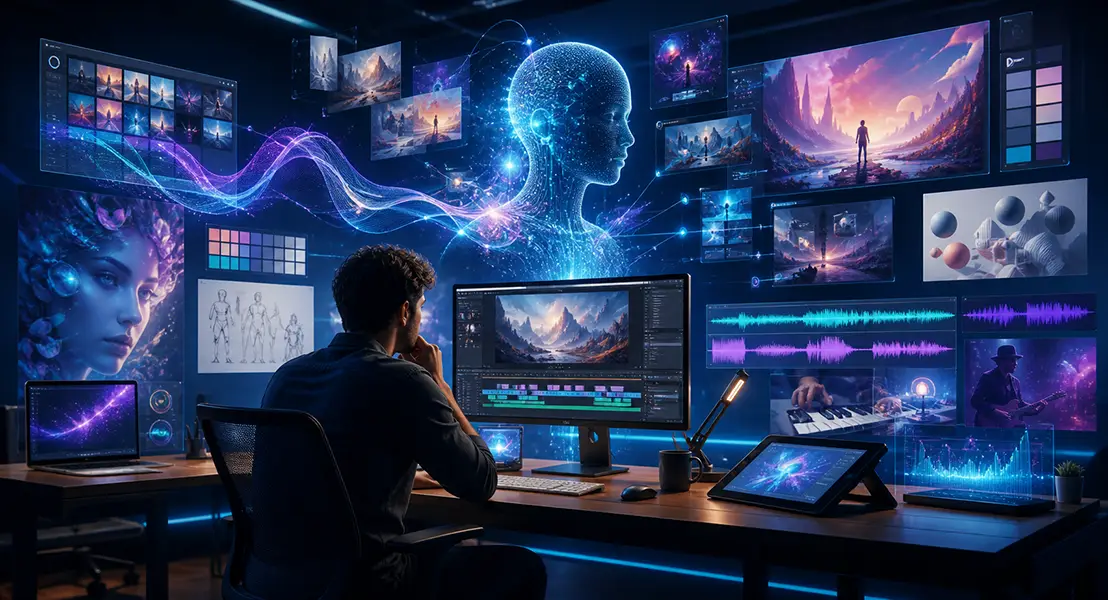
The creative industry is experiencing one of the biggest shifts since the arrival of the internet. Artificial intelligence is no longer just a tool for data, automation, or tech companies. It is now part of the everyday creative process, helping designers, marketers, filmmakers, musicians, writers, content creators, and agencies move faster from idea to execution.
For a company like Sights.com, this moment is especially exciting. Visual storytelling, digital content, branding, social media, video, and marketing are all being reshaped by AI. The question is no longer, “Will AI replace creatives?” The better question is, “How can creatives use AI to produce better work, faster, and with more imagination?”
AI is not removing the need for creativity. It is changing the creative workflow.

AI Has Become a Creative Partner
In the past, creative work usually moved through a slow process: brainstorming, sketching, writing, designing, reviewing, revising, producing, editing, and publishing. Each stage took time, budget, and specialized skill.
Today, AI can support almost every part of that process.
A designer can generate visual directions in minutes. A writer can test multiple headline options instantly. A video creator can turn a short prompt into a cinematic visual concept. A marketing team can create campaign variations for different platforms, audiences, and formats without starting from scratch every time.
Adobe has expanded Firefly into a creative AI platform that includes image, video, audio, and vector generation tools for creators. Adobe has also introduced Firefly features designed to support the full creative process, from brainstorming to finished production assets.
This is a major change. AI is moving from being a simple “generate an image” tool into a deeper creative production assistant.
Video Creation Is Moving Faster Than Ever
One of the most exciting areas of AI advancement is video.
Video has always been one of the most powerful forms of content, but it has also been one of the most expensive and time-consuming. You needed cameras, locations, lighting, editors, motion designers, sound designers, and sometimes entire production crews.
AI video tools are changing that.
OpenAI’s Sora was introduced as a text-to-video model capable of generating videos up to a minute long while maintaining visual quality and following the user’s prompt. Runway’s Gen-4 focused on consistent characters, locations, objects, style, mood, and cinematic control across scenes, while Gen-4.5 pushed further into visual fidelity, motion quality, and prompt adherence.
For creative teams, this opens up new possibilities:
- Concept videos can be created before a full production budget is approved.
- Storyboards can become moving visual previews.
- Social media videos can be produced faster.
- Mood films, brand worlds, and campaign ideas can be tested quickly.
- Small businesses can access video styles that previously required large budgets.
This does not mean traditional video production disappears. Instead, AI gives creators a faster way to explore ideas, pitch concepts, and produce supporting content.
Design Is Becoming More Experimental
AI has also changed the design process.
Instead of starting with a blank page, designers can begin with a set of generated ideas. AI can help create mood boards, logo directions, layout options, typography inspiration, image treatments, and brand style references.
This is especially useful in the early stages of creative development. When a client says, “I want something modern, premium, energetic, and futuristic,” AI can help visualize multiple interpretations of that direction quickly.
But the final creative decision still belongs to the human designer.
AI can generate options. It can remix styles. It can suggest combinations. But it does not understand brand purpose, emotional nuance, cultural timing, or business strategy the way a skilled creative person does.
The strongest creative work will come from people who know how to direct AI, not people who simply accept whatever AI creates.
AI Is Changing Branding and Marketing
Marketing teams are using AI to create more personalized and scalable content. This includes ad copy, social posts, email campaigns, landing page variations, product descriptions, video scripts, thumbnails, and campaign concepts.
For brands, the benefit is speed and flexibility.
A single campaign can now be adapted into multiple versions for YouTube, Instagram, TikTok, LinkedIn, Pinterest, blogs, and email. Each version can be adjusted for different audience groups, tones, and formats.
Adobe’s business AI tools also highlight the importance of brand consistency, allowing companies to build and use custom generative AI models trained on brand or franchise assets.
That matters because one of the biggest risks with AI content is generic output. A brand does not win by sounding like everyone else. The real advantage comes when AI is guided by a clear brand voice, strong visual identity, and human creative direction.
Music and Audio Are Entering a New Era
AI music and audio tools have also advanced quickly. Creators can now generate background music, ambient soundscapes, sound effects, voiceovers, podcast edits, and music concepts with far less technical effort.
This is powerful for YouTubers, filmmakers, advertisers, game designers, meditation channels, and social media creators.
However, this area also raises serious questions. AI-generated music has rapidly increased on streaming platforms, creating concerns around royalties, content quality, originality, and how platforms should label AI-generated work.
For creative businesses, this means AI audio should be used thoughtfully. It can be excellent for background content, concept development, and production support, but creators need to pay attention to licensing, originality, platform rules, and audience trust.
AI Is Becoming Built Into Creative Software
Another major advancement is that AI is no longer separate from creative tools. It is being built directly into the software creatives already use.
Anthropic recently announced Claude integrations with creative tools including Adobe Creative Cloud, Blender, Ableton, and Affinity, allowing AI to support tasks inside existing creative environments. Adobe has also begun testing agentic AI inside Firefly, designed to help users complete complex creative tasks across multiple Adobe applications through conversational instructions.
This is an important shift.
Instead of opening one app to generate an image, another to edit it, another to animate it, and another to publish it, creatives are moving toward AI-assisted workflows where the assistant understands the project, the tools, and the desired outcome.
This will make creative production faster, but it will also increase the value of creative direction. The person who can clearly describe the vision will have the advantage.
The New Creative Skill: Direction
The future creative professional will need more than technical software skills. They will need strong creative direction.
That means knowing how to:
- Write better prompts
- Choose stronger visual references
- Judge quality quickly
- Understand brand positioning
- Edit AI outputs with taste
- Combine human originality with AI speed
- Protect authenticity and creative ownership
AI makes it easier to create more content, but it does not automatically make the content good.
In fact, as AI content becomes more common, taste becomes more important. Strategy becomes more important. Original thinking becomes more important.
The creative people who stand out will be the ones who use AI as a tool, not a shortcut.
AI Will Not Replace Creativity, But It Will Replace Slow Workflows
There is a lot of fear around AI replacing creative jobs. Some of that fear is understandable. AI can now perform tasks that used to require hours of manual labour.
But creativity is not just task completion.
Creativity includes emotion, taste, storytelling, cultural awareness, intuition, lived experience, humour, timing, and meaning. These are human strengths.
What AI will replace are slow, repetitive, low-value workflows. Tasks like resizing assets, generating first drafts, cleaning up images, creating rough concepts, testing headline variations, or producing simple content versions will become increasingly automated.
This gives creatives more time to focus on the parts of the work that matter most: the idea, the story, the strategy, and the emotional impact.
AI Worlds are here!
Check out Open Art for BEST platform with all the lastest Models under one roof. Awesome pricing and their super easy set of tools makes it the only plaform you will need.
What This Means for Creative Businesses
For agencies, studios, freelancers, and content companies, AI is becoming a competitive advantage.
Creative businesses that adopt AI thoughtfully can:
- Produce concepts faster
- Offer more visual options to clients
- Reduce production bottlenecks
- Create more content for more platforms
- Improve pitch presentations
- Test campaign ideas earlier
- Serve small businesses with better creative assets
- Compete with larger teams
But the key word is thoughtfully.
AI should not be used to flood the internet with generic content. It should be used to raise the quality, speed, and imagination of creative work.
The best creative companies will combine human storytelling with AI-powered production.
The Future of the Creative Industry
The next few years will bring even more change. We will see better AI video, more realistic image generation, smarter editing tools, AI-powered brand systems, personalized advertising, faster animation, voice-based creative direction, and full campaign generation from simple creative briefs.
But the future will not belong to AI alone.
It will belong to creatives who know how to use AI with purpose.
AI can generate images, videos, music, layouts, scripts, and ideas. But humans still decide what matters. Humans still understand audience emotion. Humans still build brands. Humans still create meaning.
The creative industry is not ending. It is evolving.
And for creators, marketers, designers, and businesses willing to adapt, this may be one of the most exciting creative moments in history.
Final Thoughts
AI’s advancements in the creative industry are not just about technology. They are about expanding what is possible.
A single creator can now do work that once required a full team. A small business can produce professional content at a higher level. A creative agency can move from concept to execution faster than ever before. A brand can test, refine, and publish ideas across multiple platforms with new speed and flexibility.
But the most important ingredient remains the same: human imagination.
AI is the tool. Creativity is the power behind it.
For Sights.com, this is the opportunity: to use AI not as a replacement for creative thinking, but as a new engine for visual storytelling, digital marketing, and bold creative expression.