
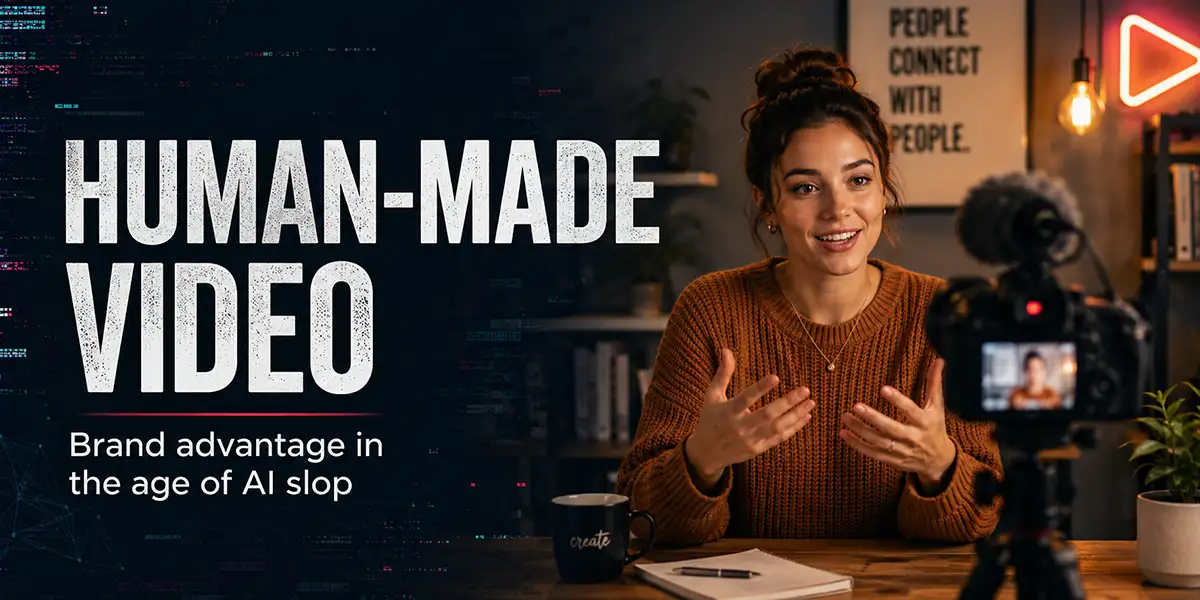
Human-Made Video Is Becoming a Brand Advantage in the Age of AI Slop
Short-form video is changing again.
For years, the trend was simple: make more content, post more often, follow the algorithm, and keep up with whatever format was working that month. Then AI arrived and made the production side even faster. Scripts, captions, thumbnails, clips, voiceovers, edits, and even synthetic visuals can now be created in a fraction of the time.
That speed is useful. But it also creates a problem.
When everyone can create more video faster, audiences start seeing more content that feels polished but empty. The internet fills with videos that look impressive at first, but lack personality, originality, trust, or a real human point of view.
This is where human-made video becomes important.
Not because brands should stop using AI. AI can be extremely helpful for planning, editing, captions, repurposing, and campaign development. But as synthetic content becomes easier to produce, brands and creators may need to show more proof of humanity to stand out.
Why This Topic Is Timely
A major signal of this shift is the return of Vine-style short-form video through a new app called Divine. According to The Guardian, Divine is positioning itself around human-made short videos and is pushing back against low-quality AI-generated content often described as “AI slop.”
The platform is also built around six-second looping videos, drawing from the original Vine format. TechRadar reported that Divine is currently invite-only, includes access to a large archive of original Vine clips, and uses a verification system designed to help prevent AI-generated content from taking over the platform.
Divine’s own launch messaging describes the app as a six-second looping video platform built for people, with “no AI slop” and a focus on raw, real, creative videos made by actual humans. You can see the platform’s launch post here: Divine Launches in App Stores.
That makes this bigger than a nostalgia story. It points to something more important in media and marketing: audiences may be getting tired of content that feels too automated, too generic, and too obviously optimized.
The Backlash Against AI Slop Is Really a Backlash Against Meaningless Content
The term “AI slop” is often used to describe low-quality AI-generated content that appears to be made quickly, cheaply, and without much human judgment.
But the real issue is not simply that AI was involved.
The issue is that the content feels disposable.

A video can be technically well-made and still feel empty. It can have a good edit, a clear voiceover, trendy visuals, and a clean caption, but still fail to make people care. That happens when the video has no real insight, no human presence, no emotional connection, and no clear reason to exist.
For brands, that is dangerous.
Content that feels generic may fill a calendar, but it does not build trust. It does not make people remember the brand. It does not create a relationship with the audience. It simply adds more noise to the feed.
Why Human-Made Video Feels Different
Human-made video has qualities that are hard to fake.
It has timing. A real person knows when a pause matters, when a reaction feels natural, when a moment is funny, and when a story needs to breathe.
It has imperfection. Not poor quality, but the small human details that make content feel alive: a real expression, a slightly messy workspace, an honest explanation, a natural voice, or a behind-the-scenes moment.
It has context. A human creator understands the audience, the brand, the product, the culture, and the moment in a way that a generic automated output may not.
It has personality. People do not only follow information. They follow voices, perspectives, taste, humor, honesty, and point of view.
This is why human-made video may become a stronger brand signal. In a feed full of automated content, real presence becomes more noticeable.
Human-Made Does Not Mean Anti-AI
This is an important distinction.
Human-made video does not mean AI cannot be part of the workflow. A creator might use AI to brainstorm topics, write draft hooks, summarize a long article into video talking points, clean up captions, organize a content calendar, or repurpose a clip into platform-specific posts.
That can all be useful.
The issue is who leads the creative process.
If AI is leading and the human is only approving, the content can quickly become generic. But if the human leads with an idea, experience, opinion, story, product knowledge, and audience understanding, AI can become a powerful assistant.
The strongest approach is human-led and AI-assisted.
Short-Form Video Is Becoming a Trust Tool
Short-form video is not just entertainment. It is also a trust-building tool.
For creators and businesses, video lets people see who is behind the brand. It shows voice, tone, confidence, warmth, energy, and authenticity. It can make a product feel real and a business feel approachable.
This matters because many buyers are cautious. They want to know if a brand is legitimate. They want to know if the person behind the content understands their problem. They want to know if the product or service is worth their attention.
Human-made video can answer those questions faster than a generic post.
A founder explaining a product can build trust. A creator showing their process can build credibility. A small business owner answering a customer question can feel more useful than a polished ad. A behind-the-scenes clip can make a brand feel more transparent.
In an AI-heavy content environment, video can become proof that real people are present.
What Brands Can Learn From the Vine Revival
The original Vine became memorable because it forced creativity through limitation. Six seconds was not much time, so creators had to rely on timing, personality, humor, and clear ideas.
That constraint made the format feel human.
Divine’s return is interesting because it revives that short-form spirit while responding to a very modern problem: feeds overloaded with synthetic content.
Brands can learn something from that.

More production does not always mean better communication. Sometimes a short, specific, human video can be more powerful than a polished campaign asset. Sometimes a real moment can do more for trust than a perfectly generated visual. Sometimes restraint creates stronger creativity.
The lesson is not that every brand needs to copy Vine. The lesson is that creativity still matters more than volume.
How Brands Can Use Human-Made Video Strategically
Brands do not need to abandon AI tools. They need to decide where human-made video creates the most value.
Here are practical places where human-made video can help:
1. Founder and team videos
People want to know who is behind a brand. Founder updates, team introductions, and personal explanations can create a stronger connection than faceless content.
2. Behind-the-scenes content
Show the process. Show how a product is made, how a campaign is planned, how a design is developed, or how a service is delivered. Behind-the-scenes video makes a brand feel more real.
3. Real product demonstrations
AI-generated product visuals can be useful, but real product video often builds stronger confidence. Show the product in use. Show scale, texture, movement, and context.
4. Customer questions
Answer real questions on camera. This can work well for social media, FAQ pages, YouTube Shorts, TikTok, Instagram Reels, LinkedIn, and even sales pages.
5. Opinion-led content
Generic tips are easy to generate. A clear human point of view is harder to copy. Share what you believe, what you are seeing in the industry, and what you think people are missing.
6. Creator-led storytelling
Creators can help brands feel more human by showing real use cases, personal reactions, and practical examples. The key is to keep it honest and specific.
Where AI Still Helps
AI can still play an important role in video strategy.
For example, AI can help turn one video into multiple assets:
- A YouTube Short description
- An Instagram caption
- A LinkedIn post
- A blog section
- A newsletter paragraph
- A Pinterest pin description
- A paid ad variation
- A product page FAQ
AI can also help with video planning:
- Writing hook options
- Creating script outlines
- Generating content calendars
- Repurposing long videos into short clips
- Suggesting platform-specific edits
- Drafting captions and calls to action
This is where AI is most useful: not replacing the human layer, but helping distribute it more effectively.
The Human Layer Is the New Differentiator
As AI content becomes more common, the brands that stand out will likely be the ones with a clear human layer.
That means:
- Real people appearing in content
- Original footage and photography
- Specific opinions and examples
- Clear brand voice
- Customer-centered storytelling
- Behind-the-scenes transparency
- Creative restraint instead of endless output
The human layer does not need to be perfect. It needs to be recognizable.
People should be able to feel that a brand has taste, judgment, experience, and a real point of view.
Why This Matters for Small Businesses and Creators
This shift is good news for small businesses and creators.
Large companies may have more budget, but small brands often have more personality. They can move quickly. They can speak directly. They can show the real people behind the work. They can respond to audience questions and create content that feels personal.
AI can help small brands produce more efficiently, but their real advantage is often trust.
A creator filming a simple, useful video from a studio, office, store, workshop, or home setup can still compete with larger brands because people respond to authenticity.
The key is consistency.
One human-made video will not transform a brand overnight. But a steady pattern of clear, useful, real content can build recognition over time.
How to Start Creating More Human-Made Video
If you are building a brand, start simple.
Choose one topic your audience cares about. Record a short video answering one question or explaining one idea. Keep it focused. Keep it real. Do not overproduce it. Then use AI to help create captions, repurpose the message, and plan follow-up content.
A simple workflow could look like this:
- Choose one customer question.
- Write a one-sentence answer.
- Record a 30- to 60-second video.
- Use AI to create three caption options.
- Post the video on one or two platforms.
- Turn the video idea into a short blog section or email.
- Track what people respond to.
This approach keeps the human idea at the center while still using AI to save time.
The Future of Video Branding Is Human-Led
AI will continue to reshape video production. Tools will get faster, more realistic, and easier to use. Brands will be able to generate more variations, edit faster, and adapt content across more platforms.
But that does not mean the future of video is less human.
It may mean the opposite.
As synthetic content becomes easier to create, human presence becomes more valuable. The brands that show real people, real ideas, real process, and real judgment will have an advantage.
The future of video branding is not about rejecting AI. It is about using AI without losing the human signal.
Final Thoughts
Human-made video is becoming a brand advantage because audiences are starting to recognize the difference between content that is produced and content that is felt.
AI can help brands move faster, but it cannot replace the trust created by real presence, honest storytelling, and original creative judgment.
The return of human-first short-form platforms like Divine shows that the conversation is shifting. People still want creativity that feels alive. They still want content made by people, for people.
For brands, the opportunity is clear.
Use AI behind the scenes.
Use human creativity at the front.
That is how brands can stand out in the age of AI slop.
Want to Improve Your AI Visibility?
Download the free AI Visibility Starter Kit from Sights.com and start improving your content clarity, customer questions, trust signals, and AI search readiness.