
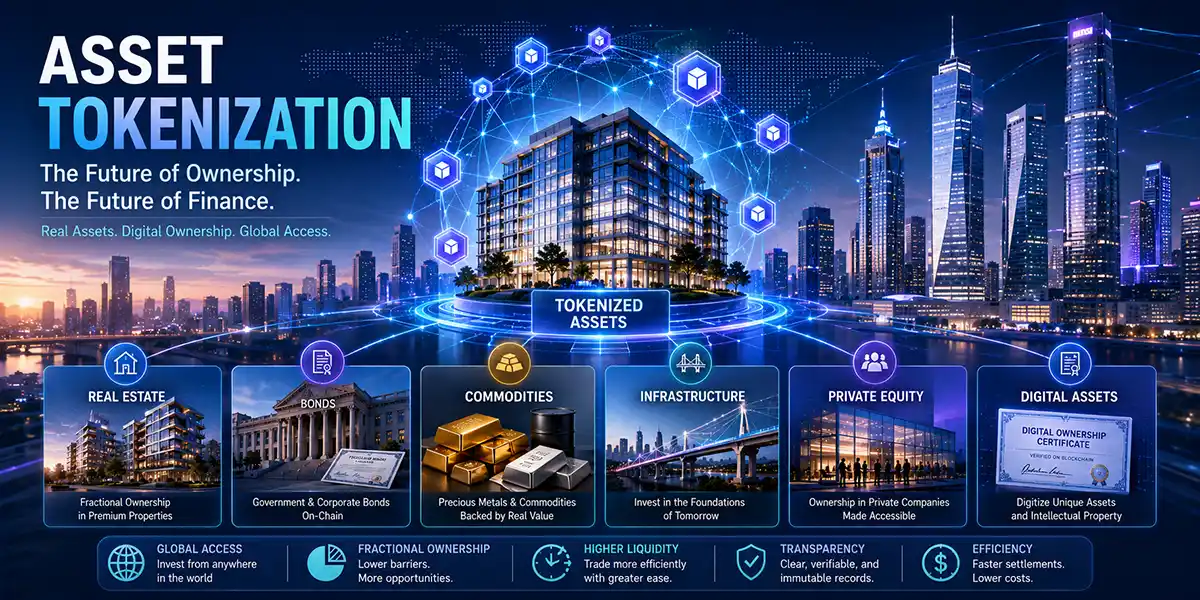
What Is Asset Tokenization and Why It Could Transform Global Finance
When most people hear the words blockchain or crypto, they often think of digital currencies such as Bitcoin. However, one of the most important innovations emerging from blockchain technology may have little to do with cryptocurrency itself. Instead, it focuses on transforming how ownership is recorded, transferred, and managed in the digital age.
This innovation is known as asset tokenization. Many industry experts believe it could become one of the most significant developments in the future of finance, bringing trillions of dollars worth of real-world assets onto blockchain networks.
From commercial real estate and government bonds to commodities and private equity, asset tokenization has the potential to make investing more accessible, efficient, and transparent while opening entirely new opportunities for businesses and individuals in the Future Digital Economy.
What Is Asset Tokenization?
Asset tokenization is the process of converting ownership rights in a physical or digital asset into blockchain-based digital tokens.
Each token represents a share or fractional ownership of an underlying asset. These tokens can then be bought, sold, transferred, or traded using blockchain technology.
Imagine a commercial office building valued at $50 million. Instead of requiring a single buyer or a small group of investors, the property could be divided into millions of digital ownership tokens. Investors could then purchase only the amount they wish to own.
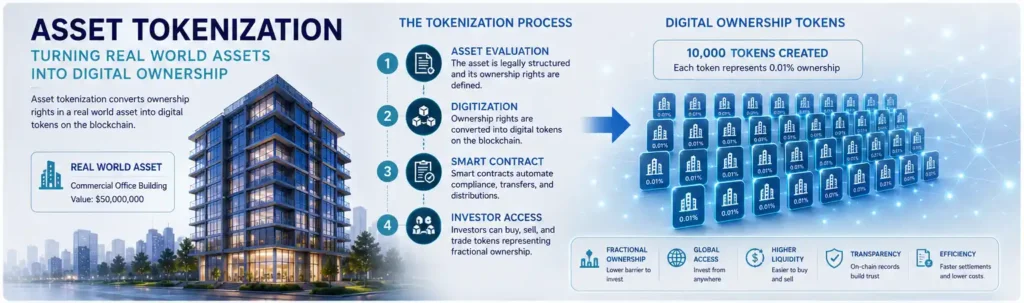
This creates opportunities for broader participation while potentially increasing liquidity and accessibility.
What Assets Can Be Tokenized?
One of the most exciting aspects of asset tokenization is that almost any asset with value can potentially be represented on a blockchain.
- Commercial and residential real estate
- Stocks and equities
- Government and corporate bonds
- Gold and commodities
- Infrastructure investments
- Private equity
- Art and collectibles
- Intellectual property
- Carbon credits
- Business ownership interests
This ability to digitally represent ownership creates entirely new possibilities for investing, capital formation, and digital ownership.
Why Asset Tokenization Matters
The traditional financial system often involves multiple intermediaries, lengthy settlement times, geographic restrictions, and high barriers to entry. Asset tokenization offers an alternative approach built on digital infrastructure.
Organizations such as the World Economic Forum have identified asset tokenization as one of the key innovations capable of improving accessibility, liquidity, and efficiency across global financial markets.
Fractional Ownership
Investors can purchase small portions of high-value assets rather than needing significant capital upfront.
Greater Liquidity
Traditionally illiquid assets such as real estate and private equity may become easier to buy and sell through tokenized marketplaces.
Global Access
Blockchain networks can enable participation from investors around the world, potentially expanding access to investment opportunities.
Faster Settlement
Transactions that may currently take days can potentially settle in minutes or hours using blockchain-based systems.
Transparency and Trust
Ownership records and transaction histories can be verified through blockchain ledgers, improving transparency and reducing disputes.
Understanding Real World Assets (RWAs)
One of the fastest-growing areas of blockchain innovation is the tokenization of Real World Assets, often called RWAs.
RWAs are traditional physical or financial assets that are represented digitally on blockchain networks. They help bridge the gap between traditional finance and the emerging digital economy.
The tokenization of real-world assets has attracted growing attention from financial institutions, regulators, and technology providers. Research from the Bank for International Settlements (BIS) highlights how tokenized assets and programmable financial infrastructure could transform capital markets over the coming decade.
- Real estate
- Treasury bills
- Government bonds
- Private credit
- Infrastructure projects
- Commodities
- Corporate debt
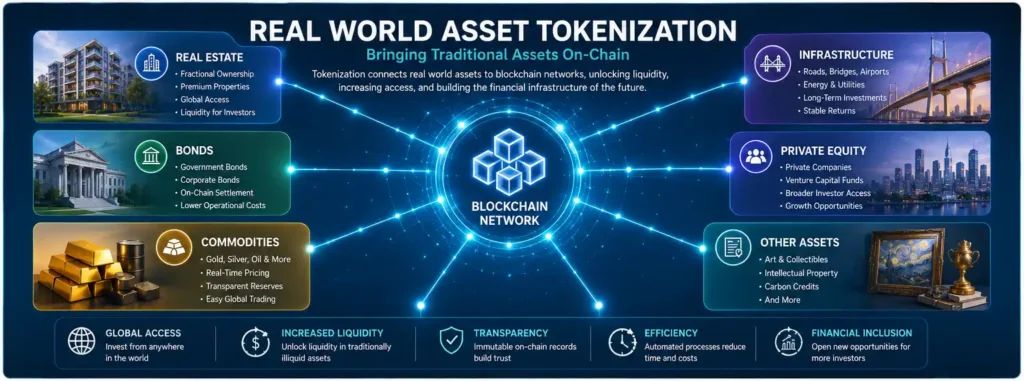
Many analysts view RWA tokenization as one of the most practical and scalable applications of blockchain technology because it solves real-world financial challenges while unlocking new investment opportunities.
How Blockchain Enables Asset Tokenization
Blockchain acts as a decentralized ledger that records ownership and transactions securely and transparently.
Smart contracts can automate processes that traditionally require intermediaries, including ownership transfers, compliance procedures, distributions, and reporting.
By reducing friction and increasing efficiency, blockchain infrastructure may significantly improve how assets are managed and exchanged globally.
Challenges and Risks of Asset Tokenization
While the potential is substantial, asset tokenization is still developing and faces several challenges.
- Regulatory uncertainty
- Custody and security concerns
- Technology adoption barriers
- Cross-border legal issues
- Market infrastructure development
As regulations mature and financial institutions continue exploring blockchain solutions, many of these challenges are expected to become easier to address.
The Future of Asset Tokenization
Asset tokenization represents far more than a blockchain trend. It signals a fundamental shift in how ownership may be recorded, transferred, and managed in the future digital economy.
Global organizations including the International Monetary Fund (IMF) continue to study the implications of blockchain-based financial systems, digital assets, and tokenization as governments and institutions explore the next generation of financial infrastructure.
Just as the internet transformed how information moves around the world, tokenization has the potential to transform how value and ownership move globally.
Over the coming decade, tokenized versions of real estate, financial products, infrastructure investments, and other assets may become a normal part of investing and wealth creation.
Final Thoughts
Asset tokenization is helping bridge the gap between traditional finance and the emerging digital economy. By making ownership more accessible, transparent, and efficient, it has the potential to unlock entirely new opportunities for investors, businesses, and global markets.
While the technology is still evolving, the direction is becoming increasingly clear: the future of finance is digital, programmable, and connected.

About the Author
Curtis Randall is an award-winning creative executive and future systems thinker helping people and businesses understand the future of work, technology, digital ownership, and creativity. Through CurtisRandall.com, and Sights.com, Curtis explores the systems shaping how people work, create, own, and build value in a rapidly changing world.
Connect with Curtis: LinkedIn · YouTube · Instagram · X · TikTok · Facebook · Threads
Want the Complete AI Video Marketing System?
The AI Video Marketing Kit for Creators gives you prompts, scripts, planners, affiliate video templates, course promo workflows, and repurposing tools to turn your ideas into useful video content faster.