
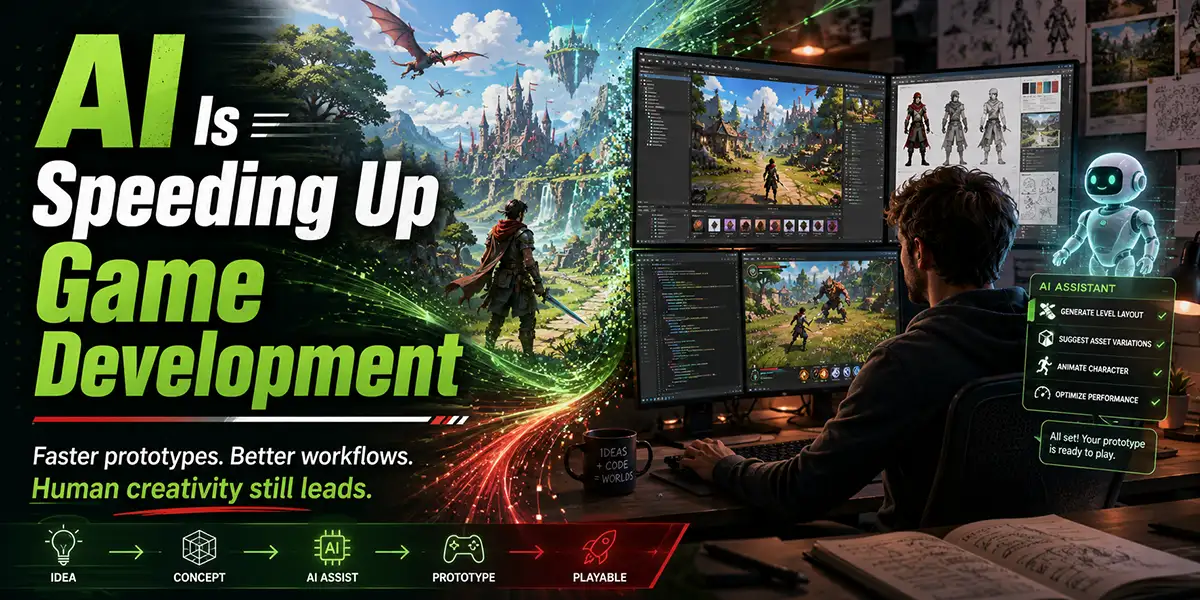
How AI Is Speeding Up Game Development Without Replacing Creativity
Game development has always been one of the most complex creative industries. A finished game is not just one idea. It is a combination of art, code, design, animation, sound, storytelling, world-building, user experience, testing, performance, marketing, and constant iteration.
That is why AI game development is becoming such an important topic. AI is not simply another trend for game studios to watch from a distance. It is becoming a practical tool that can help developers move faster from idea to playable prototype.
The important point is this: AI is not replacing creativity. It is speeding up the development process around creativity.
Developers still need to decide what the game is about, why players should care, how the mechanics feel, what the world looks like, how the story unfolds, and what makes the experience fun. AI can assist with coding, assets, testing, environments, dialogue drafts, and prototyping, but it does not automatically create a great game.
The future of AI in games is not about removing the developer. It is about giving developers faster tools, better workflows, and more room to experiment.
Why Game Development Takes So Long
To understand why AI matters in game development, it helps to understand why games are so difficult to make.
A game is interactive. That makes it different from a film, image, song, or article. A game has to respond to the player. It needs rules, systems, controls, feedback, progression, rewards, environments, characters, menus, animations, physics, and performance optimization.
Even a small game can involve dozens of moving parts. A character needs movement. The movement needs to feel good. The camera needs to behave properly. The level needs to guide the player. The enemies need logic. The user interface needs clarity. The audio needs timing. The gameplay loop needs balance.
This is why game development often involves so much iteration. Developers build, test, adjust, break things, fix them, and test again. The challenge is not only making something work. The challenge is making it feel fun.
AI can help because many parts of this workflow involve repeated tasks, first drafts, testing, and technical friction. If AI can reduce that friction, developers can spend more time improving the actual experience.
AI Game Development Starts With Faster Prototyping
One of the biggest opportunities for AI game development is prototyping.
Prototyping is the stage where a developer tests whether an idea works. This might be a new movement mechanic, a combat system, a puzzle concept, a level layout, or a simple interaction. The goal is not to create the final game. The goal is to discover whether the idea has potential.
AI can make this stage much faster. Instead of spending days setting up basic systems from scratch, developers can use AI tools to help generate code snippets, create rough placeholder assets, draft character behavior, build test environments, or summarize a design idea into a technical plan.
This is especially useful for indie developers and small teams. A solo developer may have a strong idea but limited time, limited budget, and limited support. AI can help them build early versions faster, test more ideas, and avoid getting stuck on repetitive setup work.
The faster a developer can prototype, the faster they can answer the most important question in game development: is this fun?
AI Can Help With Coding and Debugging
Code is one of the biggest areas where AI can speed up game development. Developers can use AI coding assistants to draft scripts, explain errors, suggest functions, refactor messy code, create documentation, and help with debugging.
In a game engine like Unity, this could mean generating a basic C# script for player movement, inventory logic, enemy behavior, camera controls, or UI interactions. In Unreal Engine, AI can help explain Blueprint logic, suggest C++ structures, or help translate a gameplay idea into a technical workflow.
This does not mean AI code should be accepted blindly. Game development code needs to be tested carefully because small bugs can break gameplay, performance, save systems, or physics. AI-generated code should be treated as a draft, not a final answer.
The real value is speed. AI can help developers get past the blank page, understand unfamiliar systems, and find possible solutions faster. Human developers still need to review, test, and improve the result.
AI Tools Are Moving Into Game Engines
Another reason AI game development is becoming more important is that AI tools are moving closer to the engines developers already use.
Unity promotes Unity AI as a way to streamline game development through an in-editor assistant that can help automate tasks, generate assets, and simplify workflows. This matters because AI becomes more useful when it is built into the environment where creators are already working.
Unreal Engine is also part of this larger AI-assisted future. Research projects are exploring how multi-agent systems can generate 3D games inside Unreal Engine by coordinating tasks such as scene generation, gameplay code, interaction logic, and automated testing.
This does not mean fully automated games are suddenly replacing game studios. It means the development environment is becoming more intelligent. AI will increasingly act like a production assistant inside the tools developers already know.
That is a major shift. Developers will not always need to leave the engine to get AI support. The help will become part of the workflow.
AI Can Speed Up Asset Creation
Visual assets can take a lot of time. Characters, props, textures, environments, icons, interface elements, concept art, animation references, and marketing visuals all require creative labor.
AI can help developers create rough concepts, placeholder assets, mood boards, texture ideas, environmental references, and early visual directions. This is useful because early development does not always need final-quality art. It often needs enough visual material to test direction and communicate the idea.
For example, a developer working on a sci-fi survival game might use AI to explore different environment styles, generate concept images for abandoned stations, test color palettes, or create rough creature silhouettes. These assets may not go directly into the final game, but they can help the team make faster creative decisions.
This is where the difference between inspiration and final production matters. Many studios may use AI for ideation and internal references while still relying on human artists for final assets, quality control, originality, and consistency.
AI can help generate possibilities. Artists still define the style.
AI Can Help Build Bigger Worlds Faster
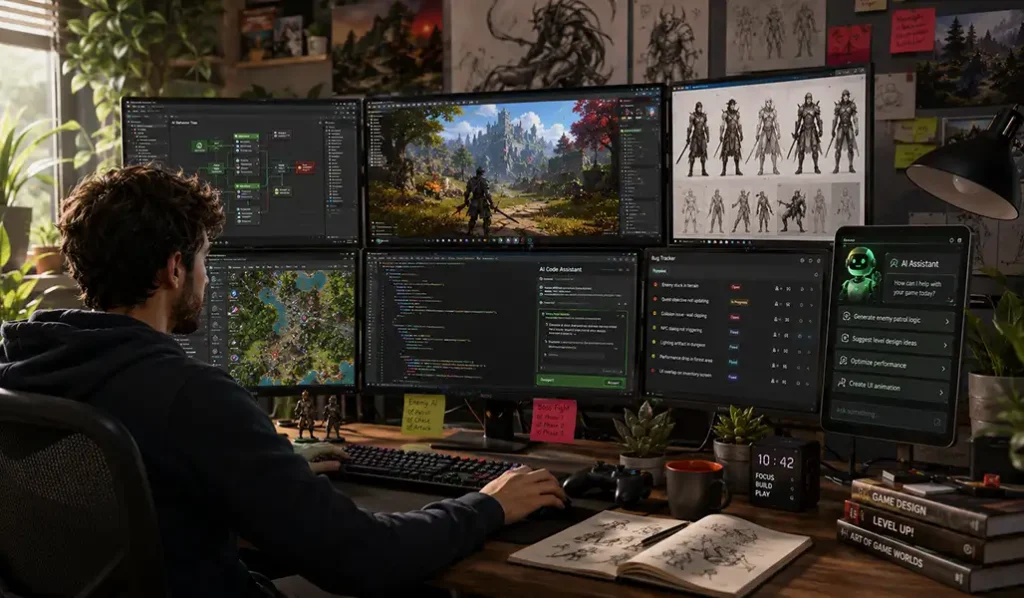
World-building is another area where AI can help speed up development. Many games require large environments, background details, lore, NPC dialogue, side quests, item descriptions, maps, and environmental storytelling.
AI can help generate rough drafts for these elements. A writer or designer could use AI to brainstorm faction names, location descriptions, quest ideas, character backstories, item descriptions, or alternate dialogue options.
Again, the key word is draft. AI-generated world-building can become generic if it is not directed by a strong creative vision. The developer needs to decide what belongs in the world and what does not.
The best use of AI is to create raw material that the creative team can shape. Instead of staring at a blank page, designers can start with options, reject the weak ones, improve the strongest ones, and build a more detailed world faster.
AI for NPC Behavior and Dynamic Gameplay
AI has always been part of games in some form. Enemy behavior, pathfinding, difficulty adjustment, and non-player character logic have used different forms of AI for decades.
The newer conversation around generative AI is different. Developers are now exploring ways to create more dynamic NPCs, more responsive dialogue, and more personalized gameplay experiences.
This could change how open-world games, role-playing games, simulations, and live-service games feel. Instead of every interaction being fully scripted, future games may include characters that can respond more naturally to player choices.
However, this also creates challenges. Developers need to manage tone, safety, consistency, lore accuracy, performance, moderation, and player expectations. A dynamic NPC is exciting only if it still feels like it belongs in the game world.
AI can make games feel more alive, but it needs careful design.
AI Can Improve Testing and Quality Assurance
Testing is one of the most important parts of game development. Games can break in many ways because players do unexpected things. They jump where they should not jump, open menus during animations, exploit physics, skip triggers, stack items, or find strange paths through a level.
AI can help with automated testing by simulating player actions, checking for bugs, identifying broken interactions, testing performance, and helping developers find problems earlier.
This can be especially valuable for larger games with many systems. Every new feature can create new bugs. AI-assisted testing can help teams run more checks more often, which may reduce the amount of manual testing needed for basic issues.
Human testers are still essential because they understand experience, feel, frustration, balance, and fun. AI can help detect problems. Humans decide whether the game feels good.
Why AI Will Not Replace Game Creativity
The biggest fear around AI game development is that AI will replace artists, writers, designers, and developers. That concern is understandable, especially in an industry already dealing with pressure, layoffs, rising costs, and intense competition.
But great games are not created by production speed alone. A game can have beautiful assets, clean code, and advanced systems and still fail if it is not fun, memorable, or emotionally engaging.
Creativity in games is about judgment. It is about knowing what to keep, what to cut, what to simplify, what to polish, and what makes the player want to keep playing.
AI can generate ideas, but it does not understand player emotion the way a designer does. It can create dialogue, but it does not automatically know the soul of a character. It can generate assets, but it does not automatically build a visual identity. It can suggest mechanics, but it does not know whether the mechanic feels satisfying.
The best games still need human taste, originality, and direction.
How Indie Developers Benefit From AI Game Tools
Indie developers may benefit the most from AI game development tools because they often have the fewest resources.
A small team may not have a full-time concept artist, technical artist, writer, QA tester, producer, marketer, and programmer. AI can help cover some of the early-stage workload by assisting with first drafts, planning, research, code support, and content variations.
This does not mean every indie game will become easy to make. Shipping a polished game is still difficult. But AI may help more creators reach the prototype stage, test ideas, and build proof-of-concept demos.
That matters because many good ideas never get tested. The developer gets stuck before the game becomes playable. AI can help reduce that early friction.
For indie creators, the advantage is not just speed. It is momentum.
A Practical AI Game Development Workflow
A smart AI-assisted game development workflow should keep humans in control while using AI to speed up repetitive or early-stage tasks.
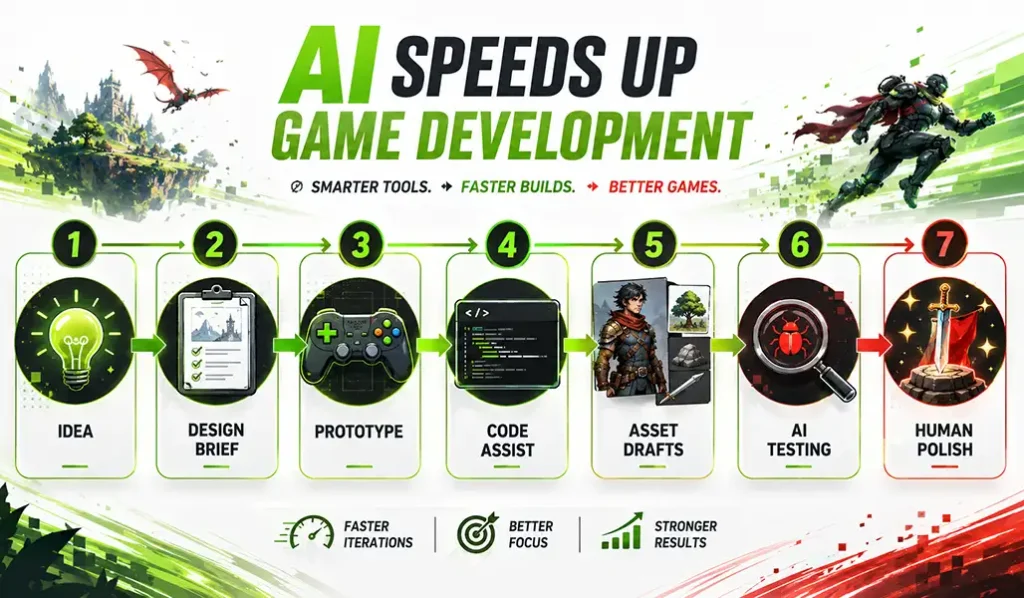
A practical workflow might look like this:
- Start with the core idea: Define the player fantasy, genre, mechanic, and emotional experience.
- Create a simple design brief: Use AI to help organize the concept into goals, systems, characters, and features.
- Prototype the core mechanic: Use AI coding support to speed up early scripts and engine setup.
- Generate placeholder assets: Use AI for mood boards, references, rough visuals, and temporary content.
- Test quickly: Use AI-assisted testing and debugging to find issues earlier.
- Refine with human judgment: Cut weak ideas, improve the strongest ones, and focus on what feels fun.
- Build a repeatable pipeline: Turn the process into a system for future features, levels, and updates.
This kind of workflow gives developers the best of both worlds. AI helps with speed. Humans protect quality.
The Future of AI in Game Development
The future of AI game development will likely be more integrated, more visual, and more interactive.
Developers may describe a game mechanic in natural language and receive a working prototype. Artists may create concept variations inside the engine. Designers may generate test levels and instantly adjust difficulty. Writers may test dialogue branches faster. QA teams may use AI agents to search for bugs before players ever see the build.
This future will not remove the hard parts of game creation. It may actually raise creative expectations. If tools make production faster, players may expect richer worlds, more polished experiences, and more frequent updates.
That means the winning studios and creators will not be the ones who use AI simply to make more content. They will be the ones who use AI to make better decisions faster.
Final Takeaway
AI game development is not about replacing the people who make games. It is about speeding up the journey from idea to prototype, from prototype to testable build, and from testable build to polished experience.
AI can help with code, assets, world-building, testing, documentation, dialogue drafts, and production workflows. But it cannot replace the creative judgment that makes a game worth playing.
The future belongs to developers who learn how to direct AI without giving up creative control.
AI can help build the game faster.
Human creativity still makes the game matter.
FAQ: AI Game Development
What is AI game development?
AI game development is the use of artificial intelligence tools to support game creation. This can include coding, prototyping, asset creation, animation, dialogue, testing, level design, NPC behavior, and production planning.
Will AI replace game developers?
AI may automate some repetitive development tasks, but it will not replace the need for human creativity, design judgment, storytelling, gameplay testing, art direction, and final decision-making.
How can AI speed up game development?
AI can speed up game development by helping developers generate code drafts, create placeholder assets, brainstorm design ideas, test systems, debug issues, write documentation, and build prototypes faster.
Is AI useful for indie game developers?
Yes. AI can be especially useful for indie developers because it helps small teams move faster, test ideas earlier, and reduce the amount of repetitive setup work needed to reach a playable prototype.
What parts of game development should still be human-led?
Game vision, creative direction, final art style, gameplay feel, story quality, player experience, balance, and polish should remain human-led. AI can assist the process, but humans should guide the result.
Sources and Further Reading
Unity AI: AI Game Development Tools
Unity 2026 Game Development Report
AutoUE: Automated Generation of 3D Games in Unreal Engine via Multi-Agent Systems
Automated Unity Game Template Generation from GDDs via NLP and Multi-Modal LLMs