

Boosting AI Search Visibility: How to Build AI-Powered SEO Visibility
AI search is changing how people discover brands, products, services, creators, and ideas online. For years, search visibility was mostly about ranking on Google’s traditional results page. Today, visibility also means being included, cited, summarized, recommended, or referenced inside AI-generated answers.
This is where AI search visibility becomes important. It is not just about ranking for keywords anymore. It is about making your content clear, trustworthy, structured, useful, and easy for AI-powered search systems to understand.
For creators, marketers, agencies, small businesses, and digital brands, this shift matters because AI-powered search experiences are changing the path between a question and a click. People may ask longer questions, compare options directly inside search, or get a summarized answer before visiting a website.
That does not mean SEO is dead. It means SEO is expanding. The future of SEO is not only about keywords and backlinks. It is about building a stronger visibility system that works for traditional search engines, AI Overviews, answer engines, chatbots, and discovery platforms.
The brands that win in AI search will be the ones that make their expertise easy to find, easy to verify, and easy to trust.
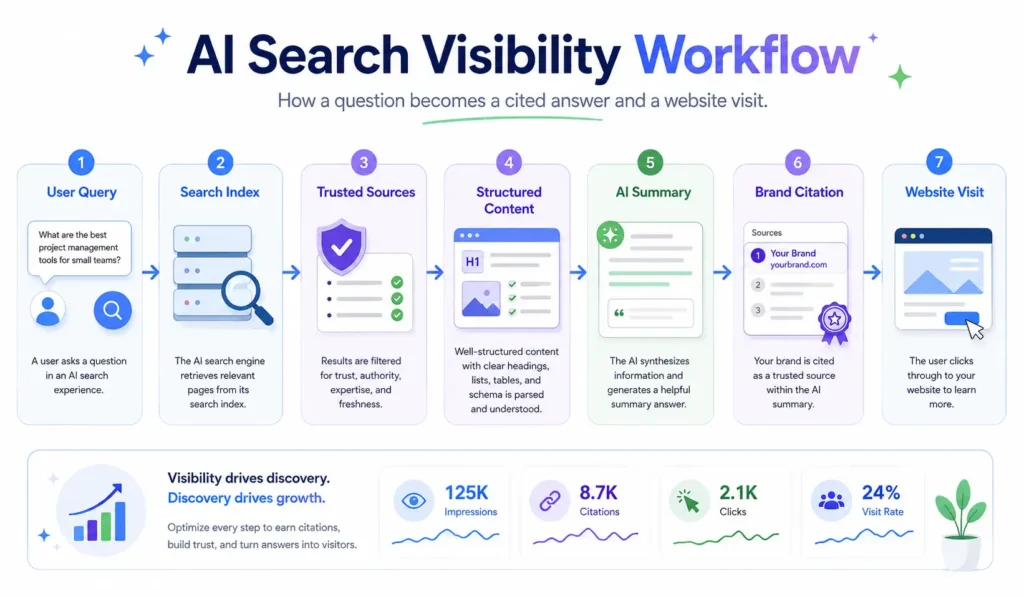
What Is AI Search Visibility?
AI search visibility is the ability of your brand, content, products, or expertise to appear inside AI-powered search experiences. This can include Google AI Overviews, AI Mode, ChatGPT-style search experiences, Perplexity-style answer engines, Bing Copilot, Gemini, and other AI discovery tools.
Traditional SEO focuses on helping pages rank in search results. AI search visibility focuses on helping your information become part of the answer.
That difference is important. In a traditional search result, users scan a list of links. In AI search, users may receive a synthesized answer that pulls from multiple sources. Your goal is no longer just to be one of the links. Your goal is to become a trusted source that AI systems can confidently reference.
This does not replace SEO. It builds on it. Good technical SEO, helpful content, clear page structure, fast performance, and strong authority signals still matter. But AI-powered discovery adds another layer: your information must be clear enough for machines to interpret and credible enough for them to use.
Why AI-Powered SEO Visibility Matters Now
AI-powered search is changing user behavior. People are asking more specific questions, using natural language, and expecting direct answers. Instead of searching for “best email marketing tools,” a user might ask, “What is the best email marketing tool for a small coaching business that wants automation but has a limited budget?”
That type of query changes the content game. Generic articles are less useful. Thin list posts are less useful. Vague marketing pages are less useful. AI search favors content that directly answers real questions with clarity, depth, and context.
This creates a major opportunity for smaller brands. You may not be able to outrank major companies for broad keywords, but you can become visible for specific questions, niche expertise, detailed comparisons, practical workflows, and original insights.
In other words, AI search visibility rewards content that is useful enough to be quoted, summarized, or recommended.
AI Search Visibility Is Still Built on SEO Fundamentals
There is a lot of hype around terms like AEO, GEO, LLM optimization, and answer engine optimization. These terms can be useful, but they can also make the process sound more mysterious than it really is.
The foundation is still SEO. Your website needs to be crawlable. Your pages need to load properly. Your content needs to be useful. Your site structure needs to make sense. Your titles, headings, internal links, schema, and metadata still matter.
AI-powered SEO visibility does not mean chasing tricks. It means improving the quality and clarity of the signals your brand sends online.
Think of it this way: traditional SEO helps search engines find and rank your content. AI-powered SEO helps search engines understand, trust, and reuse your content in answers.
The New Rules of AI Search Visibility
To improve AI search visibility, brands need to think beyond simple keyword targeting. The goal is to create content that can be understood by both people and machines.
Here are the new rules that matter most.
1. Answer Real Questions Clearly
AI search systems are built around questions and answers. That means your content should answer real user questions clearly and directly.
Every article, product page, service page, and guide should make it obvious what question it answers. If your content takes too long to get to the point, it becomes harder for AI systems and human readers to extract value from it.
A strong AI-ready answer usually includes a clear definition, a practical explanation, examples, supporting details, and a takeaway. This makes your content more useful for search engines, AI assistants, and readers.
2. Structure Content for Easy Understanding
Content structure is one of the most important parts of AI-powered SEO. A well-structured article is easier to scan, easier to quote, and easier for search systems to interpret.
Use clear headings, short sections, descriptive subheadings, bullet points when helpful, comparison tables, FAQs, summaries, and step-by-step frameworks. Avoid walls of text. Avoid vague headlines. Avoid burying the main answer halfway down the page.
Good structure helps human readers. It also helps AI systems identify the key ideas on the page.
3. Build Topical Authority
AI search visibility improves when your website becomes a trusted source on a specific topic. That means you should not publish random content with no connection between posts. You need a topical content system.
For example, a website focused on digital marketing could build topic clusters around AI SEO, content creation, video marketing, social media strategy, branding, and creator tools. Each article should connect to related articles through internal links.
This helps search engines understand what your site is about. It also helps readers move through your content in a logical way.
4. Make Your Brand Facts Consistent Everywhere
AI search systems do not only look at one page. They may compare information from your website, social profiles, business listings, news mentions, review sites, directories, videos, podcasts, and other sources.
If your brand information is inconsistent, it becomes harder for AI systems to know what is accurate. Your company name, founder name, location, services, product descriptions, social links, and expertise should be consistent across the web.
This is especially important for businesses, personal brands, agencies, creators, consultants, and local companies.
AI-powered SEO is not only about your website. It is about your entire digital footprint.
5. Use Schema and Structured Data
Structured data helps search engines understand the meaning of your pages. It can clarify whether a page is an article, FAQ, product, service, organization, local business, video, recipe, review, or event.
Schema will not magically guarantee AI search visibility, but it improves clarity. It helps search systems understand your content and connect it to the right context.
For most content-focused websites, useful schema types may include Article, BlogPosting, FAQPage, Organization, Person, Product, Service, VideoObject, and BreadcrumbList.
6. Create Original, Useful Content
AI search creates a problem for generic content. If an article only repeats what dozens of other websites already say, there is little reason for AI systems or readers to treat it as special.
Original content matters more than ever. This can include your own examples, frameworks, opinions, workflows, case studies, templates, checklists, data, screenshots, product experience, or expert commentary.
The goal is to create content that adds something useful to the conversation.
AI can summarize generic content. It has a harder time replacing original experience.
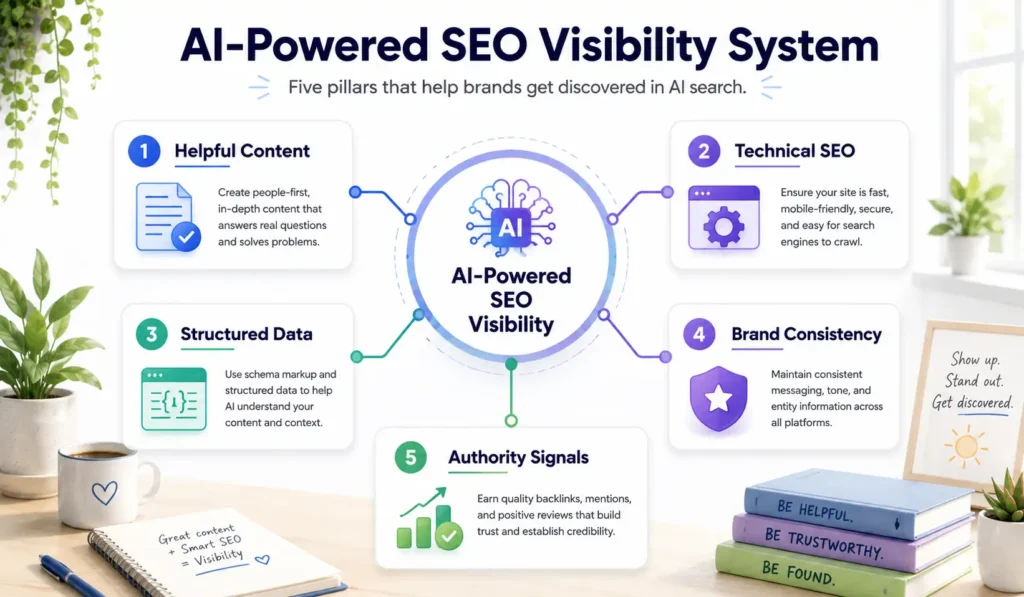
How to Build an AI-Powered SEO Visibility System
Boosting AI search visibility is not a one-time task. It is a system. The best approach is to build a repeatable workflow that improves your content, structure, authority, and measurement over time.
Step 1: Audit Your Current AI Search Visibility
Start by checking how your brand appears in AI-powered search tools. Search for your brand name, founder name, product name, service category, and important customer questions.
Look for answers to questions like:
- Does AI search understand what your brand does?
- Are your products or services described accurately?
- Are competitors mentioned when you are not?
- Are your articles being cited or ignored?
- Are outdated details appearing in answers?
- Are third-party sources describing your brand correctly?
This gives you a baseline. You cannot improve AI search visibility until you know how your brand is currently being understood.
Step 2: Build Question-Based Content
AI search is driven by natural language questions. Your content strategy should include the questions your audience is actually asking.
Instead of only targeting broad keywords, create content around specific questions, comparisons, problems, and decisions.
For example, instead of writing only “AI marketing tools,” create articles like:
- How can small businesses use AI to create weekly content?
- What is the best AI workflow for repurposing blog posts?
- How do AI search engines choose which brands to mention?
- What is the difference between SEO, AEO, and GEO?
- How can creators improve visibility in Google AI Overviews?
Question-based content gives AI systems clearer material to work with and gives your audience more useful answers.
Step 3: Create Content Clusters
A content cluster is a group of related articles built around one major topic. This helps search engines understand your expertise and helps readers explore related ideas.
For example, a cluster around AI search visibility could include:
- What is AI search visibility?
- How to optimize content for AI Overviews
- How to use schema for AI-powered SEO
- How to build topical authority for AI search
- How to track brand mentions in AI answer engines
- How creators can use AI SEO tools
Each article should link to the others where relevant. This creates a stronger topical map for both users and search engines.
Step 4: Strengthen Your Source Signals
AI search systems look for trustworthy information. Your website should make your expertise clear.
Add author bios, credentials, company information, contact details, editorial standards, dates, sources, examples, and relevant internal links. Show who is behind the content. Show why the content should be trusted.
For businesses, this also means improving About pages, service pages, product pages, case studies, testimonials, reviews, and third-party profiles.
Trust is not created by one signal. It is built through consistency.
Step 5: Make Content Machine-Readable
Machine-readable content is content that is easy for search systems to process. This does not mean writing for robots. It means organizing your content so the meaning is clear.
Use descriptive headings, concise paragraphs, clean HTML, structured data, image alt text, internal links, clear navigation, and simple page layouts. Avoid hiding important content inside images, scripts, or complex design elements that are hard to crawl.
Your best information should be visible in the body of the page, not buried in graphics or vague marketing copy.
Step 6: Distribute Your Expertise Beyond Your Website
AI search visibility is influenced by more than your own website. Mentions across the web can help reinforce your authority.
This can include guest articles, podcast appearances, YouTube videos, LinkedIn posts, industry directories, press mentions, interviews, case studies, reviews, and partnerships.
The goal is to create a digital footprint that confirms your expertise from multiple angles.
When AI systems see consistent information about your brand across trusted sources, your visibility can become stronger.
What AI SEO Tools Can Help With
AI tools can help improve SEO visibility, but they should not replace strategy. The best use of AI is to speed up research, planning, optimization, and content improvement.
AI-powered SEO tools can help with:
- Finding audience questions
- Building topic clusters
- Creating content briefs
- Improving headings and structure
- Generating FAQ sections
- Reviewing content gaps
- Summarizing competitor coverage
- Repurposing content for social platforms
- Checking brand consistency
- Creating schema suggestions
However, AI tools should be guided by human judgment. A tool can suggest content. A strategist decides whether that content is useful, accurate, original, and aligned with the brand.
Common Mistakes That Hurt AI Search Visibility
Many brands will struggle with AI search visibility because they focus on shortcuts instead of fundamentals.
One common mistake is publishing too much generic AI-generated content. More content does not automatically mean more authority. If the content is thin, repetitive, or unhelpful, it may weaken your brand instead of strengthening it.
Another mistake is ignoring technical SEO. If search engines cannot crawl, render, or understand your pages, AI visibility becomes much harder.
A third mistake is inconsistent brand information. If your website says one thing, your LinkedIn says another, and third-party directories say something outdated, AI systems may struggle to understand which version is correct.
The biggest mistake is thinking AI search optimization is a trick. It is not. It is a long-term visibility strategy.
A Simple AI Search Visibility Checklist
Use this checklist to improve your AI-powered SEO visibility:
- Make sure your website is crawlable and technically healthy.
- Create helpful content that directly answers specific audience questions.
- Use clear headings, short sections, and logical page structure.
- Add schema where appropriate.
- Build topic clusters around your core expertise.
- Keep brand facts consistent across your website and profiles.
- Add author bios, sources, examples, and trust signals.
- Create original insights, examples, workflows, or case studies.
- Update old content so it stays accurate.
- Track how your brand appears in AI search tools over time.
How to Measure AI Search Visibility
Measuring AI search visibility is still evolving. Traditional SEO tools are useful, but they do not always show whether your brand is appearing inside AI-generated answers.
A practical measurement system should include both traditional SEO metrics and AI visibility checks.
Track keyword rankings, organic traffic, impressions, clicks, backlinks, indexed pages, and conversions. Then add manual or tool-assisted checks for AI answer visibility.
Search for your most important customer questions in AI-powered search tools. Record whether your brand appears, whether your competitors appear, which sources are cited, and whether the answer is accurate.
This gives you a practical view of how your brand is showing up in the new search environment.
The Future of AI-Powered SEO
The future of SEO will be more connected to trust, structure, authority, and usefulness. Keywords will still matter, but they will not be enough on their own.
Brands will need to think like publishers, educators, and source builders. They will need to create content that answers real questions, demonstrates expertise, and stays consistent across the web.
This is good news for creators and small businesses that are willing to be genuinely helpful. AI search creates new opportunities for niche expertise, practical guides, strong opinions, original workflows, and clear explanations.
The brands that win will not be the ones that try to game AI systems. They will be the ones that become easier to understand, easier to trust, and easier to recommend.
Final Takeaway
Boosting AI search visibility is not about abandoning SEO. It is about upgrading SEO for a new search environment.
The foundation is still helpful content, technical clarity, authority, and trust. The new layer is making your brand and content easier for AI systems to understand, verify, summarize, and recommend.
AI-powered SEO visibility belongs to brands that build clear content systems, answer real questions, maintain consistent information, and create useful resources worth citing.
Search is changing. Visibility is changing with it.
The best strategy is simple: become the clearest and most trusted answer in your space.
FAQ: AI Search Visibility
What is AI search visibility?
AI search visibility is the ability of your brand, website, or content to appear inside AI-powered search results, AI-generated answers, AI Overviews, answer engines, and chatbot-style discovery tools.
Is AI search optimization different from SEO?
AI search optimization builds on SEO. Traditional SEO helps search engines find and rank your content. AI search optimization helps search engines understand, trust, summarize, and recommend your content in AI-generated answers.
How can I improve AI-powered SEO visibility?
You can improve AI-powered SEO visibility by creating helpful content, answering specific questions, using clear structure, adding schema, building topic clusters, keeping brand facts consistent, and earning trusted mentions across the web.
Does schema help with AI search visibility?
Schema can help search engines better understand your content. It does not guarantee AI search visibility, but it improves clarity and can support stronger SEO signals.
Can AI-generated content rank in search?
AI-generated content can perform if it is helpful, accurate, original, and created for people. Low-quality automated content that adds little value is unlikely to build strong long-term visibility.
Sources and Further Reading
Google Search Central: AI Features and Your Website
Google Search Central: Optimizing for Generative AI Features
Google Search Central: Succeeding in AI Search