
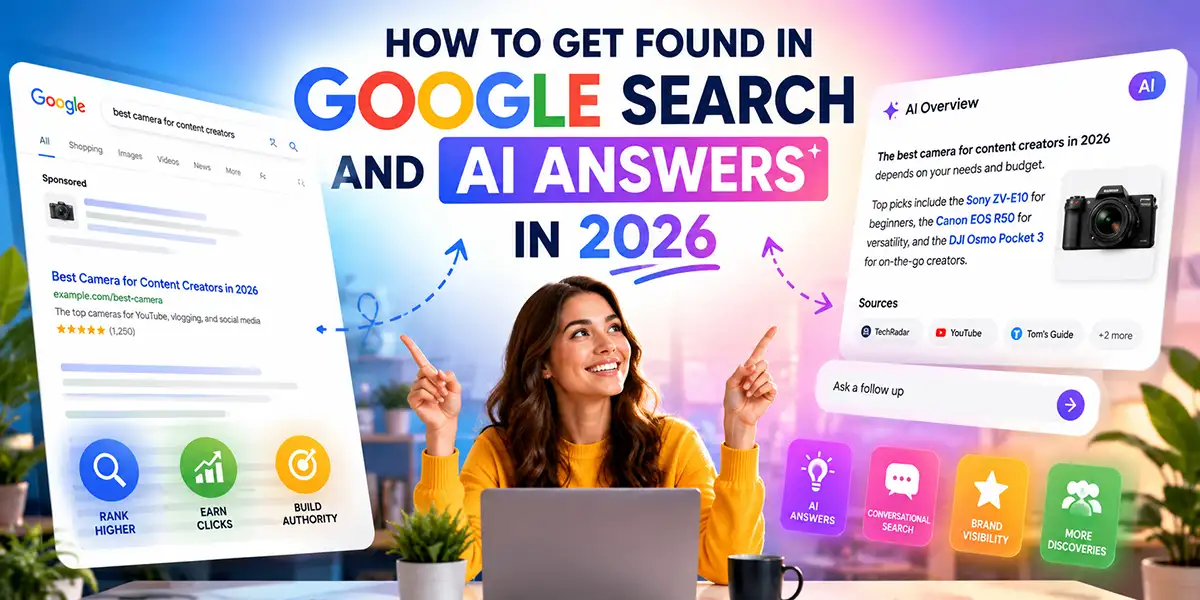
How to Get Found in Google Search and AI Answers in 2026
Search is changing again, but this time the shift is bigger than a normal algorithm update. Brands, creators, and marketers are no longer optimizing only for traditional Google rankings. They are now competing for visibility inside AI-generated answers, AI Overviews, and more conversational search experiences. That makes Google search and AI visibility one of the most important topics in digital marketing right now.
Google has continued expanding AI-powered search experiences, including AI Mode and broader AI-generated answer surfaces. Google describes AI Mode as a more advanced search experience with stronger reasoning, multimodality, and follow-up capabilities, while recent industry coverage shows Google pushing even deeper into AI-driven search, ads, and conversational discovery. That means search visibility is no longer only about being listed in blue links. It is also about becoming a source AI systems choose to summarize, cite, and surface for users. Google AI Mode update. Google Marketing Live 2026 coverage.
For content creators, businesses, agencies, and media brands, this creates a new challenge and a new opportunity. You still need strong rankings. But you also need content that is clear, authoritative, structured, and useful enough to be recognized by AI-generated search interfaces. In 2026, the winning strategy is not one or the other. It is both.
Why Google search and AI visibility now matter together
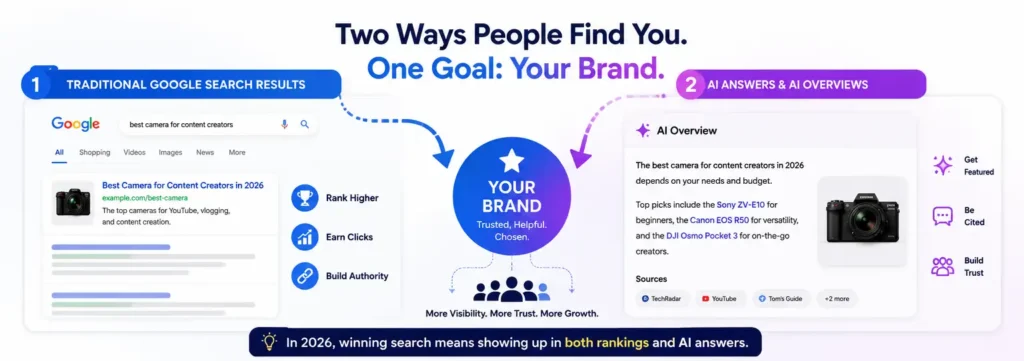
For years, SEO was mostly about ranking pages, winning clicks, and improving traffic from search engine results pages. That still matters. But AI-generated search experiences are changing how people discover information. Instead of scanning ten links, users are increasingly getting summaries, synthesized answers, and follow-up prompts right inside the search interface.
Google’s AI search direction has made this clearer. AI Mode was introduced as a more advanced, end-to-end AI search experience, and AI Overviews continue to shape how information is presented on the results page. At the same time, Google is testing new conversational formats in search and ads, signaling that the search page itself is becoming more interactive and AI-driven. Google AI Mode. Conversational ad formats in AI Mode and Search.
This matters because a search result no longer always begins with a list of websites. Sometimes it begins with an answer. If your brand is not part of the answer layer, you may lose visibility even if your site still ranks reasonably well. On the other hand, if your content becomes a trusted source for AI-generated responses, your authority can expand beyond traditional rankings.
What is changing in Google search and AI visibility in 2026
Several shifts are happening at once. First, AI-generated responses are becoming more common and more capable. Second, search behavior is becoming more conversational, which means long, intent-rich queries are growing in importance. Third, Google’s ecosystem is aligning search, advertising, shopping, and media more tightly around AI.
Recent reporting from Search Engine Land noted that Google introduced an “intelligent search box,” described as the biggest change to the search box in 25 years, designed to make AI search features easier to access. Meanwhile, Google Marketing Live 2026 reinforced that Gemini is increasingly shaping Search, advertising, commerce, and measurement as one more conversational system. Intelligent Search box coverage. Google Marketing Live 2026.
There is another important signal here too: visibility is becoming less dependent on one exact keyword. AI systems are better at understanding intent, relationships, and context. That means brands must think more broadly about topical authority, content depth, consistency, and how clearly their expertise is communicated across formats.
How to improve Google search and AI visibility with stronger content
The first step is to stop thinking about content as isolated blog posts made only to target keywords. In this new environment, content needs to answer real questions clearly and completely. AI systems prefer material that is well-structured, direct, and easy to interpret. Search engines still value relevance and authority, but AI layers also benefit from content that can be summarized accurately.
That means your articles should include strong headings, clear explanations, practical examples, and concise answers inside the body of the piece. You should also build topical clusters around key subjects rather than publishing random disconnected posts. When your site repeatedly covers a niche with depth and consistency, both search engines and AI systems are more likely to understand what you are known for.
It also helps to create content in multiple formats. Text still matters, but video, images, data visuals, and structured explainers can reinforce your authority. Google’s AI direction is increasingly multimodal, which means content that works across media may become easier for the ecosystem to connect with broader discovery experiences.
- Answer real questions directly: write content that solves specific problems clearly.
- Use structured formatting: headings, lists, summaries, and clean page organization help both people and machines.
- Build topical authority: publish multiple connected pieces around your core expertise.
- Support claims with credible sources: trustworthy content is more likely to be referenced.
- Create multimedia assets: video, visuals, and supporting media can strengthen search visibility.
Why brand strength is part of Google search and AI visibility
One of the biggest misunderstandings in SEO is the belief that rankings alone build a business. In reality, the strongest brands tend to perform better because people recognize them, search for them directly, trust their information, and engage with their content across channels. In AI search, this may become even more important.
AI systems are not only matching keywords. They are identifying useful sources, known entities, and credible information patterns. That makes brand consistency, author credibility, and editorial quality more valuable. If your brand has a clear point of view, a recognizable niche, and content that people remember, your chances of being surfaced in search and AI answers improve.
For creators and founder-led brands, this is actually good news. You do not need to be the biggest site on the internet. But you do need to be one of the clearest, most useful, and most trustworthy voices in your lane.
How to measure Google search and AI visibility without relying on clicks alone
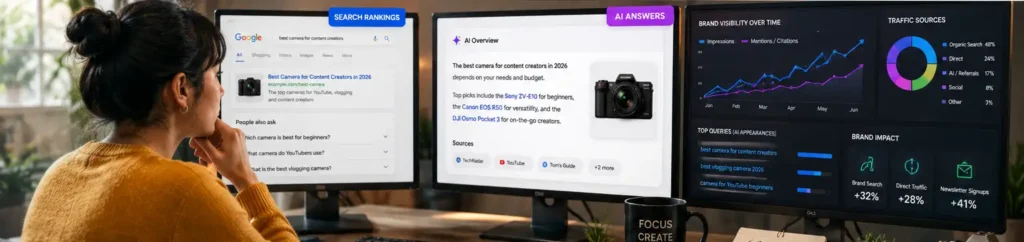
This is where many marketers will need to adjust their mindset. Traditional SEO reporting often focused heavily on rankings, clicks, impressions, and sessions. Those metrics still matter, but AI-generated search can reduce clicks even when your content is helping shape the answer. That creates a visibility problem that analytics tools do not always capture cleanly.
Industry reporting in 2026 has continued highlighting publisher concerns around reduced click visibility and changing behavior inside AI-driven search experiences. At the same time, some studies show signs that click-through rates may be stabilizing or recovering in certain cases. The key lesson is that success may need to be measured more broadly than before. Search Engine Journal on AI search links and click data. CTR recovery study coverage.
In practical terms, that means you should watch branded search growth, direct traffic, assisted conversions, newsletter signups, returning visitors, social shares, and mentions across platforms. Visibility is now more distributed. A user may first encounter your brand through an AI-generated answer, then visit later through branded search, YouTube, social media, or a direct visit. That journey still matters, even if it does not begin with a normal organic click.
What creators and marketers should do next
The best response to this shift is not panic. It is system building. Start by reviewing your existing content and identifying which pages genuinely answer important questions in your niche. Improve those pages first. Make them clearer, stronger, and more useful. Then build connected supporting content around them so your site becomes easier to understand as a trusted topic resource.
Next, tighten your brand identity. Make sure your content has a distinct point of view and is not interchangeable with generic AI-generated material. Then expand into multimedia where it makes sense, especially video and visual explainers that support your written expertise.
Finally, think beyond traffic. In 2026, winning in search means being discoverable, referencable, and memorable. The brands that adapt fastest will not just chase clicks. They will build authority that works across search engines, AI interfaces, media platforms, and audience communities.
The future of Google search and AI visibility
Search is no longer just a list of links. It is becoming a layered discovery system that includes rankings, summaries, answers, recommendations, and conversations. That changes the rules, but it also rewards better content. The future belongs to brands and creators who can communicate expertise clearly enough for both humans and AI systems to understand.
If your strategy still depends only on traditional SEO habits, now is the time to expand it. Build content that ranks. Build content that answers. Build a brand that gets remembered. That is how to get found in Google Search and AI answers in 2026.