
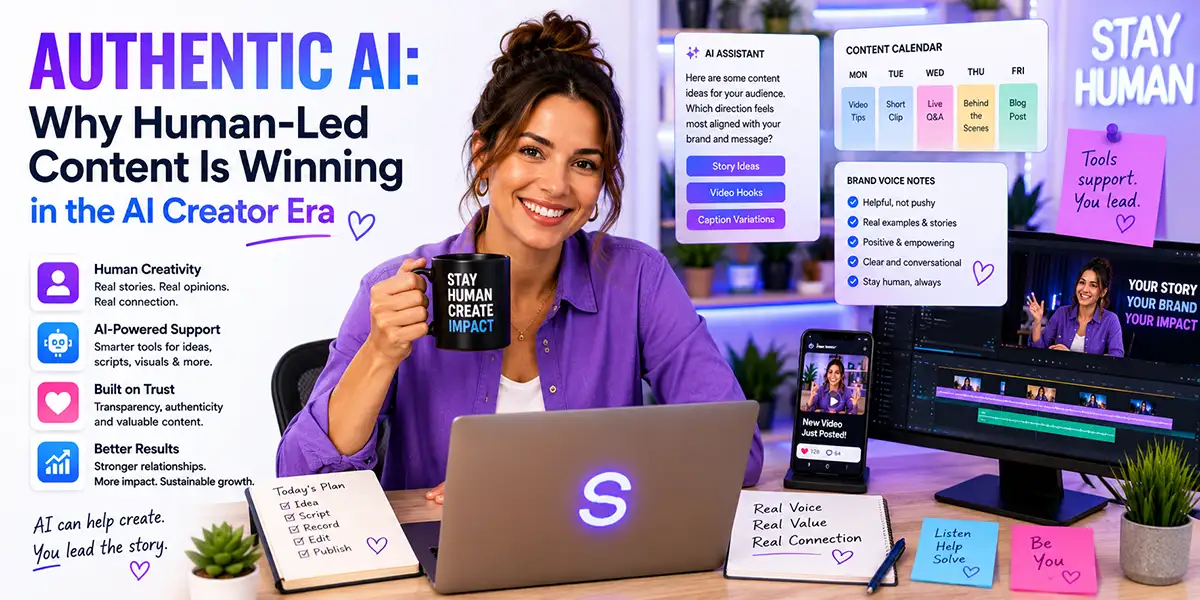
Authentic AI: Why Human-Led Content Is Winning in the AI Creator Era
AI is everywhere in content creation now.
Creators are using AI to write outlines, generate hooks, create visuals, edit videos, plan social posts, build content calendars, summarize research, and repurpose ideas across platforms.
That can be powerful. It can also become a problem.
As more AI-generated content floods the internet, audiences are becoming better at spotting content that feels generic, empty, overly polished, or disconnected from a real human point of view. People do not only want faster content. They want useful content, trustworthy content, and content that feels like it came from someone with real experience.
That is why Authentic AI is becoming such an important idea for creators, brands, marketers, and small businesses.
Authentic AI is not about rejecting AI. It is about using AI in a way that keeps human creativity, judgment, voice, and trust at the center.
Why Authentic AI Is Becoming Important Now
The first wave of AI content was about speed. People wanted to see how quickly AI could create articles, social posts, images, captions, videos, and ads.
The next wave is about trust.
When every creator has access to the same tools, speed alone is no longer enough. The difference comes from taste, perspective, editing, storytelling, experience, and brand direction.
A recent Vogue article described how brands are moving away from chasing virality and toward more intentional, value-driven ways of building trust. Digiday has also reported that after an oversaturation of AI-generated content, authenticity and originality are becoming major differentiators for creators and brands.
This shift matters because AI has made content easier to produce, but it has not made trust easier to earn.
What Authentic AI Really Means
Authentic AI means using AI as a creative assistant, not as a replacement for your voice.
It means AI can help you move faster, but you still decide what matters. AI can generate options, but you still choose the best direction. AI can suggest language, visuals, and workflows, but your brand personality and human judgment shape the final result.
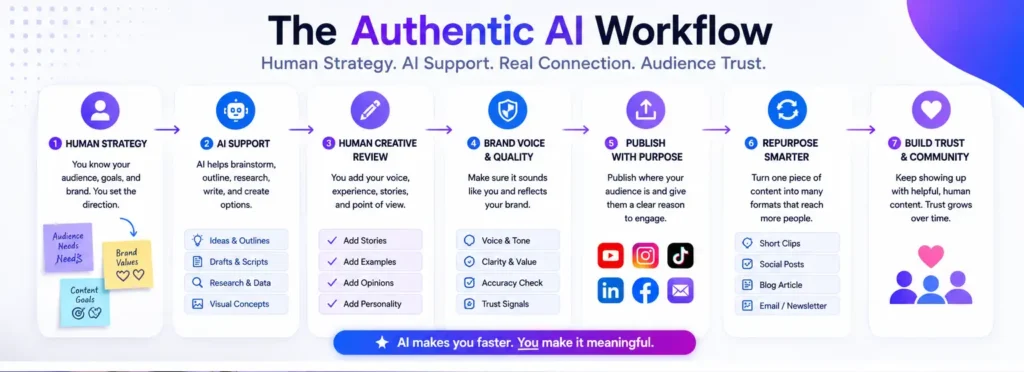
In a practical content workflow, Authentic AI might look like this:
- You choose the topic because you understand your audience.
- AI helps organize the outline.
- You add your point of view, examples, and experience.
- AI helps create variations for social media.
- You edit the final copy so it sounds like you.
- AI helps repurpose the content.
- You decide what gets published.
The human leads. AI supports.
Why Generic AI Content Is Losing Impact
Generic AI content often has the same problems.
It may be clear, but not memorable. It may be well structured, but not personal. It may sound professional, but not emotionally connected. It may cover the topic, but it does not always give the reader a reason to trust the person or brand behind it.
This is why audiences are becoming more selective.
They can feel when content is created only to fill space. They can feel when a post has no lived experience behind it. They can feel when a video is technically polished but emotionally empty.
That does not mean every piece of content needs to be raw, messy, or unedited. It means the content needs a real point of view.
The future is not AI content versus human content. The future is human-led AI content versus generic AI output.
Human-Led Content Builds Trust Faster
Trust is becoming one of the most valuable assets in digital marketing.
People want to know who is speaking, why they should listen, and whether the advice is grounded in real experience. This is especially true for creators, consultants, educators, affiliate marketers, service providers, and small business owners.
Human-led content builds trust because it includes signals AI cannot fully replace:
- Personal experience
- Clear opinions
- Specific examples
- Honest limitations
- Real stories
- Visible accountability
- Consistent brand values
- A recognizable voice
AI can help shape the content, but trust comes from the human behind it.
Why Showing Your Face and Voice Still Matters
In an AI-heavy internet, human presence becomes more valuable.
This does not mean every creator must become a full-time talking-head personality. But it does mean that real voice, real perspective, and real presence can help separate your content from generic automated output.
That could mean:
- Appearing in short videos
- Adding a personal introduction to articles
- Sharing your process
- Explaining why you believe something
- Recording voiceover instead of using only synthetic narration
- Showing behind-the-scenes decisions
- Being transparent about how you use AI
The goal is not to perform authenticity. The goal is to make it clear that a real person is guiding the work.
How Brands Can Use AI Without Losing Their Personality
Brands should not use AI to become faster versions of everyone else.
They should use AI to become clearer, more consistent, and more useful.
The best way to do that is to build a brand system before scaling content with AI.
That brand system should include:
- Brand voice guidelines
- Audience description
- Core beliefs
- Content pillars
- Visual style direction
- Approved phrases and words to avoid
- Example posts that sound right
- Example posts that sound wrong
- CTA style
- Trust signals and proof points
When this foundation is clear, AI becomes much more useful. It can help create faster drafts without pulling the brand in random directions.
Authentic AI in Video Content
Video is one of the best places to apply Authentic AI.
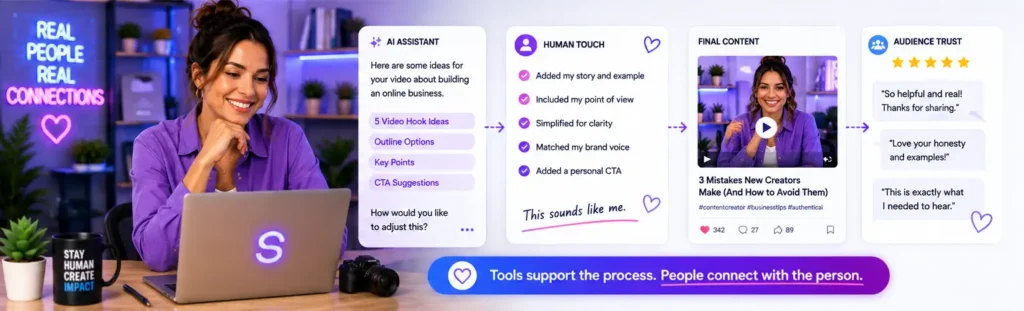
AI can help with video ideas, scripts, hooks, captions, thumbnails, scene concepts, B-roll suggestions, and repurposing. But the most effective video content still needs human direction.
A strong Authentic AI video workflow might look like this:
- Use AI to brainstorm video topics.
- Choose the topic based on your audience and brand goals.
- Use AI to create a rough script.
- Edit the script in your own voice.
- Record your own voice, face, or screen where possible.
- Use AI visuals or B-roll to support the message.
- Add captions and a clear CTA.
- Repurpose the video into shorter clips and social posts.
This keeps AI in the workflow without letting it remove the human connection.
Authentic AI in Social Media
Social media is where authenticity becomes especially important.
Overly polished content can feel distant. Generic AI captions can feel flat. Audiences want useful ideas, but they also want signs of personality, timing, humor, honesty, and perspective.
Hootsuite’s 2026 social trends describe a move toward more humanized brand content, where imperfections and natural pacing can signal authenticity, even when AI helps behind the scenes.
For creators and brands, that means AI should help prepare the content, but not erase the human texture.
Instead of publishing AI captions directly, use AI to create options, then add:
- Your real opinion
- A specific example
- A current observation
- A personal line
- A sharper hook
- A more natural CTA
- A better ending
The goal is not perfect content. The goal is content that feels useful, alive, and connected to a real person.
The Authentic AI Checklist
Before publishing AI-assisted content, ask these questions:
- Does this sound like our brand?
- Does this include a real point of view?
- Is there a human example, story, or insight?
- Would our audience actually care about this?
- Is the content useful, or just polished?
- Did we edit the AI output carefully?
- Does this build trust?
- Is the CTA clear and honest?
- Would we be comfortable explaining how this was made?
If the answer is no, the content probably needs more human direction.
Useful Tools for an Authentic AI Workflow
You do not need every AI tool. You need the right tools inside a human-led workflow.
For visual concepts, AI images, thumbnail ideas, video scenes, and creative direction, OpenArt.ai can help creators explore strong visual ideas while still keeping the final direction human-led.
For creators turning content into lessons, workshops, or digital products, LearnWorlds can help organize human-led expertise into structured online learning experiences.
For creators managing AI tools, client accounts, affiliate dashboards, and content platforms while traveling or using public networks, NordVPN can add an extra layer of privacy and safer browsing.
What Creators Should Do Next
If you want to use AI without losing your voice, start by building a simple human-led content system.
Use this process:
- Choose content topics based on real audience needs.
- Use AI to organize ideas, not replace your thinking.
- Add your perspective before publishing.
- Keep examples specific.
- Show your face, voice, or process when possible.
- Create a brand voice guide.
- Save prompts that support your style.
- Review all AI output before it goes live.
- Measure trust signals, not only clicks.
This keeps AI useful without letting it flatten your brand.
Final Thoughts
Authentic AI is not about choosing between human creativity and artificial intelligence.
It is about using AI in service of human creativity.
Creators and brands that win in the AI era will not simply produce the most content. They will produce the most trusted, useful, recognizable, and human-led content.
AI can help you move faster. But your voice, your judgment, your story, and your relationship with the audience are still the difference.
That is the future of content creation: smarter tools, stronger systems, and more human creative direction.
Want to Build More Trust With AI-Assisted Content?
Download the free AI Visibility Starter Kit from Sights.com and start improving your content clarity, customer questions, trust signals, and AI search readiness.
Affiliate Disclosure: Some links in this article are affiliate links. If you purchase through them, Sights.com may earn a commission at no additional cost to you. We only recommend tools and resources that fit the topic and may be useful for creators, marketers, and small businesses.