
What Brands Need to Know Before the Feed Disappears
For years, digital marketing has been built around one major idea: get attention in the feed. Brands have chased visibility on Facebook, Instagram, TikTok, YouTube, LinkedIn, and Google search results. The goal was to show up where people were scrolling, searching, watching, or comparing options.
But the way people find information is changing. AI search tools and conversational assistants are turning search from a list of links into a guided answer experience. Instead of typing a short keyword and clicking through ten blue links, users are asking full questions, comparing products, researching ideas, and expecting AI systems to summarize the best options.
That shift is creating a new opportunity and a new challenge for marketers: AI search ads.
OpenAI has introduced an Ads Manager Beta for creating, launching, and managing campaigns in ChatGPT Ads, with tools to monitor performance and update campaigns in one place. OpenAI has also described new ways for advertisers to buy ChatGPT ads, including CPC bidding and expanded measurement tools, while stating that conversations and personal details are not shared with advertisers.
This matters because it signals a bigger change in digital advertising. The next major marketing battleground may not be the social feed. It may be the AI-generated answer.
From Search Results to AI Answers
Traditional search advertising was built around keywords. A person searched for something, and brands competed to appear near the top of the results page. That system shaped SEO, paid search, landing pages, product pages, blogs, reviews, and online advertising for more than two decades.
AI search changes the experience. Instead of simply showing links, AI-powered platforms can summarize information, recommend options, compare choices, and guide users through a decision. This means brands may not only compete for a click. They may compete to be included inside an answer.
That is a very different kind of visibility.
In the old model, your brand wanted to rank. In the new model, your brand also needs to be understandable, trustworthy, useful, and easy for AI systems to interpret.
Why This Trend Is Happening Now
AI search advertising is becoming timely because major platforms are moving quickly. OpenAI’s advertiser site frames ChatGPT as a place where people explore options, compare choices, and make decisions, which gives advertisers a new way to appear during high-intent moments.
Yahoo is also moving into AI-powered search with Scout, an AI answer engine launched in beta. Yahoo says Scout is fueled by Yahoo’s data, content, user insights, and search history, and that it expands AI search through partnerships with Anthropic and Microsoft.
Google is moving in the same direction from the search advertising side. Google has described AI-powered campaigns as a way for advertisers to adapt as search experiences evolve, and its AI Max product is designed to expand the reach of Search campaigns beyond traditional keyword targeting.
The pattern is clear: search is becoming more conversational, more personalized, and more automated. Advertising will follow that behavior.
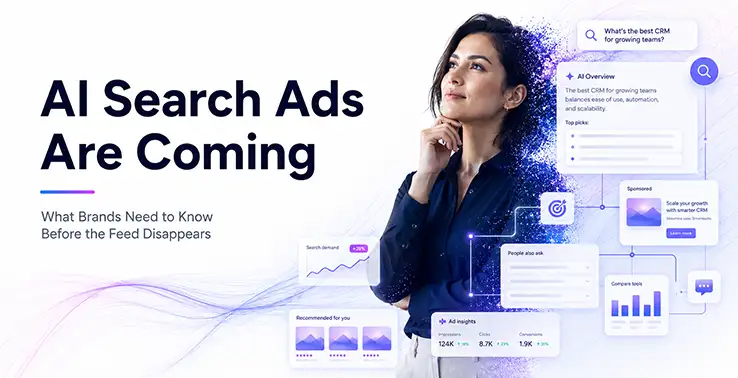
What Makes AI Search Ads Different?
AI search ads are different because the user experience is different.
In a social feed, people are often scrolling casually. Ads interrupt the experience and try to earn attention quickly. In traditional search, people type a query and scan results. Ads appear beside or above organic links.
In AI search, users may be asking deeper questions. They might say, “What is the best AI video tool for a small creative agency?” or “How should my business choose between email marketing platforms?” or “What are the most important digital marketing trends this year?”
These are not just keywords. They are decision moments.
That means ads in AI search environments need to feel more useful, contextual, and trustworthy. They cannot simply be loud. They need to fit the conversation.
The Feed May Not Disappear, But It May Lose Power
The social feed is not going away. People will still watch videos, scroll posts, follow creators, and discover brands through social platforms. But the feed may no longer be the only center of digital attention.
As AI assistants become more common, some discovery will happen before people ever reach a social platform or website. A person may ask an AI assistant for recommendations, compare options inside the assistant, and only visit a site once they are already close to making a decision.
This creates a new question for brands: what happens if your audience never sees your post, but they do see an AI-generated answer about your category?
In that environment, your content strategy needs to support more than visibility. It needs to support credibility.

Brands Need to Become Easier for AI to Understand
AI search ads will likely reward brands that are clear, consistent, and well-structured online.
If your website does not clearly explain what you do, who you serve, what makes you different, and why people should trust you, AI systems may have a harder time understanding and summarizing your brand.
This is where content becomes even more important.
Brands should build helpful articles, product guides, comparison pages, FAQs, case studies, service pages, and educational content that answer real customer questions. The goal is not just to rank for keywords. The goal is to become a trusted source that AI systems and human users can understand.
This is especially important for creative businesses, agencies, software companies, consultants, online stores, and service brands. If people are asking AI tools for recommendations, your brand needs to show up with strong signals of relevance and trust.
What Marketers Should Do Now
Marketers should not wait until AI search ads become fully mature. The preparation can start now.
First, improve your content foundation. Make sure your website explains your services, products, audience, process, and expertise clearly. AI tools depend on structured, understandable information.
Second, create content that answers real questions. Instead of only writing promotional posts, create useful resources that help people make decisions. Think buying guides, comparison articles, trend explainers, tutorials, and strategy pieces.
Third, build trust signals. Include testimonials, examples, case studies, author information, updated content, contact details, and proof that your business is real and credible.
Fourth, align SEO and paid media. AI search will likely blur the line between organic discovery and paid placement. Strong content can support both.
Fifth, keep the human voice. AI search may summarize your brand, but people still respond to personality, clarity, and authenticity. Your brand voice should be memorable, not generic.
Creative Strategy Still Matters
As advertising becomes more automated, creative strategy becomes more valuable.
AI can help place ads, generate variations, and analyze performance. But brands still need to decide what they stand for, what audience they serve, and what emotion they want to create.
In AI search, the best-performing brands may not be the ones shouting the loudest. They may be the ones that provide the clearest answer, the strongest proof, and the most useful experience.
This creates a major opportunity for thoughtful brands.
Instead of chasing every trend, brands can focus on building a content ecosystem that works across search, social, email, video, and AI assistants. Every article, landing page, video, and guide should help explain the brand more clearly.
The Future of Advertising Is Contextual
The future of advertising is moving toward context. AI systems are not just matching ads to keywords. They are trying to understand intent, behavior, and the full journey behind a question.
That means brands need to think beyond impressions.
What is the user trying to solve? What stage of the decision are they in? What information do they need next? What would make your brand the most helpful recommendation?
These questions are bigger than ad placement. They are brand strategy questions.
Final Thoughts
AI search ads are coming, and they may reshape how brands are discovered online.
The shift from feeds and search results to conversational answers will not happen all at once. But the direction is clear. Platforms like ChatGPT, Yahoo Scout, and Google’s AI-powered search experiences are changing the way people explore information, compare choices, and make decisions.
For marketers, this is the time to prepare.
Build clearer content. Strengthen your brand authority. Create useful resources. Improve your website structure. Align SEO with paid media. Make your brand easy for both humans and AI systems to understand.
The future of digital advertising may not be about interrupting attention.
It may be about earning trust inside the answer.
Want to Improve Your AI Visibility?
Download the free AI Visibility Starter Kit from Sights.com and start improving your content clarity, customer questions, trust signals, and AI search readiness.