
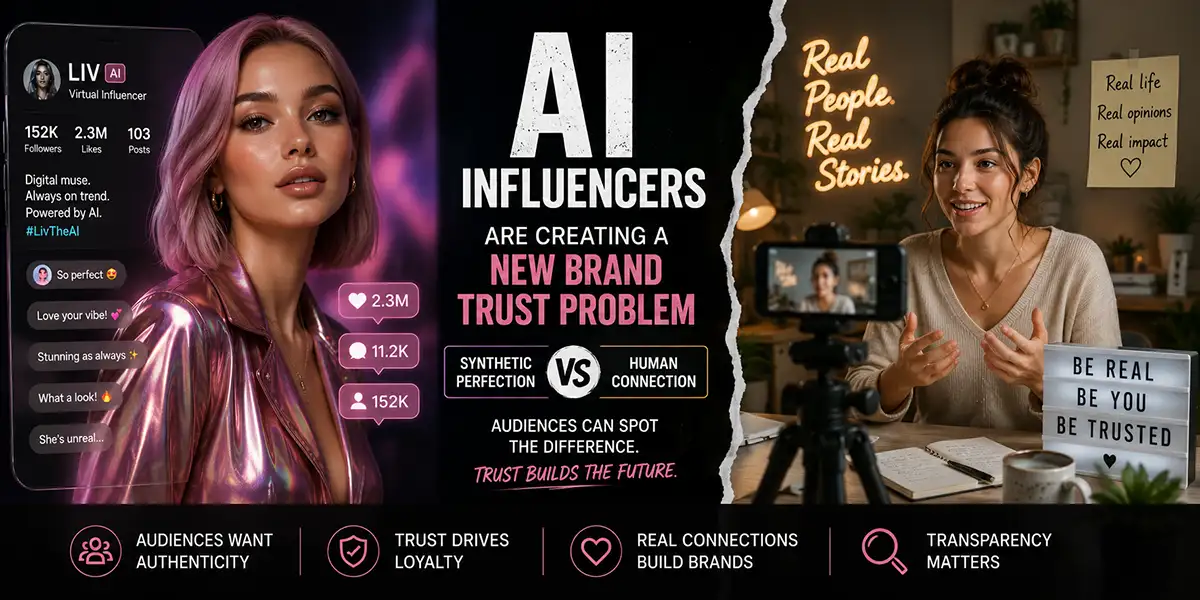
AI Influencers Are Creating a New Brand Trust Problem
AI influencers are moving from novelty into marketing reality.
Brands can now create synthetic personalities that look polished, post consistently, appear in campaign visuals, promote products, and represent a lifestyle without the scheduling issues, fees, unpredictability, or personal controversies that can come with human influencers.
On paper, that sounds efficient.
But marketing is not only about efficiency. It is about trust.
That is where the problem begins.
As AI-generated influencers become more visible, audiences are asking harder questions. Is this person real? Who created them? Why did the brand choose a synthetic personality instead of a human creator? Is the image promoting an unrealistic standard? Is the campaign being transparent? And most importantly, can an audience form real trust with a character that has no lived experience?
For brands, this creates a new challenge. AI influencers may be useful in certain creative campaigns, but they can also create a trust gap if they are used carelessly.
Why This Topic Is Timely
The conversation around AI influencers became more urgent after fashion and lifestyle platform SheerLuxe faced criticism for introducing AI-generated beauty and styling influencers on Instagram. According to The Times, the backlash focused on authenticity, unrealistic beauty standards, and concern that synthetic personalities could replace real women and real creators.
This is not an isolated issue. Across influencer marketing and social media, brands are experimenting with AI-generated personalities, virtual creators, and synthetic content. At the same time, audiences are becoming more sensitive to content that feels artificial, overproduced, or disconnected from real human experience.
A Hootsuite social trends report points to a larger shift: AI tools are becoming common in content workflows, but authenticity remains a key differentiator for brands trying to build real consumer connection.
That creates a major question for marketers: just because a brand can create an AI influencer, should it?
The Appeal of AI Influencers Is Easy to Understand
AI influencers are appealing because they give brands control.
A synthetic influencer can be designed to match a target audience, campaign aesthetic, lifestyle category, or product niche. The brand can control the look, tone, posting schedule, message, visual style, and brand alignment.
That control can feel attractive compared with traditional influencer marketing, where brands often have to manage contracts, schedules, creative approvals, fees, public behavior, audience fit, and performance uncertainty.
AI influencers can also be used at scale. A brand could create multiple personalities for different customer segments, regions, styles, or product categories. One avatar could represent beauty. Another could represent fitness. Another could represent business productivity. Another could focus on travel or lifestyle.
From a production standpoint, this can be efficient.
But from a trust standpoint, it is complicated.
The Real Issue Is Authenticity
Influencer marketing works because people trust people.
A good creator does more than display a product. They bring taste, experience, personality, context, and credibility. Their audience may trust them because they have watched their life unfold over time. They may understand their preferences, flaws, routines, values, and voice.
That trust is difficult to manufacture.
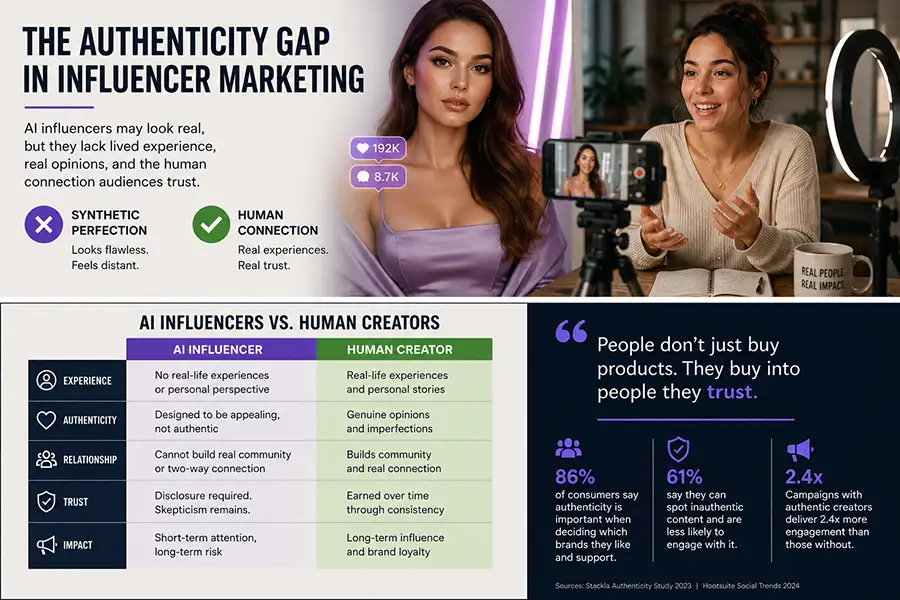
An AI influencer can look realistic, but it does not actually use the product. It does not have personal experience. It does not have a real morning routine, a real skin concern, a real creative process, or a real emotional connection to the audience.
That does not mean synthetic characters have no place in media. They can be entertaining. They can be used in fictional storytelling. They can support product visualization or experimental campaigns.
But brands should not confuse attention with trust.
Why Audiences Push Back
When audiences react negatively to AI influencers, it is often because they feel something has been taken away.
They may feel that real creators were replaced. They may feel the brand chose a cheaper synthetic option instead of supporting human talent. They may feel the AI avatar represents a beauty standard that no real person can live up to. They may feel misled if the content is not clearly labeled.
For brands, that emotional reaction matters.
Marketing is not only what the brand intended to say. It is also what the audience believes the brand is saying.
If an audience sees an AI influencer and interprets it as “this company values perfection over people,” that becomes a brand problem.
If they see it as “this company wants influencer marketing without real creators,” that becomes a trust problem.
If they see it as “this brand is using artificial women to sell beauty standards,” that becomes a reputational problem.
The risk is not only that people dislike the AI influencer. The risk is that they question the brand behind it.
AI Influencers Can Create Representation Problems
One of the biggest risks with AI influencers is representation.
If a brand can design any person it wants, the choices it makes become highly visible. What body type does the AI influencer have? What skin tone? What age? What style? What facial features? What lifestyle? What cultural cues?
Those choices are not neutral.
A brand might think it is creating an aspirational character, but audiences may see something else: a narrow version of beauty, diversity without lived experience, or a synthetic personality designed to appear inclusive without actually involving real people from those communities.
This is especially sensitive in fashion, beauty, wellness, fitness, and lifestyle categories, where representation already has a long history of criticism.
If AI influencers are used in these spaces, brands need to be especially careful. Synthetic representation can easily feel hollow if it is not handled with transparency and care.
Transparency Is Necessary, But It May Not Be Enough
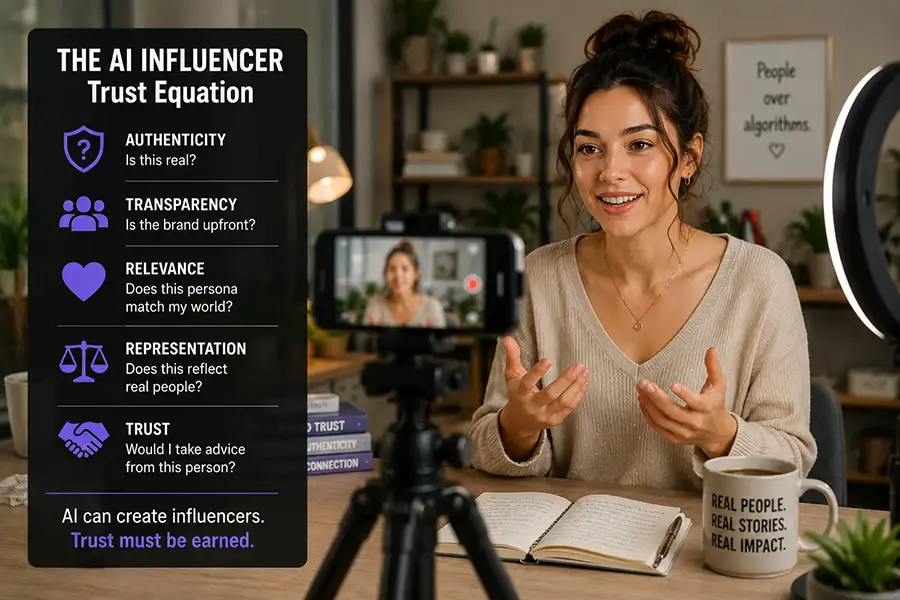
Brands should clearly disclose when an influencer or campaign asset is AI-generated.
That is the minimum.
But disclosure alone does not automatically create trust. A label may tell the audience the content is synthetic, but it does not answer the bigger question: why did the brand choose this approach?
Audiences may still wonder:
- Why not work with a real creator?
- Who benefits from this campaign?
- Is this replacing human creative work?
- Is the brand being honest about what is real?
- Is this character promoting unrealistic expectations?
Transparency helps, but it does not replace strategy, ethics, or audience understanding.
Where AI Influencers Might Actually Make Sense
AI influencers are not automatically bad. The issue is how they are used.
There are situations where synthetic characters may make sense.
For example, an AI influencer could work as part of a fictional entertainment campaign. It could represent a game, virtual world, animation, educational series, or futuristic product concept. It could be used as a brand mascot, a guide, or a fictional narrator.
AI personalities may also be useful for product visualization, concept testing, or creative exploration before a brand commits to a full campaign.
In these cases, the synthetic nature of the character can be part of the concept.
The problem comes when an AI influencer is presented like a real lifestyle authority or used as a shortcut around real human connection.
Human Creators Still Have a Major Advantage
Human creators bring something AI influencers cannot truly replicate: lived experience.
A real creator can say, “I tried this.”
They can say, “Here is what worked for me.”
They can show progress, mistakes, behind-the-scenes moments, personal taste, and real reactions.
They can build community over time because audiences feel connected to a person, not just a persona.
That is why brands should be careful about replacing human creators with synthetic alternatives. AI may reduce production friction, but it may also reduce emotional credibility.
In many cases, the better strategy is not to replace creators with AI. It is to help creators work better with AI.
The Better Model: Human Creators Plus AI Support
The strongest influencer strategy may be human-led and AI-assisted.
That means brands still work with real creators, but use AI to support the campaign behind the scenes.
AI can help with:
- Creator research
- Audience analysis
- Campaign brief development
- Content repurposing
- Caption drafts
- Video script options
- Performance analysis
- Content calendars
- Ad variation planning
This keeps the human relationship at the center while still using AI to improve speed and structure.
For most brands, that is a safer and more effective path than building a fully synthetic influencer strategy too early.
What Brands Should Ask Before Creating an AI Influencer
Before launching an AI influencer, brands should ask serious questions.
1. What problem does this solve?
If the only answer is “it is cheaper” or “it is trendy,” that may not be enough. The AI influencer should have a clear strategic purpose.
2. Why would the audience care?
A synthetic character needs a reason to exist beyond looking good. What value does it provide? Entertainment? Education? Utility? Storytelling?
3. Could a human creator do this better?
If the content relies on trust, experience, product use, lifestyle advice, or emotional connection, a real creator may be more effective.
4. How will it be disclosed?
The audience should not have to investigate whether the influencer is real. Be clear.
5. What are the representation risks?
Think carefully about body image, diversity, beauty standards, identity, and cultural cues.
6. Who approves the content?
AI influencer campaigns still need human review for tone, claims, visuals, accuracy, and brand safety.
AI Influencers and Brand Safety
Brand safety is usually discussed in relation to ad placement, but AI influencers create a different kind of brand safety issue.
The risk is not only where the ad appears. The risk is what the synthetic character represents.
A poorly designed AI influencer can create confusion, criticism, or distrust. A campaign that looks innovative internally may feel tone-deaf externally. A synthetic beauty persona may be seen as unrealistic. A virtual expert may be seen as lacking credibility.
Brands need to treat AI influencer campaigns as reputation-sensitive work, not just creative experiments.
The Future of Influencer Marketing Is Not Fully Synthetic
AI will absolutely change influencer marketing.
It will help brands discover creators, analyze audiences, build briefs, generate campaign ideas, edit content, create variations, and measure performance. It will also create more virtual characters and synthetic media experiments.
But the future is unlikely to be fully synthetic.
People still want people.
They want real opinions, real stories, real experiences, and real relationships. They want to know that someone has actually used the product, felt the problem, tested the solution, or lived the lifestyle being promoted.
AI influencers may become part of the media mix, but they should not be treated as a full replacement for human trust.
Final Thoughts
AI influencers are creating a new brand trust problem because they sit at the intersection of innovation, authenticity, representation, and audience expectation.
They can be useful. They can be entertaining. They can be visually impressive. But they can also feel artificial, disconnected, and risky if brands use them without a clear reason.
The question is not simply whether AI influencers are possible.
The question is whether they make the brand more trusted.
For many businesses, the smarter move may be to use AI behind the scenes while keeping real creators, real customers, and real human stories at the front.
Because in a world where synthetic content is becoming easier to create, human trust becomes more valuable.
About the Author
Curtis Randall is an award-winning creative executive and future systems thinker helping people and businesses understand the future of work, technology, digital ownership, and creativity. Through CurtisRandall.com, and Sights.com, Curtis explores the systems shaping how people work, create, own, and build value in a rapidly changing world.
Connect with Curtis: LinkedIn · YouTube · Instagram · X · TikTok · Facebook · Threads
Want to Improve Your AI Visibility?
Download the free AI Visibility Starter Kit from Sights.com and start improving your content clarity, customer questions, trust signals, and AI search readiness.