
AI Creative Systems Are Becoming the New Marketing Operating System
Most brands started using AI in small ways.
They used it to write a caption, brainstorm blog ideas, generate a headline, create an image prompt, summarize a meeting, or draft a quick email. Those use cases were helpful, but they were only the beginning.
The bigger shift is happening now.
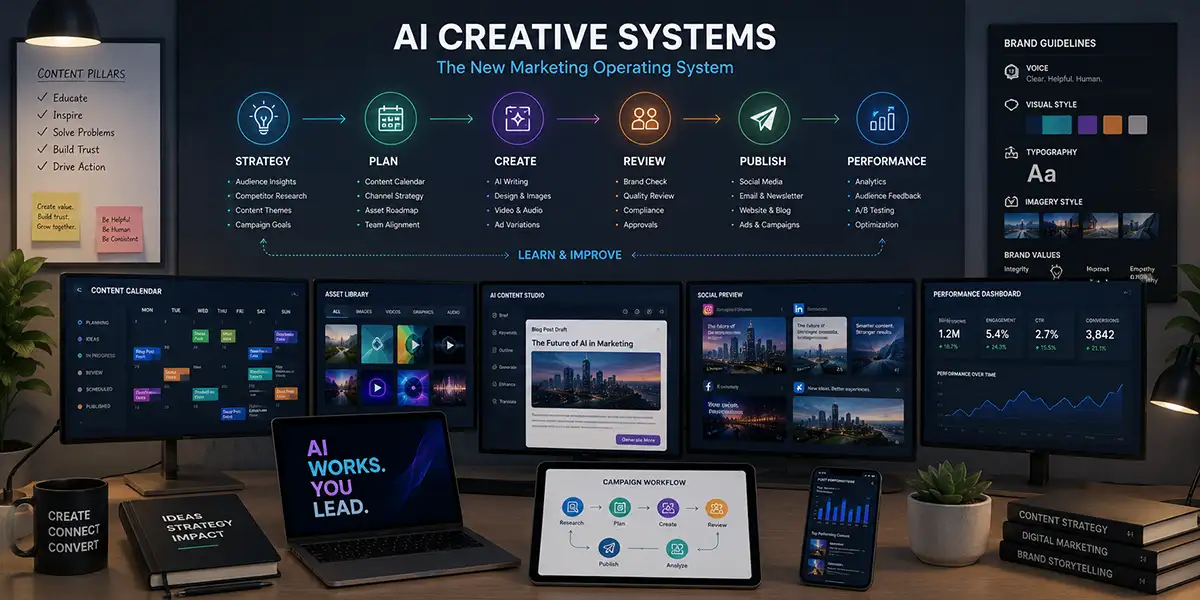
AI is moving from a collection of individual tools into something more important: a connected creative system.
Instead of asking, “Which AI tool should we use?” marketers are starting to ask a better question: “How do we build a workflow where AI helps us move from strategy to content to publishing to performance learning?”
That is why AI creative systems are becoming the new marketing operating system.
Why This Topic Is Timely
Marketing platforms are increasingly moving beyond one-off AI content generation and toward integrated systems for planning, producing, and optimizing creative work.
Google’s Asset Studio is one example. Google describes it as a creative destination inside Google Ads where marketers can generate, manage, and scale creative assets while maintaining more consistent brand visuals.
Adobe’s 2026 AI and Digital Trends Report points to a similar shift, describing how generative and agentic AI are transforming customer journeys faster than many organizations can adapt. Adobe’s report frames the challenge as more than creative production; it is about the systems, data, and alignment needed to deliver better customer experiences.
Hootsuite’s Social Media Trends 2026 also highlights creative acceleration and AI workflows as a major theme, including faster experimentation, rapid-response content, and the need to balance AI tools with human-made authenticity.
In other words, AI is no longer just a writing assistant or image generator. It is becoming part of the operational layer of marketing.
The Tool Era Is Giving Way to the System Era
The first phase of AI adoption was tool-driven.
Marketers tried different platforms for writing, design, video, research, automation, analytics, and social media. This helped teams move faster, but it also created a new problem: tool sprawl.
One person used one AI writing tool. Another used a different image tool. Someone else used a video generator. The social team had its own scheduler. The ad team worked in separate dashboards. Analytics lived somewhere else.
Each tool may have been useful, but the overall workflow still felt disconnected.
The system era is different.
In the system era, the goal is not simply to collect more tools. The goal is to connect the work.
Strategy, brand guidelines, content planning, asset creation, review, publishing, repurposing, analytics, and optimization all need to work together.
That is what turns AI from a novelty into a marketing operating system.
What Is an AI Creative Systems?
An AI creative system is a structured workflow that uses AI to support the full creative and marketing process.
It is not one tool. It is the way tools, people, prompts, brand rules, content calendars, review steps, and performance data work together.
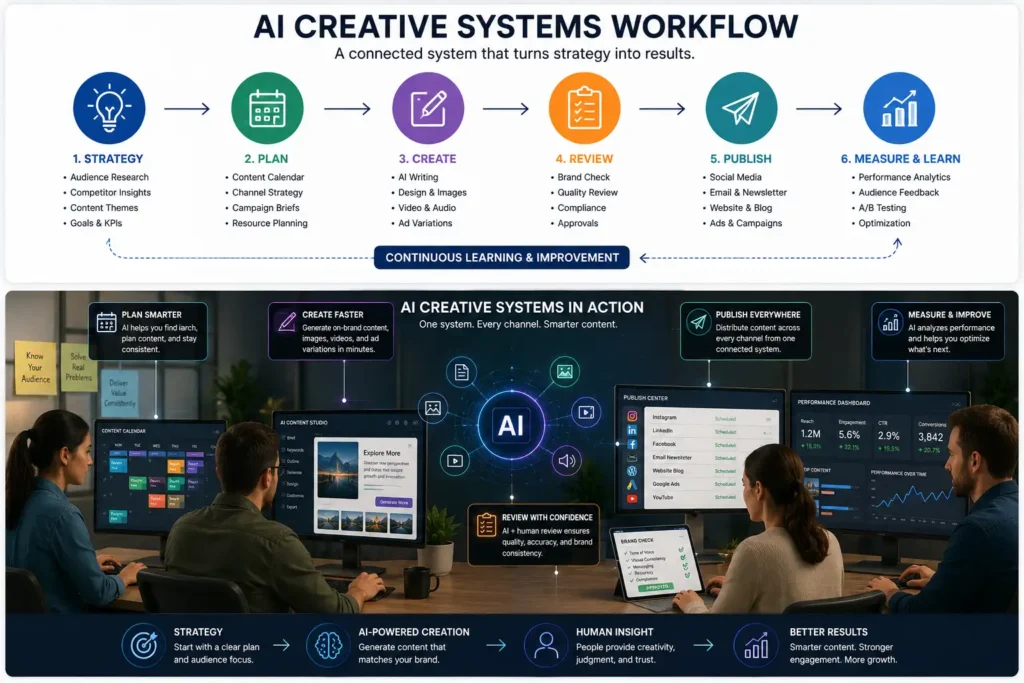
A practical AI creative systems may include:
- Brand voice guidelines
- Visual identity rules
- Audience profiles
- Messaging pillars
- AI prompt libraries
- Content planning templates
- Video and image workflows
- Approval checklists
- Repurposing systems
- Analytics review processes
The purpose is simple: create better content faster without losing strategy, quality, or brand consistency.
Why Random AI Content Is Not Enough
AI makes it easy to create more content. But more content is not the same as better marketing.
A random AI-generated caption does not create a brand strategy. A quick blog outline does not build authority by itself. A generated image does not guarantee recognition. A video script does not automatically connect to a campaign goal.
This is why many brands are realizing that AI output needs direction.
Without a system, AI can create more noise.
With a system, AI can create more leverage.
The difference is whether the work is connected to a clear strategy.
The New Marketing Operating System
A marketing operating system is the way a brand consistently turns ideas into audience-facing content and measurable results.
In the past, this system might have included planning meetings, creative briefs, campaign calendars, design templates, approval processes, publishing tools, and analytics reports.
AI is now entering each layer of that system.
It can help with:
- Researching customer questions
- Turning trends into article angles
- Creating campaign concepts
- Writing first drafts
- Generating image directions
- Drafting short-form video scripts
- Repurposing long content into social posts
- Creating ad variations
- Summarizing performance patterns
- Suggesting next content opportunities
This does not mean AI should run marketing alone.
It means AI can support the operating system while humans lead the strategy, taste, judgment, and final decisions.
Strategy Still Comes First
The biggest mistake brands can make is starting with the tool instead of the strategy.
Before using AI to create content, a brand needs to know:
- Who the audience is
- What problem the brand solves
- What the brand believes
- What topics it should own
- What voice it should use
- What action the content should drive
AI becomes more useful when those answers are clear.
A weak strategy produces weak AI output. A strong strategy gives AI better direction.
Brand Guidelines Become AI Instructions
Brand guidelines used to be documents that designers and marketers referenced occasionally.
In the AI era, brand guidelines become active instructions.
If your team uses AI to write posts, generate visuals, draft emails, or create video scripts, then your brand guide needs to be part of the prompt system.
That means your AI instructions should include:
- Brand voice
- Audience profile
- Approved terminology
- Topics to emphasize
- Claims to avoid
- Visual style direction
- CTA preferences
- Content quality rules
This is how brands keep AI-assisted content from drifting into generic territory.
Content Planning Gets Smarter
AI creative systems can also improve content planning.
Instead of staring at a blank content calendar, marketers can use AI to identify themes, customer questions, seasonal opportunities, platform-specific ideas, and repurposing possibilities.
For example, one article can become:
- A LinkedIn post
- A Facebook post
- A Twitter/X thread
- A newsletter section
- A YouTube Short script
- A Pinterest pin description
- A carousel outline
- A paid ad concept
This is not just content creation. It is content orchestration.
The system helps one idea travel farther without losing its core message.
Creative Review Becomes More Important
When AI can produce more assets faster, human review becomes more important, not less.
A good AI creative systems should include a review stage.
Before content is published, the team should ask:
- Is this accurate?
- Does this sound like the brand?
- Is this useful to the audience?
- Does this support the campaign goal?
- Is the visual style consistent?
- Is the CTA clear?
- Could this damage trust?
AI can generate options. Humans still need to choose what deserves to go live.
Performance Data Closes the Loop
The strongest AI creative systems do not stop at publishing.
They learn.
Performance data should feed back into the planning process. Which hooks worked? Which topics attracted traffic? Which social posts got engagement? Which CTAs drove clicks? Which article categories performed best? Which videos held attention?
AI can help summarize those patterns and suggest future content opportunities.
This creates a feedback loop:
Plan → Create → Review → Publish → Measure → Improve
That loop is what turns AI into an operating system rather than a content shortcut.
Why This Matters for Small Businesses
Small businesses often do not need more tools. They need better systems.
A small business owner may already feel overwhelmed by the number of AI platforms, social channels, content formats, and marketing tasks available. Adding more tools can create more confusion.
An AI creative systems simplifies the process.
It gives the business a repeatable workflow:
- Choose the content topic.
- Connect it to a business goal.
- Use AI to draft ideas and variations.
- Edit with brand voice.
- Create social and video versions.
- Publish consistently.
- Review what worked.
This kind of system helps small brands produce smarter content without needing a full marketing department.
Why This Matters for Creative Teams
Creative teams can use AI creative systems to reduce repetitive work while protecting creative quality.
AI can help with research, first drafts, resizing, repurposing, captioning, and variation. That frees creative people to focus more on concept, taste, storytelling, design direction, and campaign strategy.
The danger is treating AI as a replacement for creative thinking.
The opportunity is using AI to give creative teams more time for higher-value decisions.
The best creative teams will not simply produce faster. They will build better creative operations.
What an AI Creative Systems Could Look Like for Sights.com
A site like Sights.com is a good example of why systems matter.
One daily article can support an entire content ecosystem:
- A WordPress article
- A featured image
- Two in-article visuals
- A Facebook post
- A Twitter/X post
- A future LinkedIn post
- A short-form video script
- A newsletter section
- A CTA to a free resource
- A pathway to a paid product
That is not random content. That is a connected system.
AI helps make it manageable, but the strategy ties it together.
How to Start Building Your Own AI Creative Systems
You do not need a complicated enterprise setup to begin. Start with a simple structure.
1. Define your core content themes
Choose the topics your brand wants to be known for. These should connect to your audience, your products, and your expertise.
2. Create reusable prompts
Build prompts for article ideas, outlines, captions, video scripts, email sections, and image directions. Include your brand voice and audience in every prompt.
3. Build a content calendar
Use a simple 30-day or 90-day calendar to organize topics, formats, platforms, and CTAs.
4. Add a review checklist
Before publishing, check for accuracy, usefulness, brand voice, visual consistency, and CTA clarity.
5. Repurpose every strong idea
Do not let good ideas live in only one format. Turn articles into social posts, videos, emails, visuals, and product-related content.
6. Track what works
Use performance data to decide what topics, formats, and messages deserve more attention.
The Future Is Not More Tools. It Is Better Integration.
The AI marketplace will continue to grow. There will be more tools for writing, design, video, ads, analytics, automation, personalization, and customer experience.
But the brands that win will not simply be the ones with the longest tool list.
They will be the ones with the best integration.
They will know how strategy, content, creative production, publishing, and performance learning connect.
That is the real meaning of an AI creative systems.
Final Thoughts
AI creative systems are becoming the new marketing operating system because marketing is no longer just about creating individual assets.
It is about connecting the whole workflow.
Strategy. Planning. Creation. Review. Publishing. Repurposing. Measurement. Improvement.
AI can help at every stage, but it needs human leadership to stay useful, accurate, creative, and brand-aligned.
The future of marketing will not belong to brands that use the most AI tools.
It will belong to brands that build the smartest systems. Use AI Creative Systems!
Want to Improve Your AI Visibility?
Download the free AI Visibility Starter Kit from Sights.com and start improving your content clarity, customer questions, trust signals, and AI search readiness.