

Why AI Brand Governance Is the New Competitive Advantage for Creative Teams
AI has made creative production faster than ever.
Designers can generate visual concepts in minutes. Marketers can draft social posts, email campaigns, ad variations, and blog outlines almost instantly. Video teams can create storyboards, captions, edits, scripts, and campaign concepts with less friction. Small businesses can now produce content that once required a larger creative department.
That speed is useful.
But speed also creates a new problem.
When more people use AI to create more content across more platforms, brands can quickly lose control of their voice, visuals, claims, tone, and quality. One team may generate a sleek futuristic visual. Another may create a casual social graphic. Another may publish AI-written copy that sounds nothing like the brand. Another may use an image style that feels disconnected from the rest of the campaign.
None of these pieces may be terrible on their own. But together, they can make the brand feel scattered.
That is why AI brand governance is becoming a competitive advantage for creative teams.
Why AI Brand Governance Matters Now
The conversation around AI creativity is shifting.
In the early stage, the focus was simple: What can AI generate? Images, copy, videos, ads, layouts, captions, concepts, and campaign ideas all became easier to produce. But now the more important question is: How do brands control, approve, and scale AI-generated work responsibly?
Major creative platforms are already moving in this direction. Canva’s brand management tools emphasize centralized brand assets, Brand Kits, Brand Guidelines, and Brand Controls that can limit fonts, colors, content, and templates so teams can create while staying on brand. You can read more here: Canva Brand Management Tools.
Canva also describes Canva AI 2.0 as a broader AI design platform built around generating editable designs, documents, websites, and creative outputs from prompts. That makes governance more important because AI-generated design is moving deeper into everyday creative work. You can read Canva’s announcement here: Introducing Canva AI 2.0.
Adobe is also positioning AI around safer, more business-ready creative workflows. Adobe’s Firefly FAQ describes Firefly for teams as including commercially safe AI, shared assets, and Admin Console controls for managing users as teams grow. You can read more here: Adobe Firefly FAQ.
Adobe’s generative AI user guidelines also emphasize authenticity, safety, and respect for third-party rights. That matters because AI governance is not only about design consistency. It is also about trust, ethics, and responsible publishing. You can view the guidelines here: Adobe Generative AI User Guidelines.
The message is clear: the next stage of AI creativity is not just about generation. It is about control.
What Is AI Brand Governance?
AI brand governance is the system a company uses to guide how AI-generated or AI-assisted content is created, reviewed, approved, and published.
It includes the rules, workflows, templates, prompts, brand guidelines, review steps, and approval processes that help teams use AI without damaging brand consistency or trust.
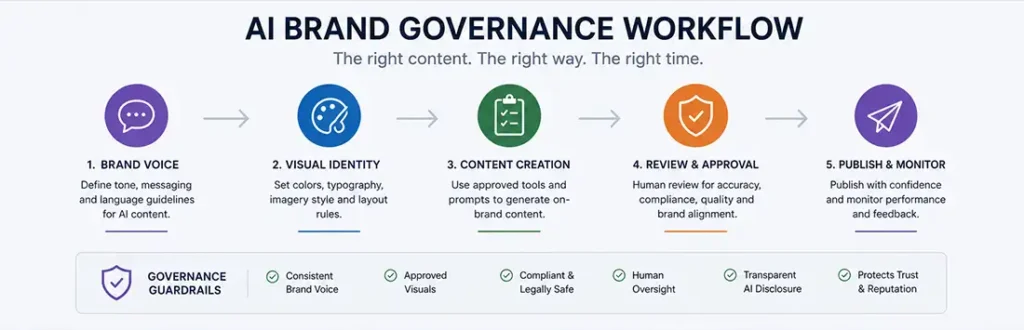
In simple terms, AI brand governance answers questions like:
- What AI tools are approved for use?
- What brand voice should AI content follow?
- What visual styles are allowed?
- What claims require review?
- Who approves public-facing AI content?
- When should AI use be disclosed?
- How do teams protect copyright, likeness, and third-party rights?
- How do we keep content consistent across every channel?
This is not about slowing teams down. It is about giving teams the structure they need to create faster without creating brand risk.
The Old Creative Problem: Too Many Versions
Even before AI, creative teams struggled with consistency.
Different departments created their own presentations. Sales teams made their own one-pagers. Social teams adjusted brand colors. Regional teams changed copy. Freelancers used slightly different design styles. Agencies created assets that looked great but did not always match internal brand rules.
AI makes that old problem bigger.
Now every person with access to an AI tool can create copy, graphics, campaigns, scripts, product descriptions, ads, images, or layouts. This gives teams more creative power, but it also increases the chance that the brand becomes inconsistent.
That is why governance matters. When everyone can create, the brand needs clearer rules.
The New Creative Advantage Is Control at Scale
For years, brands wanted speed at scale.
Now they need control at scale.
A creative team should be able to produce more content, test more ideas, adapt campaigns faster, and serve more channels. But the work still needs to feel like it belongs to the same brand.
That means AI-assisted assets need to reflect the same:
- Voice
- Visual identity
- Message
- Values
- Quality standard
- Customer promise
- Legal and ethical boundaries
The strongest brands will not be the ones that generate the most content. They will be the ones that generate useful, recognizable, trustworthy content again and again.
Why Creative Teams Need AI Governance

Creative teams are under pressure to move faster.
They need to support websites, social platforms, video channels, paid ads, newsletters, sales materials, landing pages, product launches, content hubs, and internal communications. AI can help with that workload, but only if the team has a system.
Without governance, AI can create:
- Off-brand visuals
- Generic copy
- Inconsistent tone
- Unsupported claims
- Confusing messaging
- Copyright or licensing concerns
- Unclear AI disclosure
- Too many disconnected creative directions
With governance, AI becomes more useful. It can help the team create faster while staying aligned with the brand.
AI Brand Governance Starts With Brand Clarity
Governance does not start with software.
It starts with clarity.
Before a brand can guide AI, it needs to know what the brand actually stands for. That means defining the basics:
- Who the brand serves
- What problem the brand solves
- What the brand promises
- How the brand sounds
- How the brand looks
- What topics the brand owns
- What the brand avoids
If those answers are unclear, AI will magnify the confusion.
A weak brand guide produces weak AI content. A strong brand guide gives AI better direction.
Brand Guidelines Need to Become AI Instructions
Traditional brand guidelines are often static documents. They explain logo usage, colors, fonts, imagery, and tone. Those guidelines still matter, but in the AI era, they need to become active instructions.
If your team is using AI to write, design, edit, or generate visuals, the brand guide should be part of the prompt system.
For example, an AI content prompt should include:
- The target audience
- The desired tone
- The brand promise
- The content goal
- Approved messaging pillars
- Words or claims to avoid
- Preferred call to action
- Required review standards
The better the instruction, the better the output.
AI brand governance turns brand guidelines into repeatable creative behavior.
Visual Governance Is Just as Important as Voice
AI image and design tools can create many different styles quickly. That is useful for exploration, but dangerous for consistency.
A brand may suddenly have visuals that feel cinematic in one campaign, cartoon-like in another, corporate in another, and futuristic in another. Each image may be interesting, but the brand may become harder to recognize.
Visual governance helps prevent that.
A creative team should define:
- Preferred color range
- Typography direction
- Image style
- Lighting style
- Composition rules
- Use of people or characters
- Use of icons, dashboards, or UI elements
- What visual styles do not fit the brand
This does not mean every image should look identical. It means every image should feel like it belongs to the same world.
The Human Review Loop Is Essential
AI can generate content quickly, but creative judgment still belongs to people.
Every brand should have a human review loop for AI-assisted content. This is especially important for public-facing content, paid ads, product claims, executive communications, synthetic media, and anything involving customer trust.
A simple review checklist can include:
- Does this sound like our brand?
- Does this look like our brand?
- Is the message accurate?
- Are the claims supported?
- Is the content useful to the audience?
- Does this require disclosure?
- Could this create legal, ethical, or trust issues?
- Is this worth publishing?
This review loop is where brand governance becomes real.
AI Governance Protects Creativity
Some creative teams may worry that governance limits creativity.
But good governance does the opposite.
It removes confusion. It gives teams clear boundaries. It helps creators understand what fits the brand and what does not. It creates confidence because people know the rules before they start creating.
Creative freedom works better when the brand foundation is clear.
AI can produce endless options. Governance helps teams choose the right ones.
Small Businesses Need AI Brand Governance Too
AI brand governance is not only for large companies.
Small businesses may need it even more because they often rely on a small number of touchpoints to build trust. A website, a few social posts, a product page, a video, and an email sequence may be enough to shape a customer’s entire impression of the brand.
If those touchpoints feel disconnected, the business feels less professional.
A small business can start with a lightweight system:
- One-page brand voice guide
- Simple visual style guide
- Approved prompt templates
- Content checklist
- Image style direction
- Rules for AI-generated people or testimonials
- Final human review before publishing
This does not require a large team. It requires intention.
The Role of Creative Leaders Is Changing
AI is also changing the role of creative leaders.
Creative directors, brand strategists, marketing leads, and content managers are no longer only responsible for individual assets. They are responsible for the system that produces those assets.
That means creative leaders need to think about:
- Prompt libraries
- Brand-safe AI workflows
- Approval levels
- Content standards
- Visual consistency
- Tool selection
- Team training
- Responsible AI use
The creative leader becomes less of a bottleneck and more of a system designer.
That is a major shift.
AI Brand Governance Is a Trust Strategy
At its core, AI brand governance is about trust.
Customers trust brands that communicate clearly and consistently. They trust brands that do not exaggerate. They trust brands that respect people’s rights. They trust brands that feel recognizable across every touchpoint.
If AI makes content creation easier, trust becomes harder to earn.
Governance helps protect that trust.
It ensures that speed does not come at the cost of quality, accuracy, or brand identity.
How to Start Building AI Brand Governance
Brands do not need to build a complicated system overnight.
Start with practical steps.
1. Audit where AI is being used
Find out who is using AI tools and for what types of content. Include marketing, sales, design, support, HR, leadership, freelancers, and agencies.
2. Create a simple AI content policy
Define what AI can be used for, what requires review, and what should not be created without approval.
3. Build approved prompt templates
Create prompts for blog posts, social captions, emails, video scripts, image directions, ad concepts, and content reviews.
4. Update brand guidelines for AI
Add voice, visual, disclosure, and quality standards specifically for AI-assisted content.
5. Define review levels
Low-risk drafts can move quickly. Public-facing content needs review. High-risk content such as paid ads, synthetic media, legal claims, and likeness usage needs stricter approval.
6. Train the team
Make sure people know how to use AI responsibly and how to stay aligned with the brand.
The Competitive Advantage
AI brand governance will become a competitive advantage because it allows brands to create faster without becoming careless.
It helps creative teams move quickly while keeping the brand recognizable.
It helps marketers test ideas without losing message discipline.
It helps designers explore new concepts without breaking visual identity.
It helps businesses use AI with more confidence.
The brands that build governance early will be better prepared as AI tools become more powerful and more widely used.
Final Thoughts
AI is changing creative work, but the biggest opportunity is not simply more output.
The opportunity is better creative operations.
AI brand governance gives teams the structure to create with speed, consistency, compliance, and trust.
It helps brands turn AI from a random content generator into a disciplined creative system.
In the next stage of marketing, the strongest creative teams will not be the ones using the most AI tools.
They will be the ones using AI with the clearest rules, the strongest brand system, and the best human judgment.
That is why AI brand governance is becoming the new competitive advantage for creative teams.
Want to Improve Your AI Visibility?
Download the free AI Visibility Starter Kit from Sights.com and start improving your content clarity, customer questions, trust signals, and AI search readiness.