
The Rise of Agentic Workflows: How AI Agents Are Transforming Content Creation
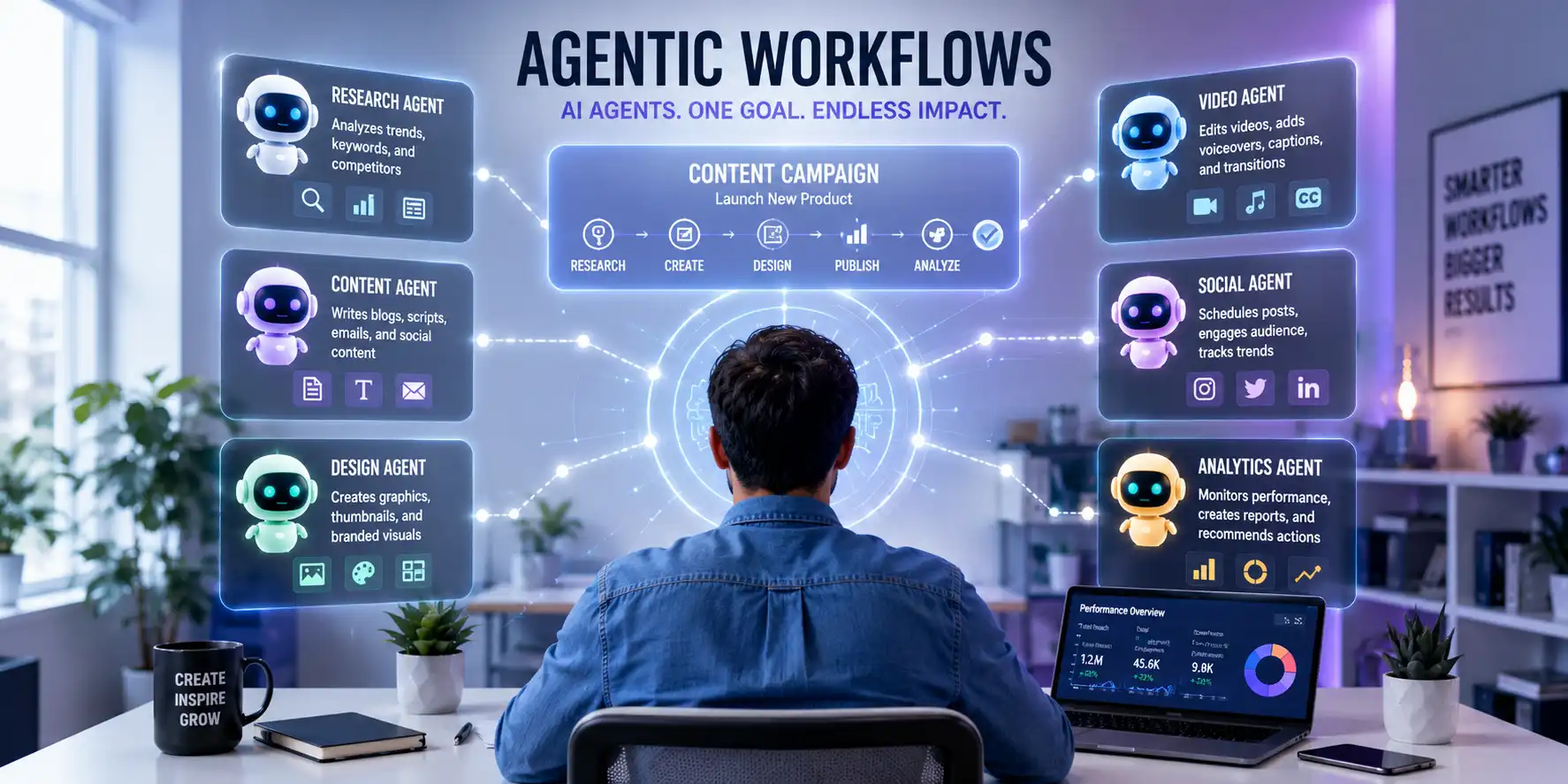
Artificial intelligence is entering a new phase. For the past few years, most businesses and creators have used AI as a tool to generate text, create images, or answer questions. While those capabilities remain powerful, a more significant shift is now underway: the rise of agentic workflows.
Instead of relying on a single AI tool, businesses are increasingly building systems where multiple AI agents work together to achieve specific outcomes. These agentic workflows have the potential to transform content creation, marketing, media production, and business operations in ways that extend far beyond simple automation.
What Are Agentic Workflows?
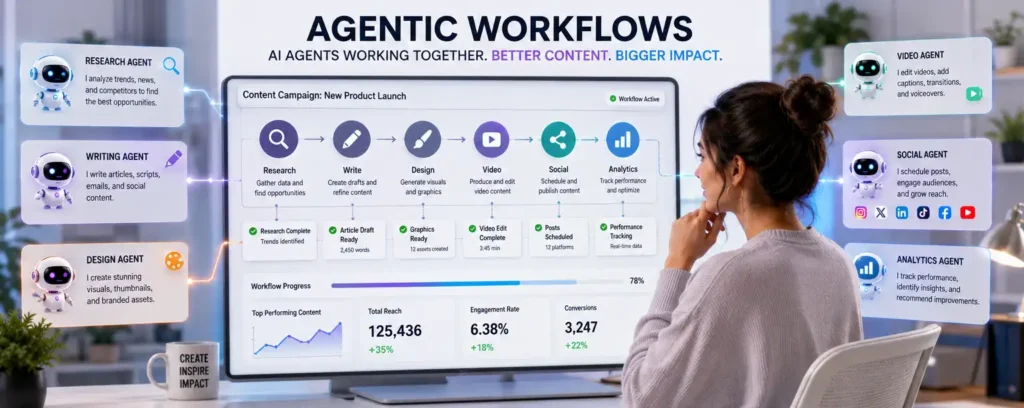
An agentic workflow is a process where multiple AI agents collaborate to complete a complex objective. Rather than performing a single task, each agent specializes in a particular function and contributes to a larger workflow.
Think of it as assembling a digital team. One AI agent conducts research, another writes content, another creates visuals, and another analyzes performance. Together, they complete projects that previously required multiple people and software tools.
The key difference is that these agents are not simply responding to prompts. They are executing actions, passing information between systems, and working toward defined goals.
From AI Tools to AI Teams
The first wave of AI adoption focused on individual tools. Businesses experimented with chatbots, image generators, and automation platforms to improve productivity.
The next phase is creating coordinated AI teams.
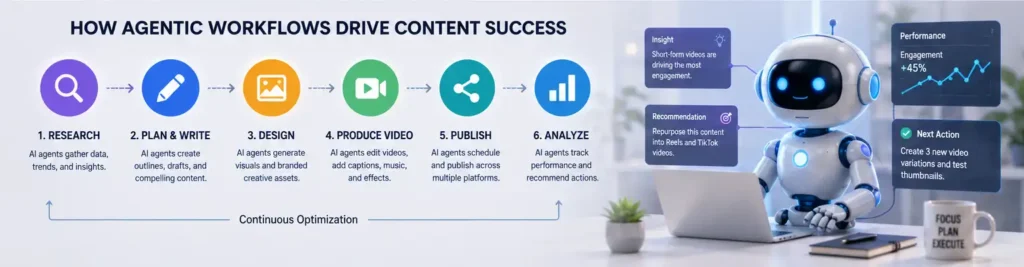
Imagine launching a new content campaign. Instead of manually managing every step, an agentic workflow could:
- Research trending topics
- Analyze competitors
- Create article outlines
- Write content drafts
- Generate supporting visuals
- Create video scripts
- Schedule social media posts
- Monitor performance metrics
- Recommend optimizations
Each task is handled by a specialized AI agent working within a coordinated system.
The Six Core AI Agents of a Modern Content Team
1. Research Agent
This agent identifies trends, gathers data, monitors competitors, and uncovers opportunities for content and marketing campaigns.
2. Writing Agent
The writing agent transforms research into articles, scripts, newsletters, and social content while maintaining consistency and structure.
3. Design Agent
Visual content, thumbnails, graphics, and branded assets can be created quickly by AI-powered design systems.
4. Video Agent
Video production agents can generate scenes, edit footage, add captions, create voiceovers, and optimize content for different platforms.
5. Social Media Agent
These agents distribute content across platforms, schedule posts, monitor engagement, and identify audience trends.
6. Analytics Agent
Analytics agents track performance, identify patterns, generate reports, and recommend improvements based on real-world results.
Why Businesses Are Adopting Agentic Workflows
The appeal of agentic workflows comes down to scale and efficiency.
Organizations are under constant pressure to create more content, reach more customers, and operate more efficiently. Agentic workflows allow businesses to increase output without proportionally increasing costs.
For small businesses and independent creators, this levels the playing field. A solo entrepreneur can now access capabilities that previously required an entire team of specialists.
What AI Agents Still Cannot Do
Despite their impressive capabilities, AI agents are not replacing human creativity.
Successful businesses still require:
- Strategic thinking
- Brand leadership
- Creative direction
- Customer empathy
- Original ideas
- Long-term vision
AI agents excel at execution, but humans remain responsible for defining goals, making critical decisions, and creating meaningful connections.
The Future of Content Creation
Agentic workflows represent one of the most important developments in artificial intelligence today. As AI agents become more capable, businesses will increasingly shift from managing tools to managing digital teams.
Creators who learn how to build and direct agentic workflows will gain a significant competitive advantage. Rather than spending time on repetitive tasks, they will be able to focus on strategy, creativity, and innovation.
The future of content creation is not simply about using AI. It is about orchestrating intelligent systems that work together to achieve outcomes.
Final Thoughts
Agentic workflows are transforming the way content is created, distributed, and optimized. They represent a shift from individual AI tools toward coordinated AI-powered teams capable of executing complex workflows.
The businesses that succeed in the coming years will not be those that adopt the most AI tools. They will be the organizations that build the most effective systems for combining AI efficiency with human creativity.

About the Author
Curtis Randall is an award-winning creative executive and future systems thinker helping people and businesses understand the future of work, technology, digital ownership, and creativity. Through CurtisRandall.com, and Sights.com, Curtis explores the systems shaping how people work, create, own, and build value in a rapidly changing world.
Connect with Curtis: LinkedIn · YouTube · Instagram · X · TikTok · Facebook · Threads
Explore the Future Digital Economy
Learn how AI, blockchain, digital ownership, Web3, automation, and emerging technologies are reshaping business, work, and opportunity. Explore more insights on Sights.com and stay ahead of the future.
Want to Improve Your AI Visibility?
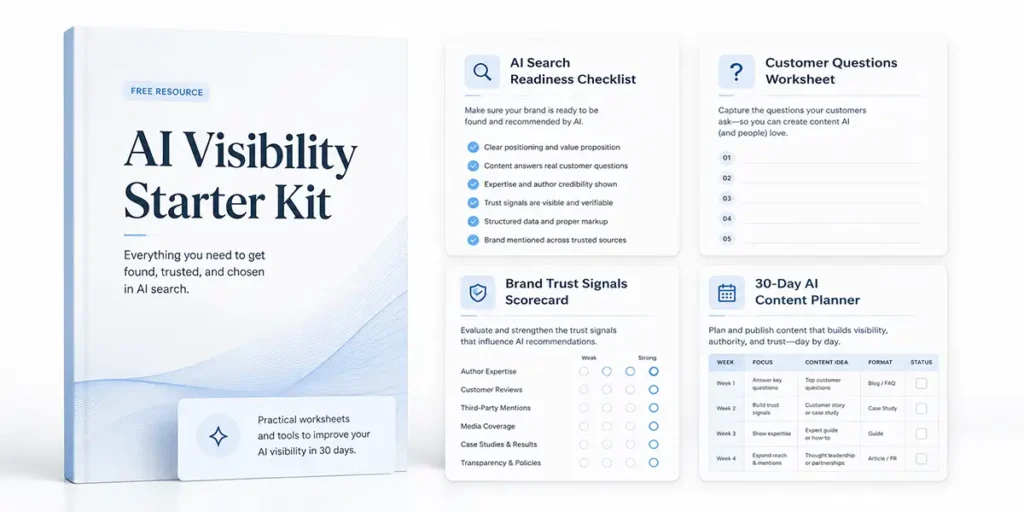
Download the free AI Visibility Starter Kit from Sights.com and start improving your content clarity, customer questions, trust signals, and AI search readiness.