
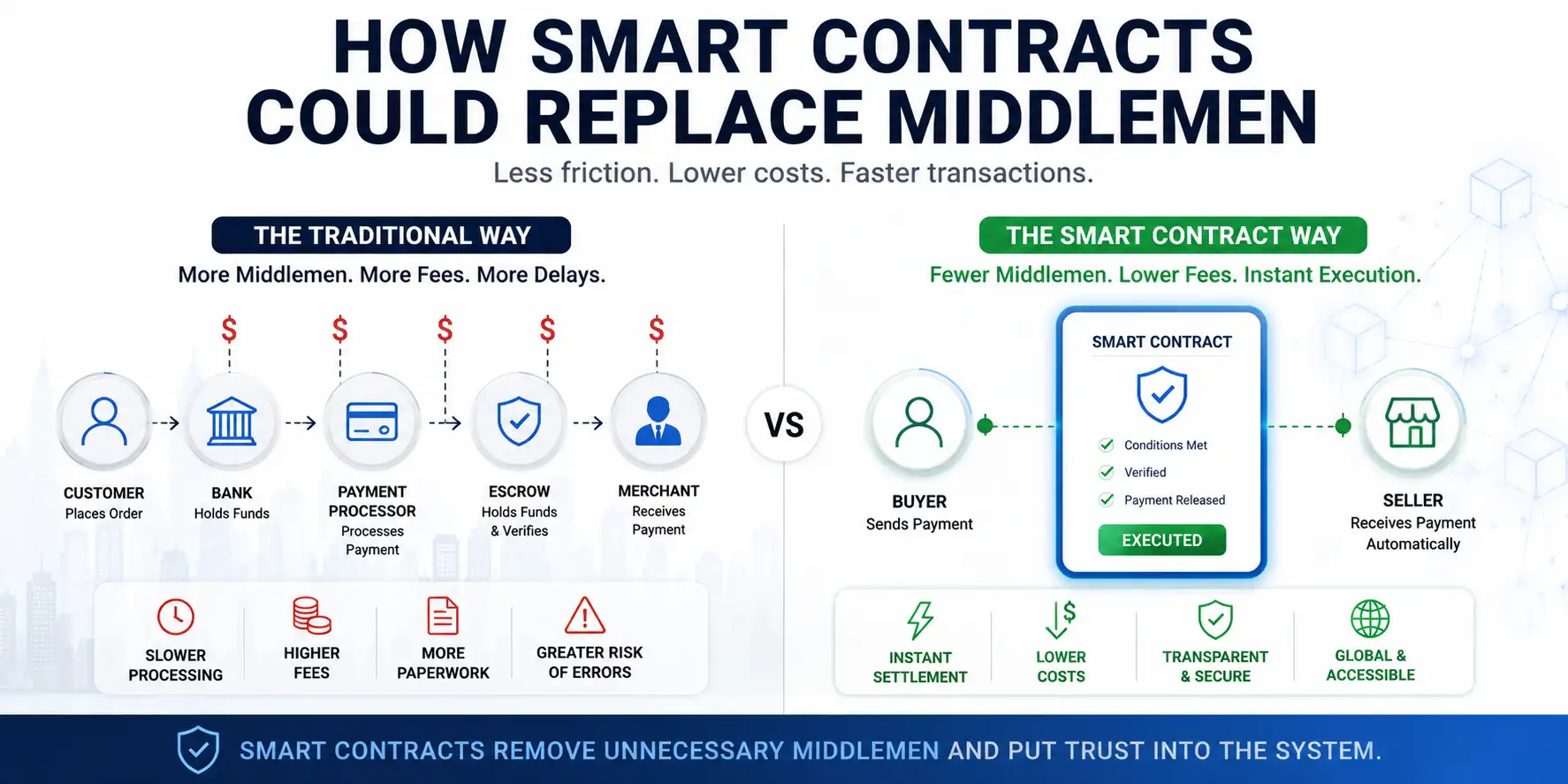
How Smart Contracts Could Replace Middlemen
Throughout history, business has relied on intermediaries. Banks facilitate payments, escrow companies hold funds, brokers connect buyers and sellers, and licensing agencies manage rights and royalties.
These organizations serve an important purpose. They create trust between parties that may not know each other, verify transactions, and reduce risk.
But what happens when technology can provide many of those same functions automatically?
This is one of the most significant ideas behind blockchain technology and smart contracts. Rather than relying on multiple intermediaries to manage transactions, blockchain enables systems that can execute agreements automatically, transparently, and securely.
While smart contracts may not eliminate every middleman, they have the potential to dramatically reduce the number of intermediaries required in many business processes.
Why Middlemen Exist
Before understanding how smart contracts could replace intermediaries, it is important to understand why those intermediaries exist in the first place.
Most middlemen solve a trust problem.
When two parties do not know each other, someone often acts as a trusted third party.
- Banks verify and process payments.
- Escrow services hold funds until conditions are met.
- Property registries maintain ownership records.
- Ticket brokers verify transactions.
- Licensing agencies distribute royalties.
- Payment processors manage financial transfers.
Without these systems, many transactions would be difficult, risky, or impossible.
How Blockchain Changes Trust
One of the most misunderstood aspects of blockchain is the idea that it removes trust.
In reality, blockchain does not eliminate trust—it changes where trust is placed.
Instead of trusting a single institution, participants trust a transparent and verifiable system.
Blockchain records are distributed across a network, making them difficult to alter. Smart contracts execute according to pre-defined rules that are visible to participants.
This creates an environment where transactions can occur with less reliance on traditional intermediaries.
Smart Contracts in Payments
Consider a typical payment transaction today.
A customer purchases a product online. The payment may pass through multiple organizations before reaching the merchant.
- Customer.
- Bank.
- Credit card network.
- Payment processor.
- Merchant bank.
- Merchant.
Each participant adds cost, processing time, and complexity.
With smart contracts, payment conditions can be automated, potentially reducing the number of organizations required to complete the transaction.
Smart Contracts for Freelancers and Consultants
Freelancers often rely on platforms that act as intermediaries between clients and service providers.
These platforms provide trust, dispute resolution, and payment protection.
A smart contract could automate much of this process.
For example:
- The client deposits funds.
- The project milestone is completed.
- The milestone is approved.
- The smart contract automatically releases payment.
The process becomes faster, more transparent, and potentially less expensive.
Smart Contracts and Music Royalties
Royalty distribution is another area where blockchain could have a significant impact.
Today, revenue generated by music often passes through multiple organizations before reaching the artist.
- Streaming platform.
- Distributor.
- Publisher.
- Rights management organization.
- Artist.
Smart contracts could automatically distribute payments according to predefined ownership percentages whenever content is consumed.
This could increase transparency while reducing administrative overhead.
Smart Contracts and Real Estate
Real estate transactions often involve multiple parties and extensive paperwork.
Buyers, sellers, lawyers, escrow companies, lenders, and registries all play important roles.
While real estate will likely continue to require professional oversight, smart contracts could automate many administrative tasks such as:
- Ownership verification.
- Payment processing.
- Document execution.
- Transfer of digital records.
This could significantly improve efficiency while reducing transaction costs.
Will Middlemen Disappear Completely?
Probably not.
Many blockchain enthusiasts once predicted that intermediaries would disappear entirely. Reality is likely to be more nuanced.
Instead of disappearing, many intermediaries may evolve.
- Lawyers may focus on legal strategy rather than paperwork.
- Banks may provide digital asset services.
- Brokers may become advisors rather than transaction processors.
- Auditors may verify blockchain systems.
- Compliance professionals may help navigate regulations.
The role of the intermediary may shift from processing transactions to providing expertise and oversight.
Why Business Owners Should Care
Businesses are constantly searching for ways to operate more efficiently.
Smart contracts offer several potential advantages:
- Lower transaction costs.
- Faster execution.
- Reduced paperwork.
- Greater transparency.
- Improved global accessibility.
- Reduced administrative burden.
Even if full adoption takes years, the long-term direction of automation appears increasingly clear.
The Future of Trust and Commerce
The biggest impact of blockchain may not be cryptocurrency.
Its most important contribution may be the creation of new trust systems that allow people and businesses to transact more efficiently.
Smart contracts represent one of the first major steps toward that future.
As businesses continue to digitize operations, the ability to automate agreements and reduce unnecessary friction could become a significant competitive advantage.
For entrepreneurs, creators, and business leaders, understanding how smart contracts could reshape commerce is no longer just a technology discussion—it is a business discussion.
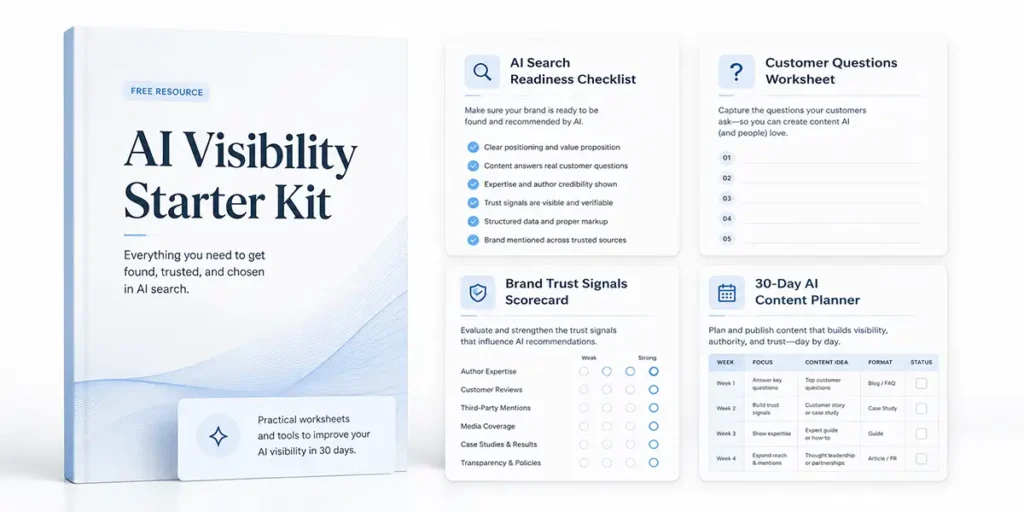
Want to Improve Your AI Visibility?
Download the free AI Visibility Starter Kit from Sights.com and start improving your content clarity, customer questions, trust signals, and AI search readiness.